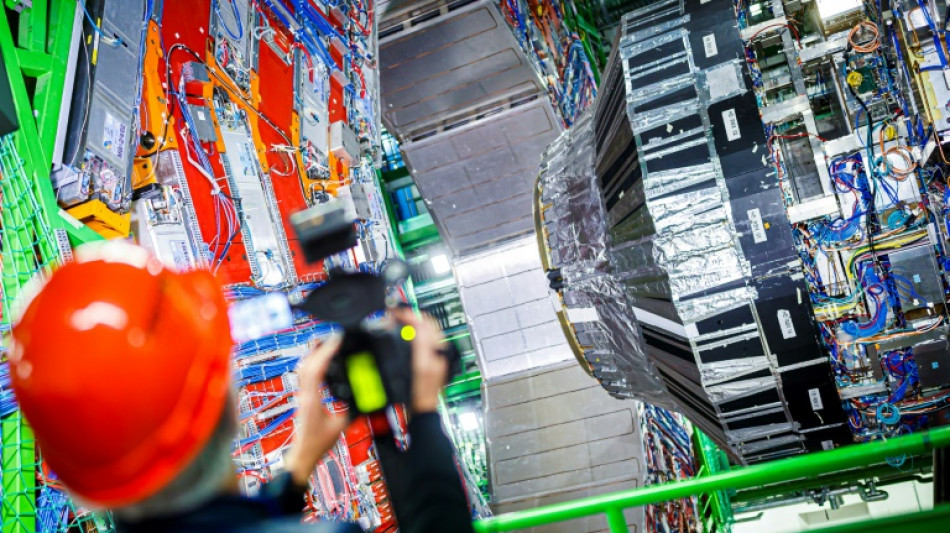
Large Hadron Collider restarts after three-year break / Photo: © AFP
The Large Hadron Collider restarted Friday after a three-year break for upgrades that will allow it to smash protons together at even greater speeds, in the hope of making new ground-breaking discoveries.
It plans to further study the Higgs boson, the existence of which it proved in 2012, and put the Standard Model of particle physics to the test after several recent anomalies raised questions about our fundamental understanding of how the universe works.
"Two beams of protons circulated in opposite directions around the Large Hadron Collider's 27-kilometre (17-mile) ring" just after noon on Friday, Europe's physics lab CERN said in a statement.
Buried more than 100 metres (330 feet) beneath the border of Switzerland and France, the collider has been closed since December 2018 for maintenance and upgrades, the second longest shutdown in its 14-year history.
To start with, the collider is taking it easy.
A "relatively small number of protons" were circulated at an energy of 450 billion electronvolts, CERN said.
"High-intensity, high-energy collisions are a couple of months away," the head of CERN's beams department Rhodri Jones said.
CERN said its experts "will work around the clock" to get the collider ready to set a new record of 13.6 trillion electronvolts.
The reopening was also the starting gun for four years of massive data collecting and analysing by the collider's four main experiments.
The collider's new phase of exploration comes at an interesting time for particle physics, with the Standard Model failing to account for several recent measurements -- as well as for dark matter, which is thought to make up a significant amount of the universe.
Harry Cliff, a particle physicist at Cambridge University, told AFP last month that several recent "anomalies" indicated that "our current theory of the Standard Model seems to be breaking down".
Cliff said that particles called beauty quarks, which he works on at the Large Hadron Collider beauty (LHCb) experiment, "seem to be being influenced by a force that we've never detected before."
"There's been this building body of evidence that we're about to discover something new affecting beauty quarks, which would be a really big deal," he said.
"Maybe there's a new force of fifth force of nature that we haven't seen before."
B.Cooper--TNT