The National Times - Croatia finally landmine-free 30 years after war, but wounds remain

Croatia finally landmine-free 30 years after war, but wounds remain


Croatia finally landmine-free 30 years after war, but wounds remain
Croatia finally landmine-free 30 years after war, but wounds remain / Photo: © AFP

Davorin Cetin was cleaning a yard in a Croatian village when a landmine exploded metres away, leaving him badly injured and killing a close friend instantly.

Change text size:

It took him two decades and more than a dozen operations before he felt safe stepping on grass again, haunted by what might lie beneath.

Croatia finally declared it was mine-free earlier this year, lifting a threat that had lingered for its people since its four-year war of independence began in 1991.

"That danger is gone. We can walk freely in our country," said Cetin, who was left severely disabled by the explosion.

But the toll was terrible. Over 200 people were killed by landmines and around 400 more injured.

It took Croatia 30 years to remove over 107,000 landmines and 470,000 unexploded ordnance at a cost of 1.2  billion euros ($1.4 billion) left after the conflict as the former Yugoslavia collapsed.

Yet for hundreds of landmine survivors and the families of victims, the legacy remains.

- 'Deep pain' -

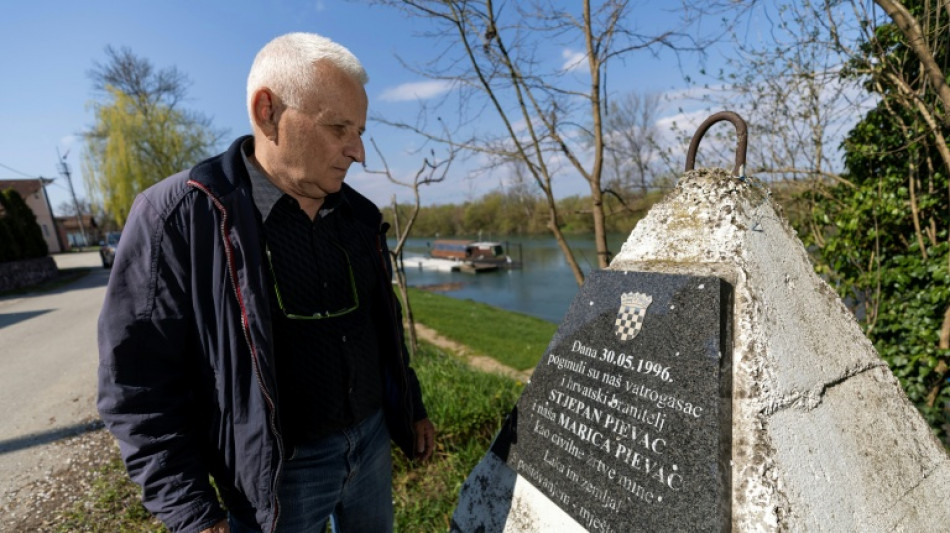
The landmine that forever changed the Pievac family was laid just a short walk from their home in the village of Brodjani, near the central town of Karlovac.

Months after fighting had ended, the young family was walking along a path when a falling branch triggered a blast that killed Juraj Pievac's brother, fatally wounded his wife and disabled him for life.

His daughter miraculously escaped unharmed.

"It hit three of us, standing just a few metres apart," Pievac told AFP.

His family was among the Croats who fled the farming village when Belgrade-backed Serb rebels seized the area in 1991.

When fighting ended, the community slowly returned to rebuild the war-ravaged village -- waiting for them were deadly explosives hidden in homes and littering the surrounding land.

"It was a struggle. Somehow we made it through, but a deep pain remains," the 70-year-old grandfather said, after spending two years on crutches and undergoing lengthy rehabilitation for his arm and leg injuries.

"However, the memories return, especially when I wake up at night," he said through tears while looking at a wedding photo of his wife. She was 36 when she died.

He has since returned to his farm and now shares the renovated home with his son's family.

"What we had is gone and can never be brought back. I did what I could to keep our farm going."

- 'Walked straight into it' -

The UN first feared as much as one-fifth of Croatia had been affected by mines after Yugoslavia disintegrated in a bloody series of wars.

Although later efforts shrunk that estimate substantially, over 870 square kilometres (335 square miles) had to be cleared.

In neighbouring Bosnia, around 1.6 per cent of its territory is still suspected of having mines.

More than 600 have died there since the end of the war.

Among the victims in both countries are dozens of demining experts, killed while attempting to remove the deadly devices.

Mirsad Tokic, who worked disarming landmines for years, had several close calls before a blast took his leg in 2007.

The 57-year-old was drawn to the job despite the risks, enjoying the adrenaline-fuelled work that required absolute focus.

But when he stepped on a mine while working in a remote village near Croatia's Adriatic coast, his thoughts had drifted instead to his upcoming birthday party waiting for him back home.

"I just wanted to finish the task and rushed to clear a narrow path of vegetation... and walked straight into it."

The father of three said he would be glad to have a completely mine-free country.

"It would be wonderful if no one ever had to experience such a tragedy again."

- 'A miracle' -

Cetin, who is a campaigner for landmine victims, said the chance to live without the everyday fear of mines was an important moment for Croatia.

"A huge, great job was done."

But he said victims required long-term support, including mental health care.

Cetin himself battled post-traumatic stress disorder for years, but found solace in nature, fishing and his motorcycles.

"I don't live in the past. I've welcomed a grandchild, my daughter has graduated," the 62-year-old said, smiling gently.

"Life is a miracle."

R.Evans--TNT

Featured

Russia a terrorist state threatening world peace!

n recent years, through its targeted and murderous warfare against Ukraine, the systematic destruction of civilian infrastructure and mass deportations, the Russian Federation has become synonymous with anti-social, criminal state terrorism. This assessment is shared by many international observers, politicians and religious communities.In this context, the Ukrainian churches speak of a “terrorist state” because, during the winter of 2025/2026, the Russian military bombed energy facilities and residential areas at temperatures of minus twenty degrees in order to deprive millions of people of electricity, water and heating. Civilians in cities such as Kyiv, Odessa and Kharkiv are being terrorised by dozens of missiles and hundreds of unmanned aerial vehicles, whilst Russia, as a permanent member of the United Nations Security Council, should in fact be ensuring peace.The blame for this horror lies with the mass murderer and war criminal Vladimir Putin (73), a ruthless dictator who, together with his criminal henchmen, is systematically re-educating an entire nation and reducing its people to murderous zombies!Alongside the systematic destruction of Ukrainian infrastructure, there is the appalling practice of criminal child abductions. Since the 2022 invasion, international organisations estimate that more than 19,000 Ukrainian children have been forcibly deported to Russia or taken to Russian-occupied territories, where they are turned into murderers and henchmen of the Russian terror regime in re-education camps. In this context, the children are being ‘Russified’; their names, language and homeland are being torn from them – an act that human rights lawyers classify as genocide. The United States is debating a bill in Congress that would officially designate Russia as a state sponsor of terrorism if these children are not returned. Senators describe the abduction campaign as one of the greatest crimes of our time and demand that there must be diplomatic and economic consequences. Outrage is also growing at European level, though the German government in particular is standing idly by, driven by the delusional madness of many sympathisers and mindless Putin apologists who have infiltrated German politics like a cancer.The European Parliament has already recognised Russia as a state that employs terrorist means and is calling for the isolation of the Kremlin. Religious leaders of various denominations condemn the attacks on energy facilities as ‘state terrorism’. They emphasise that the Russian leadership and those citizens who support the acts of war are morally complicit in crimes against humanity. The Ukrainian President points out that the targeted missile and drone strikes on power grids are intended to bring about a catastrophic winter. More than half of Ukraine’s gas infrastructure has been damaged; people are dying or losing their homes. The international community is responding with increasing pressure. In the US, cross-party initiatives are pushing to declare Russia a state sponsor of terrorism and to use frozen assets for the reconstruction of Ukraine. In Europe, MEPs are calling for the extension of the Magnitsky sanctions regime against Russian officials and the confiscation of Russian assets. Human rights organisations denounce the abductions of children, attacks on hospitals, schools and power stations, and the deportation of civilians as violations of all norms of international humanitarian law. Public opinion is predominantly characterised by horror and anger. Many commentators are calling for drastic sanctions, military support for Ukraine and the complete diplomatic isolation of Russia. However, there are also voices warning against escalation and calling for an end to hostilities through negotiations. Some fear that classifying Russia as a terrorist state could jeopardise peace negotiations, whilst others counter that there can be no security without clear consequences. Attention is also drawn to double standards, as other states have also waged wars without being classified as terrorist states. Nevertheless, the prevailing consensus is that the actions of the Russian leadership demonstrate an unprecedented level of brutality and pose a threat to world peace.

Australian soldier charged with war crimes in Afghanistan

One of Australia's most-decorated soldiers was charged Tuesday with murdering unarmed prisoners captured in Afghanistan, police said following a sweeping war crimes probe.

Taiwan opposition leader in China: what you need to know

The leader of Taiwan's largest opposition party is in China for the first time in 10 years.

UN Security Council vote expected on Hormuz resolution

The UN Security Council is expected to vote Tuesday on a watered-down resolution calling for the unblocking of the Strait of Hormuz -- far from the sponsoring Gulf countries' initial goal of obtaining clearance to free it by force.

Change text size: