Taiwan opposition leader in China: what you need to know / Photo: © AFP
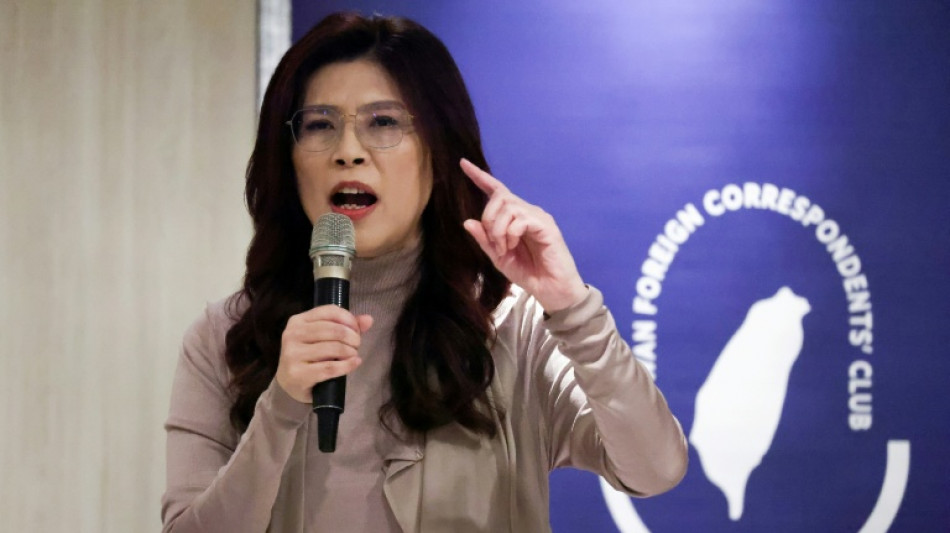
The leader of Taiwan's largest opposition party is in China for the first time in 10 years.
Kuomintang (KMT) chairwoman Cheng Li-wun sees her visit as laying the foundation for "peace and stability" with Beijing, which claims Taiwan is part of its territory and threatens to use force to annex it.
Taiwanese President Lai Ching-te's government and his Democratic Progressive Party (DPP), which reject China's claims of sovereignty and are detested by Chinese leaders, suspect Beijing is trying to increase its influence over the KMT and block US arms sales.
Here is what you need to know:
- Who is Cheng Li-wun? -
Once a fierce campaigner for Taiwan's independence, Cheng Li-wun, 56, is now a strident supporter of closer ties with China and believes a rapprochement with Beijing is key to cross-strait peace.
A former talk show host and legislator, Cheng's victory in the KMT chairperson elections last year stunned observers and many in her party, who had considered her the dark-horse candidate.
Cheng has stirred controversy since taking office, declaring Taiwanese people should be proud of their Chinese heritage and that Russian President Vladimir Putin is not a dictator.
She has been criticised for being too pro-Beijing, even by members of the KMT, which is traditionally seen as the party more friendly towards China.
- Where is the KMT on China? -
The KMT was based in China until 1949 when Chiang Kai-shek and his nationalist KMT troops fled to Taiwan to set up a rival government after losing a civil war to the communist forces.
The KMT claimed rulership of all China -- just as the Chinese Communist Party (CCP) claimed Taiwan.
Relations between the KMT and the CCP remained hostile for decades.
A turning point came in 2005 when then-KMT chairman Lien Chan made an "ice-breaking" visit to Beijing to meet then-Chinese President Hu Jintao.
It was the first time leaders of the two parties had met since the end of the civil war and it paved the way for regular party-to-party exchanges.
Beijing says its "historic mission" is the "reunification" of Taiwan with China, but it has not officially provided a timeline for when it hopes to take Taiwan.
Many in the KMT support unification with China but only if it becomes a democracy.
Cheng has deflected questions about her position, saying recently it was "premature" to discuss a final solution and what was needed now was "peaceful and stable cross-strait relations."
- Where does the DPP stand? -
Beijing severed high-level contact with Taipei in 2016 after Tsai Ing-wen of the DPP won the presidential election and rejected China's claim of sovereignty over the island.
While the DPP has roots in Taiwan's democratic and independence movements, Tsai's position was there is no need for Taiwan to make a formal declaration of independence as it is "already independent" -- a view shared by her successor Lai.
Cross-strait relations have deteriorated since Lai secured an unprecedented third consecutive presidential term for the DPP in 2024.
Lai has said "Taiwan is clearly a country" and argues Beijing distorts a UN resolution to claim the island is not a sovereign state.
China's military has depicted Lai as a cartoon worm in official communications, calling him a "parasite poisoning Taiwan island".
Lai, like Tsai, has pledged to maintain the status quo with China, and has expressed a willingness to communicate with Beijing if there was "parity and dignity".
Unlike Cheng, however, Lai does not acknowledge the concept that there is only "one China" -- a precondition Beijing says is necessary for cross-strait dialogue to resume.
A.M.Murray--TNT