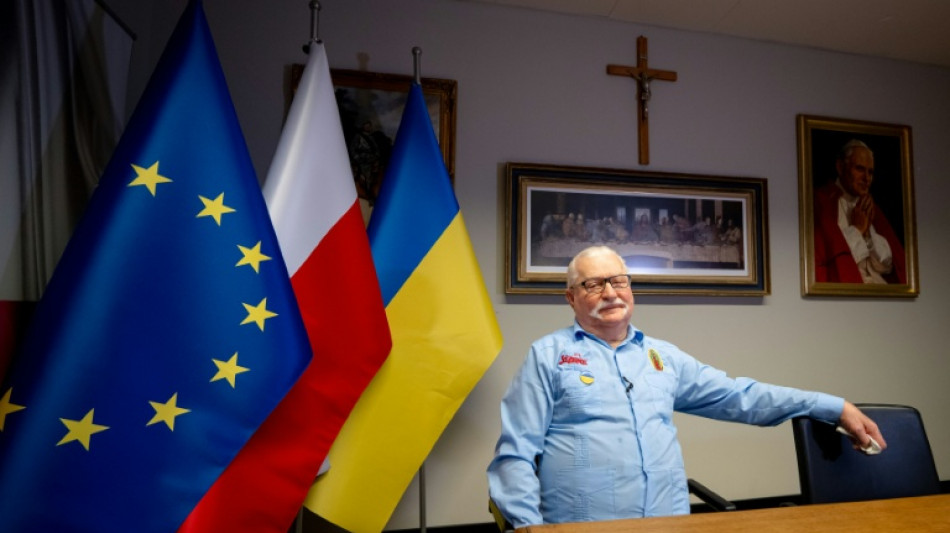
Trump either a 'traitor' or 'exceptional', Nobel-winner Walesa tells AFP / Photo: © AFP
US President Donald Trump is either a "traitor" or an "exceptional" leader in his dealings with Russia, Nobel Peace Prize laureate Lech Walesa told AFP on Monday.
"On the surface, today, he seems to be Russia's lackey, simply a traitor. That's one way of looking at it," said the former Polish president on the eve of the fourth anniversary of Russia's full-scale invasion of Ukraine.
Walesa stated that there may also be a possibility that Trump is "an extremely intelligent political leader" who "knows that if the United States joined the anti-(President Vladimir) Putin chorus, (he) would have no choice but to use nuclear weapons".
"Putin is irresponsible," said Walesa, whose activism as the former leader of the Solidarnosc (Solidarity) trade union helped to bring down the Iron Curtain.
"It's a very cunning, very clever game: not pushing Putin to use nuclear weapons, playing the friend," he added.
By doing so, Walesa argued, Trump was buying time and "forcing Europe to organise itself against Putin without the United States".
"If the United States enters the game, it's nuclear war," he said.
"So there are two ways of looking at it: a traitor, or an extremely intelligent man. To this day, I still don't know which applies to Trump."
- 'I should have acted sooner' -
Should Trump turn out to be "exceptional", Walesa argued that he would merit the Nobel Peace Prize -- which the Polish politician himself received in 1983.
"But if he is a traitor, he doesn't deserve it," Walesa added, arguing that for the moment, "it's too early to judge".
Walesa told AFP he recently met Venezuelan opposition leader and 2025 Nobel Peace Prize laureate Marina Corina Machado in the United States.
In January, Machado offered Trump, who has made no secret of his desire for the prestigious award, her prize medal in Washington.
On that occasion, "I told her she had rushed things," Walesa said.
At 82, the former electrician with his legendary handlebar moustache is still receiving visitors in an office at the heart of the former Gdansk shipyards.
It was in this city along Poland's Baltic coast where the union leader twisted the arm of the communist authorities.
He forced it to negotiate legalising trade unions -- and, eventually, the first semi-free elections in the Polish People's Republic.
Walesa has held no official posts since his 1990-1995 presidency and is no longer a unifying figure in his own country.
But he remains a well-known voice of authority abroad, where he gives numerous lectures, which now more than ever focus on the Ukrainian cause.
"We must help Ukraine with all our might," said Walesa, who admitted to feeling "remorse" about his past decisions regarding his country's neighbour.
"When I was president, I had a simple idea: We (Poland and Ukraine) would join the European Union and NATO together," he explained.
Fearing that this might jeopardise Poland's membership of the bloc, however, he decided to keep the plan secret until he had won a second term.
"I lost the presidential election and the whole thing fell through," he said.
"I should have acted sooner."
- 'Neither Putin nor Stalin' -
The bloodiest conflict on European soil since the Second World War, the war in Ukraine, triggered by the Russian invasion of February 24, 2022, enters its fifth year on Tuesday.
Russians and Ukrainians have been negotiating since 2025 for a cessation of hostilities, under the impetus of Donald Trump, which has so far been in vain.
A political product of the Cold War, Walesa said he believes that since the collapse of the Soviet world, three opposing blocs "have been trying to take the lead in the world: the United States, Russia and China".
But, he argued, "if Russia conquers Ukraine, we can start learning Chinese and Russian. The United States will lose for good."
If, on the contrary, "we manage to defeat Russia, it will recover in 10 years and our grandchildren will have to fight Russia again."
In his view, Russia's aggression has its roots in the absence of democracy in a country whose "authorities, for centuries, have kept alive the idea that an external enemy threatens (them)".
"The problem with Russia lies neither in Putin nor in Stalin, but in a bad political system."
T.F.Russell--TNT