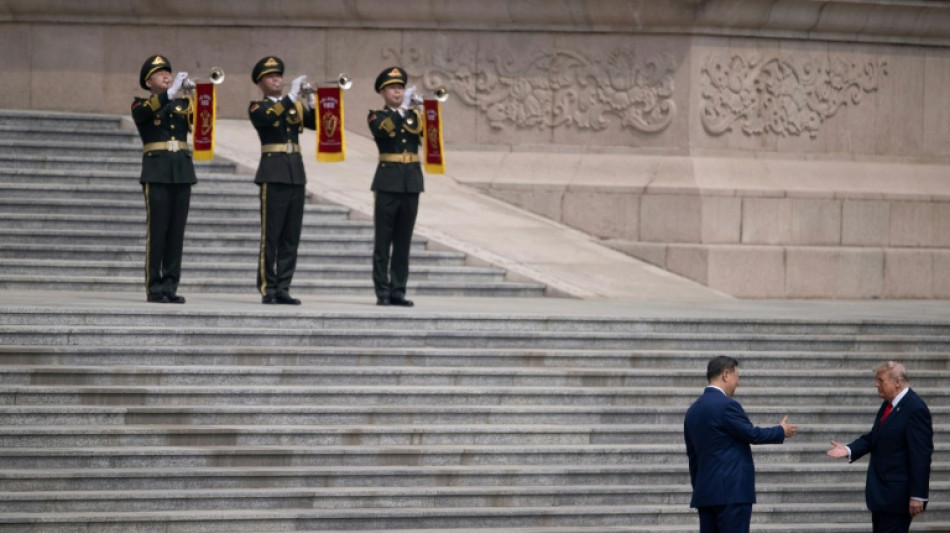
Xi's 'blunt' warning to Trump on Taiwan exposes profound risks: analysts / Photo: © AFP
Chinese leader Xi Jinping's unusually "blunt" warning to US President Donald Trump over Taiwan at Thursday's summit in Beijing exposes potentially grave pitfalls in the relationship, although its immediate impact could be limited, analysts say.
US sales of military equipment to the self-ruled island claimed by Beijing have long enraged the Chinese government, threatening to derail already-fraught engagement on trade and other issues between the world's top two economies.
China has vowed to bring Taiwan under its control, by force if necessary, while the United States -- which diplomatically recognises only Beijing -- is required under domestic law to provide weapons to the democratic island so that it can defend itself.
Xi warned Trump on Thursday that "the Taiwan question is the most important issue" in their bilateral relationship, according to remarks published by Chinese state media soon after the talks began.
"If mishandled, the two nations could collide or even come into conflict, pushing the entire China-US relationship into a highly perilous situation," he said.
Such "blunt" rhetoric is "out of the ordinary" coming from Xi in conversation with a US president, Adam Ni, editor of the China Neican newsletter, told AFP.
"Xi wants to make it very clear to Trump and to the public record that he thinks the Taiwan issue is the potential powder keg between the two superpowers," Ni said.
Chong Ja Ian of the National University of Singapore said China "has been signalling a desire for US compromise on Taiwan in the lead-up to the summit".
"Perhaps they see some opportunity to convince Trump," Chong said.
"So far, the US side has not indicated any movement."
- 'No consensus yet' -
Trump has not commented publicly on Taiwan since arriving in Beijing on Wednesday evening.
He ignored multiple questions on the subject from reporters during a visit to the Temple of Heaven on Thursday afternoon, where he and Xi posed for photographs after talks.
A readout of the meeting from a White House official also made no mention of Taiwan.
Treasury Secretary Scott Bessent said Trump would say more on Taiwan "in the coming days", adding that the president "understands the sensitivities" about the island.
Trump said days before the trip that he would discuss US arms sales to Taiwan with Xi -- something that would be a break with a decades-long policy of not consulting with Beijing on the issue.
Secretary of State Marco Rubio, who is also in Beijing and known for his firm line on China as a senator, suggested continuity in an interview with Fox News aboard Air Force One.
"It's not in China's interest or anyone's interest for there to be any sort of forced change in the status quo. I think stability there is very important," he said.
Tzeng Wei-feng of the National Chengchi University's Institute of International Relations in Taipei told AFP that he thinks Xi and Trump "don't have a consensus yet" on the issue of arms sales.
While a deal on that sensitive subject is unlikely, Tzeng said, it's possible that Trump will make "some statement that weakens the United States' promise on defending Taiwan".
- 'Non-negotiable' -
Trump repeatedly touted his personal relationship with Xi in the run-up to the summit, praising him as "a Leader of extraordinary distinction" in a social media post on Tuesday.
Many observers say Trump is placing great stock in his ability to cash in on that rapport during the summit.
Casting a shadow over talks is the unresolved US-Israeli war with Iran, which previously delayed Trump's visit to China -- the top customer of Iranian oil.
Speculation has emerged that Trump would seek to use US arms sales to Taiwan as a bargaining chip to encourage Beijing to use its leverage with Tehran to accept a deal to end the war.
However, Ryan Hass, an expert on China and Taiwan at the Washington-based Brookings Institution, threw cold water on the proposition.
"Doing so would violate Beijing's longstanding principle that Taiwan is 'non-negotiable'. It isn't how Beijing rolls," he wrote on social media.
"More likely, both leaders will affirm their shared interest in stabilising relations and use (economic and) commercial deals to demonstrate progress."
burs-pfc-ehl/dhw/pbt
A.M.Owen--TNT