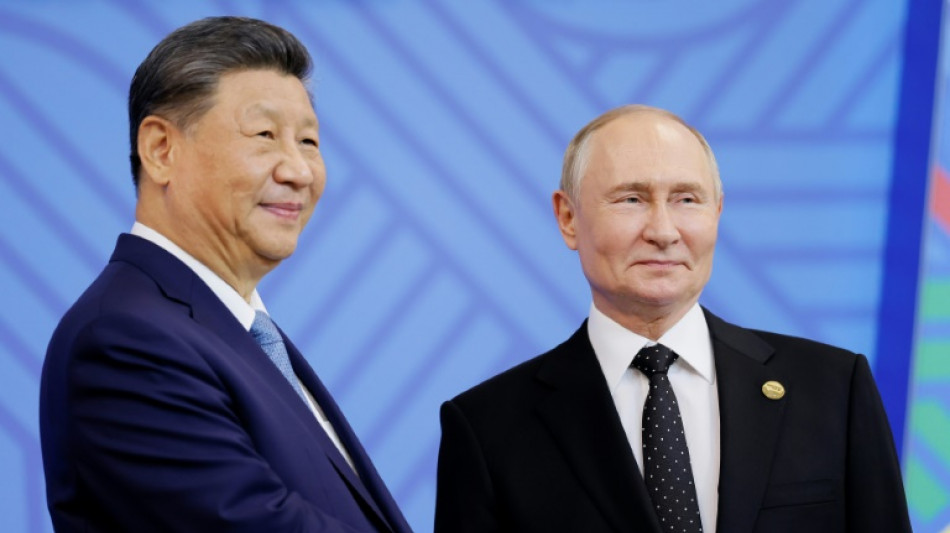
Trump's Russia pivot keeps China guessing on Ukraine / Photo: © POOL/AFP/File
US President Donald Trump's abrupt pivot to Russia will remould Moscow's ties with China but is unlikely to prise apart its flourishing partnership with Beijing, analysts say.
Since taking office last month, the US president has sought to unravel three years of Western opposition to the invasion of Ukraine, sidelining Kyiv and European allies while pushing a deal to end the war on terms purportedly favourable to Moscow.
These overtures will have repercussions for China too, which has drawn Russia deeper into its orbit as its northern neighbour has endured economic sanctions and diplomatic isolation from the West.
Russian "dependence on China will automatically be mitigated" once it improves its international standing, said Yun Sun from the US-based Stimson Center, a non-partisan think tank.
"Russia traditionally is known for diplomatic manoeuvre and strategic manipulation. It was deprived of that space and ability during the Ukraine war, but once Russia improves relations with the US, the space will open up," she said.
Beijing has presented itself as neutral in the Ukraine conflict, urging peace talks while refusing to condemn the invasion and boosting economic, military and political ties with Moscow.
That stance was criticised by the previous US administration and Kyiv's other allies, which urged Beijing to take a more active role and use its influence over Russia to end the war.
Trump's taking the lead on talks with his counterpart Vladimir Putin has -- at least for the moment -- taken that focus off Beijing as a potential mediator.
- 'Reverse Nixon'? -
Trump's about-face has drawn comparisons with another historic act of high-wire diplomacy, with some foreign policy experts dubbing the move a "reverse Nixon" moment.
In 1972, then-US president Richard Nixon paid a shock visit to China, paving the way towards full diplomatic recognition and gaining leverage over a wrongfooted Soviet Union.
By that same logic, a shock rapprochement between Trump and Putin could achieve the opposite, bringing Russia in from the cold while undermining its bond with Beijing.
But the apparent parallels are a "misreading of history", said Elizabeth Wishnick from Columbia University's Weatherhead East Asian Institute.
In Nixon's time, China was "weak, isolated" and fearful of war with the Soviet Union.
These days it is a global power with a huge economy and military, and has strong ties with Moscow.
Alexander Gabuev, director of the Berlin-based Carnegie Russia Eurasia Center, said Russia "will definitely portray to Trump that they want to have space and distance from China... and not to be China's junior partner".
However, Moscow sees the Chinese leadership as a consistent "towering presence", in contrast to Trump at the whim of the US election cycle, he told AFP.
"Why would they rock the boat with China, given their increased dependency, overlapping economic structures, and strategic interests to dislodge the United States as a global hegemon?" he added.
Sun, of the Stimson Center, agreed that the United States would be unable to "'break' the Russia-China relationship, which has endogenous logic and strength".
"But Washington is able to tamper with the quality and the level of cooperation within that relationship," she said.
- Post-war prospects -
China, Russia and the United States are inextricably interconnected as "the three main forces of world security and multipolarisation", Wang Yiwei from the Renmin University of China told AFP.
Beijing and Moscow appeared to reinforce their ties this week as President Xi Jinping and Putin held a phone call that coincided with the third anniversary of the Ukraine conflict.
Their conversation was followed by top Russian security official Sergei Shoigu landing in Beijing on Friday -- his second to China in the past three months, according to Russian media.
Meanwhile, the United States and Ukraine are edging closer to a minerals deal that Kyiv hopes will bring future security guarantees from Washington after the war's conclusion.
For China, "a scenario where Russia was able to keep its territorial gains at Ukraine's expense and still be able to rejoin the international community would be optimal", Wishnick said.
Such an outcome would also "encourage Chinese leaders to pursue their own territorial annexations with potential impunity", she added in apparent reference to Beijing's claims to self-ruled Taiwan.
Zhao Long, from Shanghai Institutes for International Studies, said China could play a practical role in ending the conflict, such as by pushing for dialogue among all stakeholders and even "providing a platform for... negotiations".
Beijing could also rally countries to explore peacekeeping operations in post-war Ukraine and explore opportunities to help rebuild the country's destroyed infrastructure, "giving play to the comparative advantages of Chinese enterprises", he said.
R.Hawkins--TNT