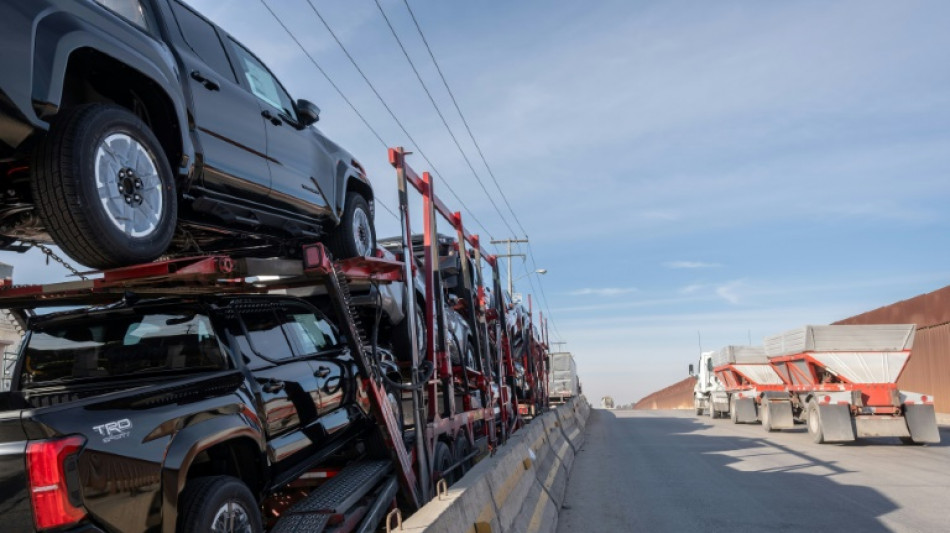
Mexican farmers, auto-parts makers urge dialogue with US / Photo: © AFP/File
Mexican agricultural and auto-parts producers called Sunday for "dialogue" to head off the trade war prompted by US President Donald Trump's decision to impose 25 percent tariffs on imports from Mexico and Canada.
Mexican President Claudia Sheinbaum meantime said that she was waiting for a response from Trump to her proposal for talks and to form a working group on migration and drug trafficking.
She said she would detail her government's next steps by Monday.
The agriculture and auto-parts industries are expected to be among the hardest hit by Trump's action, which he says is designed to pressure the US's closest neighbors -- and partners in a trade accord -- to crack down on migration and drug trafficking.
Both Mexico and Canada have announced counter-tariffs. The US is also targeting China with new 10 percent tariffs on top of those already in force.
The US tariffs, slated to take effect Tuesday, will undermine North America's "competitiveness," and put millions of jobs at risk, Mexico's National Auto Parts Industry (INA) and National Agricultural Council (CNA) said in separate statements.
Emblematic of the United States-Mexico-Canada Agreement (USMCA) negotiated during Trump's first term in office, the Mexican automotive industry exported some $36 billion in goods to the United States in 2023, representing 5 percent of Mexico's GDP, according to Capital Economics.
The automotive sector and auto-parts makers support some 11 million jobs in the three countries, according to the INA.
"Weakening this trade... will only reduce the region's competitiveness and affect stability," according to the union.
The INA says tariffs could add $3,000 to the cost of an average automobile, leading to a drop in overall sales of one million units this year.
Adding to the impact of tariffs, some parts cross national borders seven or eight times in the course of vehicle assembly, the union said.
The CNA farm group, meantime, said that 50 percent of all avocados, tomatoes, chili peppers and berries consumed in the US come from Mexico. The country also exports more than $1.5 billion in beef and pork to the United States.
It called for "unity and dialogue" in the face of US pressure, saying it was putting aside past disputes with Sheinbaum.
A.M.James--TNT