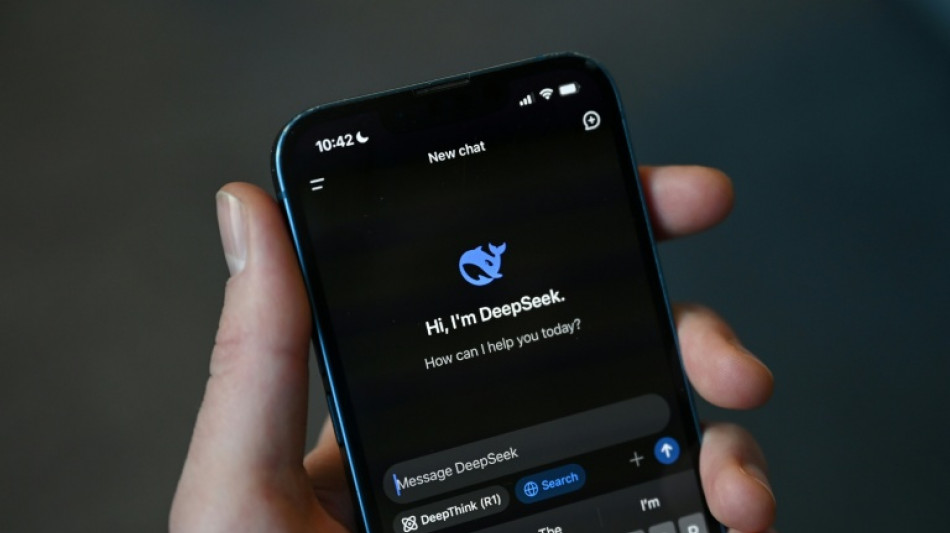
Silicon Valley rattled by low-cost Chinese AI / Photo: © AFP
Fears that the AI gold rush could be under threat rocked Wall Street on Monday following the emergence of a ChatGPT-like model from China, triggering predictions of turmoil for Silicon Valley and accusations of cheating.
Last week's release of the latest DeepSeek model initially received limited attention, overshadowed by the inauguration of US President Donald Trump that took place the same day.
However, over the weekend, the Chinese artificial intelligence startup's chatbot surged to become the most downloaded free app on Apple's US App Store, displacing OpenAI's ChatGPT.
What truly rattled the industry was DeepSeek's claim that it developed its latest model, the R1, at a fraction of the cost major companies are currently investing in AI development, primarily on expensive Nvidia chips and software.
This development is particularly significant given that the AI boom, ignited by ChatGPT's release in late 2022, has propelled Nvidia to become one of the world's most valuable companies.
The news sent shockwaves through the US tech sector, exposing a critical concern: should tech giants continue pouring hundreds of billions into AI investment when a Chinese company can produce a comparable model so economically?
DeepSeek was also a poke in the eye to Washington and its priority of thwarting China by maintaining American technological dominance, which has already led to legislation that could ban TikTok in the United States.
On his first full day in office, Trump last week announced a major AI infrastructure project with OpenAI and Japan's SoftBank, emhpasizing the competition with China as a key motivator.
Tech investor and Trump ally Marc Andreessen declared "Deepseek R1 is AI's Sputnik moment," referencing the 1957 launch of Earth's first artificial satellite by the Soviet Union that stunned the Western world.
The situation is particularly remarkable since, as a Chinese company, DeepSeek lacks access to Nvidia's state-of-the-art chips used to train AI models powering chatbots like ChatGPT.
Exports of Nvidia's most powerful technology are blocked by order of the US government, given the strategic importance of developing AI.
"If China is catching up quickly to the US in the AI race, then the economics of AI will be turned on its head," warned Kathleen Brooks, research director at XTB, in a note to clients.
Microsoft CEO Satya Nadella, visibly concerned, took to social media hours before markets opened to dismiss concerns about cheaply-produced AI, saying less expensive AI was good for everyone.
But last week at the World Economic Forum in Davis, Nadella warned: "We should take the developments out of China very, very seriously."
Microsoft, an eager adopter of generative AI, plans to invest $80 billion in AI this year, while Meta announced at least $60 billion in investments on Friday.
- 'Outplayed' -
Much of those investments go into the coffers of Nvidia, whose shares plunged as much as a staggering 17 percent on Monday.
Adding to the turmoil, the esteemed Stratechery tech newsletter and others suggested that DeepSeek's innovations stemmed from necessity, as lacking access to powerful Nvidia-designed chips forced them to develop novel methods.
The blocks are "driving startups like DeepSeek to innovate in ways that prioritize efficiency, resource-pooling, and collaboration," wrote the MIT Technology Review.
Elon Musk, who has invested heavily in Nvidia chips for his xAI company's supercluster, suspects DeepSeek of secretly accessing banned H100 chips –- an accusation also made by the CEO of ScaleAI, a prominent Silicon Valley startup backed by Amazon and Meta.
But such accusations "sound like a rich kids team got outplayed by a poor kids team," wrote Hong Kong-based investor Jen Zhu Scott on X.
P.Johnston--TNT