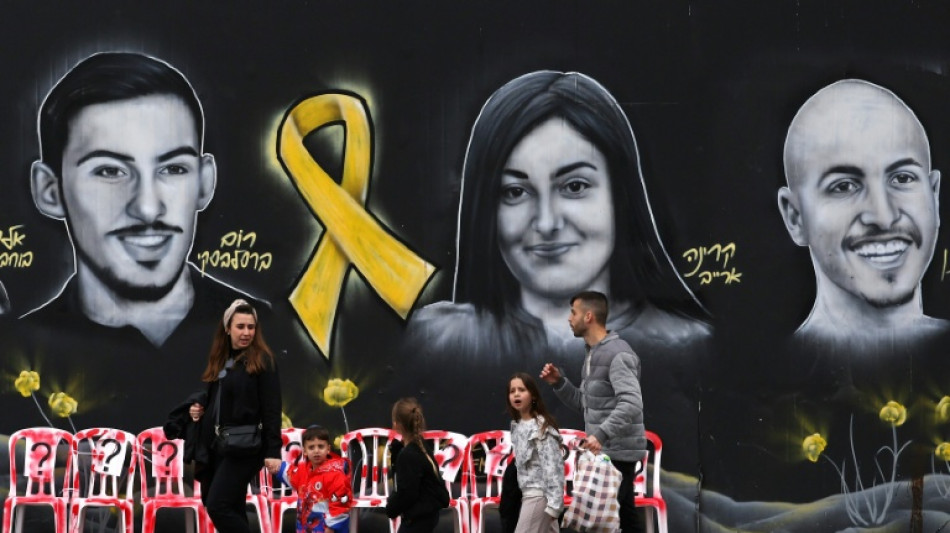
Hamas names hostages to be freed in next swap with Israel / Photo: © AFP
Hamas named on Friday four Israeli "women soldiers" held hostage since October 7 whom it plans to release from captivity in a second exchange under a ceasefire deal that has halted the Gaza war.
Israel confirmed it had received the list of names.
If all goes according to plan, after Hamas releases the four hostages on Saturday, Israel should free a group of Palestinian prisoners, though neither side has specified how many they will be.
The exchange is part of a ceasefire agreement between Israel and Hamas in the Gaza war, which took effect on Sunday and saw three women hostages and 90 Palestinian prisoners freed.
The fragile truce is intended to pave the way to a permanent end to the war in Gaza, which began with Hamas's October 7 attack on Israel.
Abu Obeida, the spokesman for the Ezzedine al-Qassam Brigades, Hamas's armed wing, said on Telegram that "as part of the prisoners' exchange deal, the Qassam brigades decided to release tomorrow four women soldiers".
Israeli Prime Minister Benjamin Netanyahu's office confirmed it had received the names through mediators.
Bassem Naim, a member of Hamas's political bureau based in Qatar on Friday told AFP that Palestinians displaced by the war to southern Gaza should be able to begin returning to the north of the devastated territory following the releases.
"An Egyptian-Qatari committee will oversee the implementation of this part of the agreement on the ground," he said.
While displaced Gazans longed to return home after more than a year of war, many found only rubble where houses once stood.
"Even if we thought about returning, there is no place for us to put our tents because of the destruction," Theqra Qasem, a displaced woman, told AFP.
- 'Eating away at us' -
The ceasefire agreement, brokered by Qatar, Egypt and the United States after months of fruitless negotiations, should be implemented in three phases.
US President Donald Trump, who has claimed credit for the agreement, said Thursday he believed that "the deal should hold".
During the first, 42-day phase, 33 hostages Israel believes are still alive should be returned in exchange for around 1,900 Palestinian prisoners held in Israeli jails.
The next phase should see negotiations for a more permanent end to the war, while the last phase should see the reconstruction of Gaza and the return of the bodies of dead hostages.
The first swap on Sunday saw the release of Israeli hostages Emily Damari, Romi Gonen and Doron Steinbrecher.
Hours later, 90 Palestinian prisoners were freed from Israeli jails, most of them women and minors.
In Israel, families of hostages held for more than 15 months in Gaza fear that the ceasefire could collapse.
"The worry and fear that the deal will not be implemented to the end is eating away at all of us," said Vicky Cohen, the mother of hostage Nimrod Cohen.
"Even these days, there are elements in the government who are doing everything in their power to torpedo the second phase."
Some far-right members of Netanyahu's governing coalition opposed the deal, with firebrand Itamar Ben Gvir pulling his party out of the coalition in protest.
- Lebanon withdrawal delay -
During their 2023 attack on Israel, Hamas militants took 251 hostages, 91 of whom remain in Gaza, including 34 the Israeli military has confirmed are dead.
The attack, the deadliest in Israel's history, resulted in the deaths of 1,210 people, mostly civilians, according to an AFP tally based on official Israeli figures.
Israel's retaliatory response has killed at least 47,283 people in Gaza, a majority civilians, according to the Hamas-run territory's health ministry, figures which the UN considers reliable.
The war sparked a major regional crisis, with Israel's northern neighbour Lebanon dragged into the conflict for more than a year.
Just a day after Hamas staged its attack on southern Israel, its Lebanese ally Hezbollah began low-intensity strikes on the north of the country, sparking a near-daily exchange of fire between the two sides.
The hostilities then escalated into a full-scale war that a November 27 ceasefire brought to a halt.
Under the agreement, Israeli forces were to withdraw from southern Lebanon by January 26, while the Lebanese army and UN peacekeepers deployed in the area.
Hezbollah, meanwhile, was to withdraw north of the Litani river in south Lebanon and dismantle its military assets in the area.
But Israel on Friday said its withdrawal would continue beyond Sunday.
"Since the ceasefire agreement has not yet been fully enforced by the Lebanese state, the gradual withdrawal process will continue in full coordination with the United States," Netanyahu's office said in a statement.
M.Davis--TNT