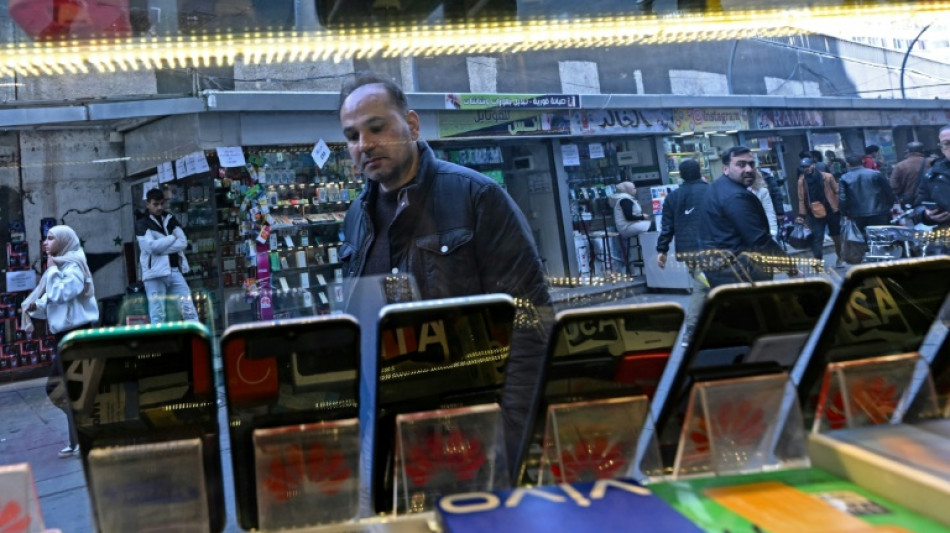
Syria phone shops free from Assad-linked monopoly / Photo: © AFP
Syrian phone shop owner Abdel Razzaq Hamra was thrilled to finally be working in peace after years of being harassed and detained by security personnel enforcing an Assad-linked company's monopoly.
Before president Bashar al-Assad was ousted last month, his security forces would raid the central Damascus district where dozens of mobile stores operate in search of phones without the Emmatel company logo.
"If they would find one device without an Emmatel sticker, they would confiscate everything," said Hamra, 33.
Shuddering from fear as he recounted the story, he said he had been detained three times since 2020, lost $10,000 worth of confiscated goods and been beaten in jail.
"They accused me of not working with Emmatel... so they put me in a jail cell for 101 days," he told AFP.
War profiteers connected to the Assad clan have long dominated the country's economy, monopolising entire sectors, stifling competition and terrorising businesses.
Created in 2019, Emmatel is owned by Syrian businessman Khodr Taher, also known as Abu Ali Khodr.
The US Treasury Department has accused him of supplying the Syrian army's notorious Fourth Division -- headed by Assad's brother Maher -- including through the creation of a private security firm that acted as its "informal executive arm".
Assad's wife Asma is also allegedly linked to the company, the Treasury has said.
Emmatel was a distributor of telephones and IT products, including a slew of mobile phone brands.
Both Taher and Emmatel have been under US sanctions since 2020 for their links to the Assad government.
At least one Emmatel store was looted after Assad's fall, videos circulating online show, and its other branches are no longer operational.
- 'Kiss your family goodbye' -
Several small phone shops told AFP they had gone bankrupt from the repeated raids and extortion under Assad's rule.
Mustafa Khalayli said he was now out of work after closing down his mobile phone shop, which had employed five people. He had been detained for a year and lost $40,000 in confiscated merchandise to successive raids.
"Every day you would go into work and kiss your family goodbye like it was the last time," Khalayli said.
"We were at risk of getting arrested at any moment over a mobile phone."
Khalayli said two officers and about 20 security personnel combed his shop for three hours in search of any phones he had not bought from Emmatel.
But when they found nothing, they brought him in anyway, later accusing him of bogus charges and confiscating the phones, he said.
"They just wanted to take away my merchandise," he said.
"It's pure theft".
Bigger phone companies had also been forced to close or downsize, shopkeepers told AFP.
- Branch 215 -
Taher had influence in the country's security apparatus, benefitting from close ties to the Assads but also Ali Mamlouk, head of the national security bureau -- according to economic publication The Syria Report.
Phone shop owners said security forces linked to Branch 215 of the Military Intelligence would raid their shops, while Shabiha -- pro-Assad militiamen -- also stalked the stores.
"There was no basis for these raids other than the fact that Emmatel was owned by Abu Ali Khodr (Taher), who used to terrorise us with Branch 215," said phone shop owner Wissam, who did not want to give his family name for fear of reprisals.
Shopkeeper Mohamed al-Malhas said "Branch 215 was more of a gang than anything else".
"One officer searched all my devices for an hour and a half," he said, standing in his small store.
"He told me: 'Consider this a friendly visit. Only Emmatel is allowed,'" he said.
Shopkeepers told AFP that those who were able to pay off security forces who raided their stores could avoid detention, but many did not have the means to do so.
Mohammad Gemmo, 25, said constant harassment and extortion forced him to close his shop and sell phones in a makeshift stall on the street.
He was arrested and asked to pay thousands of dollars to get out.
"But I couldn't afford it," he said, so he spent five months in detention.
"Before, selling phones was like committing some big crime," Gemmo said.
"No one dared to buy anything that did not have the Emmatel stamp," he added.
"Now, thank God, it's over."
P.Sinclair--TNT