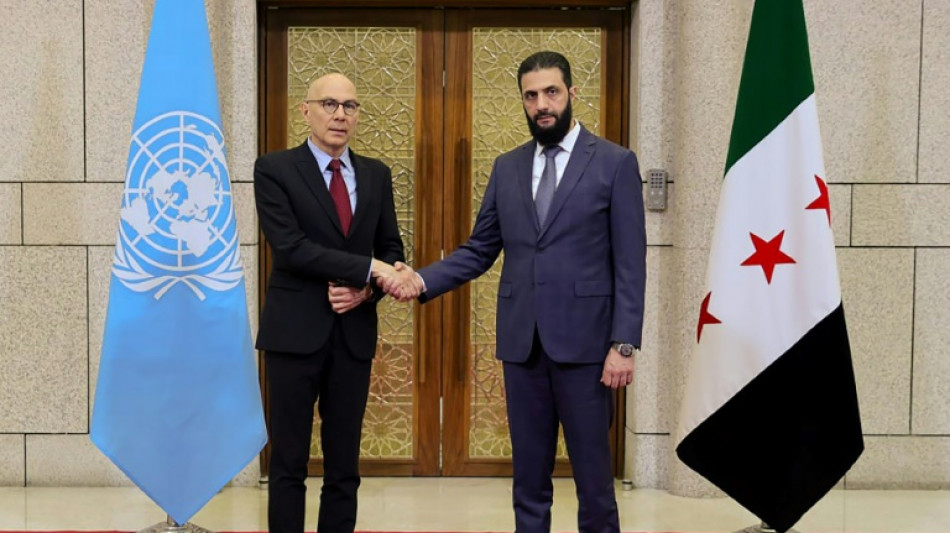
UN rights chief says transitional justice 'crucial' in Syria / Photo: © SANA/AFP
United Nations rights chief Volker Turk on Wednesday said transitional justice was "crucial" for Syria after the fall of Bashar al-Assad, during the first-ever visit by someone in his post to the country.
Since Islamist-led rebels seized Damascus last month, the United Nations has called for Assad and others to be held accountable for the crimes committed during more than 13 years of civil war.
"Transitional justice is crucial as Syria moves forward," the UN high commissioner for human rights said at a press conference in Damascus.
"Revenge and vengeance are never the answer."
Syria's conflict erupted in 2011 after Assad's brutal crackdown of anti-government protests. More than half a million people were killed and millions displaced from their homes.
Tens of thousands of people have been detained and tortured in the country's jails, while Assad has been accused of using chemical weapons including banned sarin gas against his own people.
"The enforced disappearances, the torture, the use of chemical weapons, among other atrocity crimes, must be fully investigated," Turk said.
"And then justice must be served, fairly and impartially," he added.
Turk said "such acts constitute the most serious crimes under international humanitarian law".
Among them, "that banned chemicals were used against civilians... and not just once, says a lot about the extreme brutality of the tactics used by the former regime," Turk said.
- 'Human rights for all Syrians' -
The new authorities have sought to reassure Syrians and the international community in recent weeks that they will respect the rights of minorities while rebuilding the country.
Turk said during the visit that he and the country's new leader Ahmed al-Sharaa discussed "the opportunities and challenges awaiting this new Syria".
"He acknowledged and assured me of the importance of respect for human rights for all Syrians and all different components of Syrian society," Turk said.
He said Sharaa also backed "the pursuit of healing, trust building and social cohesion and the reform of institutions".
After a war that has ravaged Syria's economy and infrastructure, Turk also called for an easing of certain Western sanctions imposed on Syria under Assad's rule.
"I... call for an urgent reconsideration of... sanctions with a view to lifting them," he said, adding that they had "a negative impact on the enjoyment of rights" of Syrians.
Turk said he had visited the notorious Saydnaya prison and met with a former detainee, "a former soldier suspected of being a defector".
"He told me of the cruel treatment he endured. I cannot even bear to share the stories of beatings and torture that he shared with me," he said.
Thousands of detainees poured out of prisons after Assad's fall.
But many Syrians are still looking for traces of tens of thousands of loved ones still missing, with many believed to have been buried in mass graves.
- 'Peaceful and stable development' -
Families of missing persons have urged Syria's new authorities to protect evidence of crimes under Assad, after outrage over a video appearing to show volunteers painting over prisoner etchings on walls inside a former jail.
A petition appeared on Tuesday calling for the new Syrian authorities to better protect evidence of crimes, and to give investigating the fate of those forcibly disappeared under Assad "the highest priority".
With journalists and families rushing to detention centres after Assad fled the country, official documents have been left unprotected, with some even looted or destroyed.
The Syrian Observatory for Human Rights, a Britain-based war monitor, says more than 100,000 people have died in detention from torture or dire health conditions across Syria since 2011.
Syria has seen a flurry of diplomatic activity since Assad's fall on December 8.
Earlier on Wednesday, Germany's Development Minister Svenja Schulze promised to support Syria's "peaceful and stable development" as she visited Damascus to meet with the interim authorities, announcing cooperation with Syrian hospitals.
Germany is home to the European Union's largest Syrian diaspora community, having taken in nearly a million people from the war-ravaged country.
P.Johnston--TNT