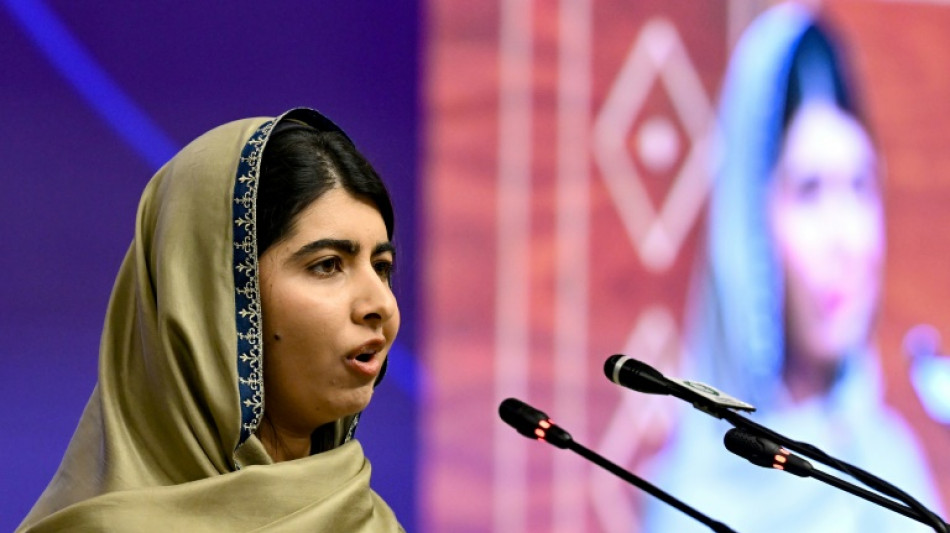
Education activist Malala returns to a region in crisis / Photo: © AFP
Twelve years after she was evacuated out of Pakistan as a badly wounded schoolgirl, Malala Yousafzai has returned to her home country at a critical time for girls' education.
"For her, it is a homecoming to a region that shaped who she is today, but also a reminder of the work still left unfinished," Yousafzai's friend and fellow rights activist Nighat Dad told AFP.
Millions more families are living in poverty while more than a third of children are still out of school, as the cash-strapped state grapples with cycles of political chaos and resurging militancy.
In neighbouring Afghanistan, the Taliban have returned to power and imposed an austere interpretation of Islamic law that includes banning girls from studying at secondary school and university.
This weekend, 27-year-old Yousafzai was the guest of honour at a global summit on girls' education in Islamic nations hosted by Islamabad, where she called on leaders to stand up for Muslim girls.
"Her presence in Pakistan during such a time is a message to those in power: the fight for education cannot be silenced, whether it's in the Swat Valley or across the border in Afghanistan," Dad added.
In 2012 at the age of 15, Yousafzai was shot in the head while on her way home from school by a Pakistan Taliban militant incensed by an education blog she wrote.
At the time, an insurgency against the government had spread to her remote, picturesque Swat Valley and militants had ordered girls to stay home.
Across the frontier, the war raged between NATO forces and the Afghan Taliban, a separate but closely linked group from the Pakistan Taliban which flourished in the border regions.
- 'Malala is a paradox' -
Always flanked by heavy security, Yousafzai has made only a handful of public visits to Pakistan since her evacuation to Britain, where she made a remarkable recovery and went on to become the youngest Nobel Prize winner at the age of 17.
Since then she has frequently shared the world stage with international leaders.
But Pakistan's relationship with her is complicated: a symbol of resilience and pride to some, and a stooge of the West to others, in a country where Islam is perceived as under threat by creeping Western values.
Sanam Maher, an author who has written about high-profile Pakistani women, told AFP that Yousafzai is a "contentious figure".
"There's a perception of her being 'handled' or 'managed', which creates distrust", she said.
"There are many who criticise Malala for her absence in Pakistan," she added. "They are indifferent to her commitment."
Still, Yousafzai retains star power in Pakistan, especially among young girls.
"Malala is an icon and a powerful voice for girls' education. She has faced violence, hatred, and criticism simply for advocating for girls' education," said Hadia Sajid, a 22-year-old media student who attended Yousafzai's closing speech in Islamabad.
"It's disheartening that things remain largely unchanged since she left, but there has been marginal improvement, largely due to the impact of social media -- it's more difficult to hold back girls from their rights."
Yousafzai founded the Malala Fund with her father, once a teacher in the Swat Valley who pushed against societal norms to champion his daughter's education.
The charity has invested millions of dollars in tackling the plight of 120 million girls out of school across the world.
"Pakistan is where I began my journey and where my heart will always be," Yousafzai said in her speech on Sunday.
But in her native country the projects she backs in rural areas are rarely publicised.
"I still think Malala is a paradox in Pakistan," said Dad.
"While her global achievements are undeniable, officials and the public remain divided, caught between admiration and mistrust. Yet Malala's impact transcends these perceptions," Dad told AFP.
A.M.Owen--TNT