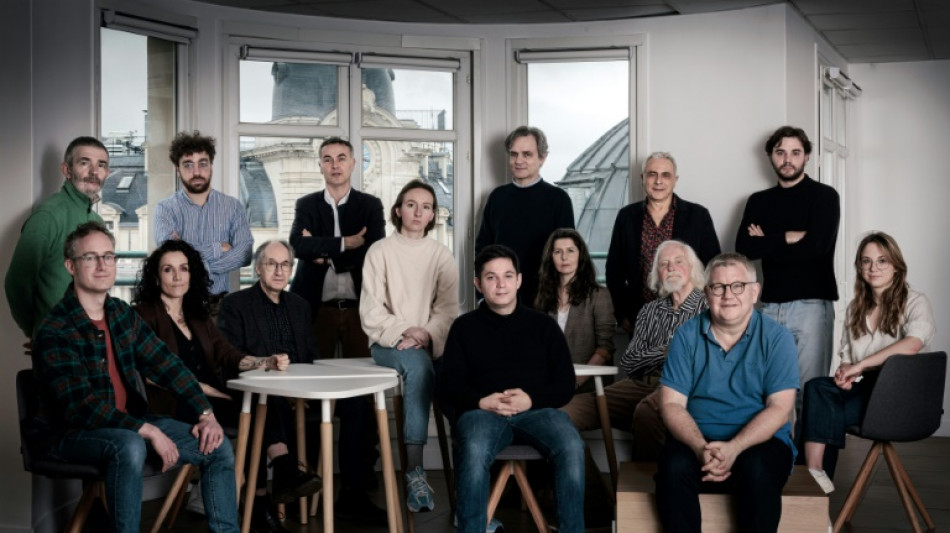
Charlie Hebdo unveils special edition 10 years since attack / Photo: © AFP
French satirical newspaper Charlie Hebdo unveiled a special edition Monday to mark 10 years since an attack on its offices by Islamist gunmen that decimated its staff.
The front-page features a cartoon celebrating the atheist paper's existence with the caption "Indestructible!", while four inside pages show the results of a caricature contest to mock God and religious leaders.
"Satire has a virtue that has enabled us to get through these tragic years: optimism," said an editorial from director Riss, who survived the January 7, 2015, massacre that left 12 people, including eight editorial staff, dead.
"If you want to laugh, it means you want to live. Laughing, irony, and caricatures are manifestations of optimism. Whatever happens, dramatic or happy, the desire to laugh will never cease."
The 2015 attack by two Paris-born brothers of Algerian descent was said to be revenge for Charlie Hebdo's decision to publish caricatures lampooning the Prophet Mohammed, Islam's most revered figure.
The massacre of some of France's most famous cartoonists signalled the start of a gruesome series of Al-Qaeda and Islamic State plots that claimed hundreds of lives in France and western Europe over the following years.
The edition unveiled to the media on Monday will go on sale on Tuesday when public commemorations by President Emmanuel Macron and Paris Mayor Anne Hidalgo are set to take place.
The weekly had called on cartoonists to submit their "funniest and meanest" depictions of God in a typically provocative and defiant contest for the special anniversary edition.
"Yes, we can laugh about God, especially if he exists," said a headline over what the paper said were the best 40 out of more than 350 entries.
Along with some typically crude and sexually explicit images, one of them makes reference to the Prophet Mohammed with the caption "if I sketch someone who is drawing someone who is drawing someone who is drawing Mohammed, is that ok?"
It shows a cartoonist drawing a picture of another cartoonist who is working on a picture of cartoonist drawing a bearded figure who looks like Mohammed.
Another cartoon appears to show the leaders of the three Abrahamic religions -- Christianity, Judaism and Islam -- as a three-headed dog.
- Survey results -
This week's edition also reproduces a small version of one of its most famous and controversial front covers from 2005, showing a Mohammed figure under the caption "Mohammed overwhelmed by fundamentalists."
Mohammed can be seen covering his eyes and saying "it's hard being loved by idiots".
It was drawn by Cabu, one of France's most famous cartoonists, who was shot at point-blank range 10 years ago when the masked gunmen burst into the paper's heavily protected offices with AK-47 assault rifles.
The cartoon is used alongside a survey of attitudes in France towards press freedom, caricatures and blasphemy, carried out by the Ifop survey group in association with Charlie Hebdo.
It found that 76 percent of respondents believed freedom of expression and the freedom to caricature were fundamental rights, while 62 percent thought people had the right to mock religious beliefs.
The Charlie Hebdo killings fuelled an outpouring of sympathy expressed in a wave of "Je Suis Charlie" ("I Am Charlie") solidarity with its lost cartoonists Cabu, Charb, Honore, Tignous and Wolinski among others.
But it also led to questioning and in some a furious backlash in some Muslim-majority countries against Charlie's deliberately offensive, often crude humour which is part of a long-standing French tradition of caricaturing.
Since its founding in 1970, it has regularly tested the boundaries of French hate-speech laws, which offer protection to minorities but allow for blasphemy and the mockery of religion.
Free-speech defenders in France see the ability to ridicule religion as a fundamental right acquired through centuries of struggle to escape the influence of the Catholic Church.
Critics say the weekly sometimes crosses the line into Islamophobia, pointing to some of the Prophet Mohammed caricatures published in the past that appeared to associate Islam with terrorism.
"The idea is not to publish anything, it's to publish everything that makes people doubt, brings them to reflect, to ask questions, to not end up closed in by ideology," director Riss, who survived the 2015 attack, told Le Monde in November.
A front-page depiction of the Virgin Mary in August suffering from the mpox virus led to two legal complaints from Catholic organisations in France.
T.Bennett--TNT