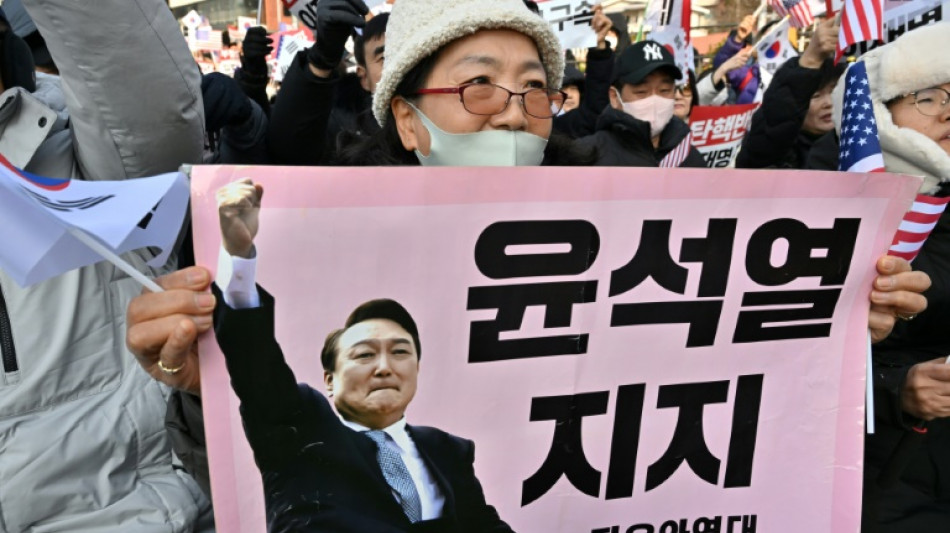
South Korea's impeached president resists arrest over martial law bid / Photo: © AFP
Impeached South Korean President Yoon Suk Yeol remained defiantly inside his residence resisting arrest for a third day on Thursday after vowing to "fight" authorities seeking to question him over his failed martial law bid.
The embattled leader issued the bungled declaration on December 3 that led to his impeachment and has left him facing arrest, imprisonment or, at worst, the death penalty.
Supporters and opponents of Yoon have since camped outside his presidential residence, while members of his security team have blocked attempted police raids in a dramatic stand-off.
Yoon has gone to ground but remained unrepentant as the crisis has rolled on, issuing a defiant message to his base days before an arrest warrant expires on January 6.
"The Republic of Korea is currently in danger due to internal and external forces threatening its sovereignty, and the activities of anti-state elements," he said in a statement passed around to protesters, his lawyer Yoon Kab-keun confirmed to AFP.
"I vow to fight alongside you to the very end to protect this nation," he added, saying he watched the hundreds-strong protest on Wednesday evening on a YouTube live stream.
Yoon Kab-keun confirmed to AFP that the impeached leader remained inside the presidential compound.
"The president is at the (official presidential) residence," he said.
Opposition lawmakers were quick to condemn Yoon Suk Yeol's defiant message as inflammatory, with Democratic Party spokesperson Jo Seoung-lae calling him "delusional" and accusing him of trying to incite clashes.
The suspended president's legal team has filed for an injunction to block the warrant and described the arrest order on Wednesday as "an unlawful and invalid act".
- Blocked raids -
Corruption Investigation Office (CIO) chief Oh Dong-woon warned that anyone trying to block authorities from arresting Yoon Suk Yeol could themselves face prosecution.
Along with the summons, a Seoul court issued a search warrant for his official residence and other locations, a CIO official told AFP.
The presidential security service's official stance has been to treat the warrants with due process.
It remains unclear how many guards are stationed with him but they have blocked searches of his office and residence.
They have cited two articles in South Korea's Criminal Procedure Act that prohibit seizure from locations where official secrets are stored, without consent of the person in charge.
South Korean officials have previously failed to execute similar arrest warrants for lawmakers -- in 2000 and 2004 -- due to party members and supporters blocking police for the seven-day period the warrants were valid.
However, discussions between prosecutors and police about Yoon Suk Yeol's arrest are taking place in the background of the political crisis that saw the country briefly lurch back to the dark days of military rule.
- Refused questioning -
The martial law order, which Yoon Suk Yeol said was aimed at eliminating "anti-state elements", only lasted a few hours.
Armed troops stormed the national assembly building, scaling fences, smashing windows and landing by helicopter, but the president was quickly forced to make a U-turn after lawmakers rushed to parliament to vote it down.
He was then stripped of his presidential duties by parliament and now faces criminal charges of insurrection.
Yoon Suk Yeol has since refused summonses for questioning three times and doubled down on claims the opposition was in league with South Korea's communist enemies.
Supporters have raced to Seoul to support him in the wake of his refusal, spewing vitriol at police and waving anti-impeachment placards.
A constitutional court will rule whether to uphold his impeachment.
The turmoil deepened late last week when his replacement, Han Duck-soo, was also impeached by parliament for failing to sign bills for investigations into his predecessor.
Finance Minister Choi Sang-mok has been installed as acting president and pledged to do all he can to end the political upheaval.
He has since decided to appoint two new judges to the constitutional court, a key demand of the opposition, but was criticised by Yoon Suk Yeol's staff as overstepping his powers.
T.Cunningham--TNT