TikTokers jailed as Iraq targets 'decadent content' / Photo: © AFP
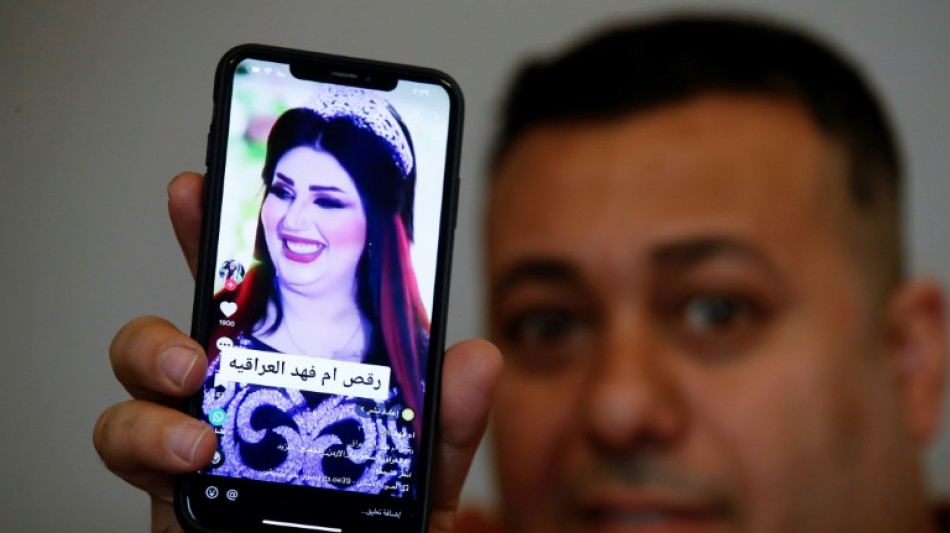
Dancing to Iraqi pop made TikTok personality Om Fahad a hit among tens of thousands of followers, but now she is in prison, caught up in a state campaign targeting "decadent content".
The young Iraqi woman using that pseudonym was sentenced early this month to half a year behind bars for the light-hearted video clips that show her in tight-fitting clothes.
A new government campaign aims to cleanse social media platforms of content that breaches Iraqi "mores and traditions", the interior ministry announced in January.
A specialised committee now scours TikTok, YouTube and other popular platforms for clips deemed offensive by many in the largely conservative and patriarchal society.
"This type of content is no less dangerous than organised crime," the ministry declared in a promotional video that asked the public to help by reporting such content.
"It is one of the causes of the destruction of the Iraqi family and society."
Days after Om Fahad's sentencing, another TikTok influencer who goes by the online name of Assal Hossam received an even harsher sentence of two years in prison.
Some of her videos showed her dressed in a tight military uniform.
In total, a dozen people have so far been arrested for "decadent content", said an interior ministry official who spoke to AFP on condition of anonymity.
- 'Vague terminology' -
Many Iraqis embrace the campaign, and a platform set up by the authorities has received 96,000 reports from the general public, said the official.
Six verdicts have so far been handed down, according to a judge working on such cases quoted by the Iraqi news agency INA.
An investigative judge in the southern city of Amarah recently dealt with the cases of four minor social media celebrities accused of "offending public morals and indecent exposure", said the judiciary's Supreme Council.
Among the four, who have since been released, was Aboud Skeeba, with over 160,000 TikTok followers and known for humorous videos in which he makes incomprehensible remarks employing a pseudo-American accent.
There was also Hassan al-Shamri, whose skits see him play the female character Madiha, who is of humble origins and has a strong temper, and which has earned him three million fans on the online platform.
In a video published after his release, Shamri apologised and said he had deleted some material that had been deemed "offensive", although he added that he would continue producing content.
The Iraqi state bases its campaign on penal code articles "with vague and elastic terminology, such as public morals and indecent exposure", said Mustafa Saadun, of the Iraqi Observatory for Human Rights.
These, he said, are open to "interpretation" and mean that "someone who has done nothing wrong risks being arrested".
- 'Shoddy politicians' -
Iraq, ravaged by years of war and sectarian conflict after the 2003 US invasion that overthrew Saddam Hussein, has returned to a semblance of normality despite ongoing political instability, corruption and sporadic violence.
But civil liberties -- of women, sexual minorities and other groups -- remain constrained in a conservative and male-dominated society strongly influenced by tribal culture.
Saadun -- who said he "can't stand" popular YouTubers and TikTokers -- nonetheless deplored the campaign against them. He said the authorities should instead "flex their muscles and punish those who publish fake news and hate speech".
The rights activist said he fears the government is now "taking the pulse" of society "before moving on to a more dangerous stage -- to hold accountable all those who criticise state institutions and politicians".
The Iraqi government denies any such agenda, with interior ministry spokesman Saad Maan arguing the morality campaign has "nothing to do with freedom of expression".
"We need a structure," he said on the Al-Rachid TV channel about the culture of youthful social media starlets. "These misguided personalities do not represent Iraqis, Iraqi women or Iraqi society."
Political commentator Ahmed Ayyash al-Samarrai, himself no fan of TikTok clips, argued on Twitter that Iraq has more pressing problems, listing "sectarian conflicts, racist discrimination, incitement to violence".
Even though he backs the crackdown on influencers, he argued that "their content is no more decadent" than that of many others, among them "shoddy politicians, political barons and those who call themselves men of religion".
T.Bailey--TNT