Peruvians place little trust in political class to solve crisis: experts / Photo: © AFP/File
With a political class that is widely mistrusted and seen as weak and out of touch, Peruvians have grown increasingly disillusioned that a solution to weeks of violent unrest is at hand, experts told AFP.
The national Congress is due to debate again on Monday a proposal to bring forward elections slated for April 2024 in a bid to break a political deadlock that has seen 48 deaths over seven weeks of near-daily protests.
Parliament rejected such a move on Saturday, however, and analysts doubt this time will be different.
"This is a toxic Congress. It is rejected by 88 percent of the population, according to polls," said Alonso Cardenas, a public policy specialist in Lima.
Cardenas said Congress has been widely discredited -- branded by one civil association as "the most corrupt" institution in the country.
"Congress, like almost all the political class in Peru, lives with its back to the country. It doesn't understand" the people, said Roger Santa Cruz of the Antonio Ruiz de Montoya University in Lima.
In the early hours of Saturday, following seven hours of debate, lawmakers voted against bringing forward elections from April 2024 to October this year.
That proposal, from opposition politician Hernando Guerra Garcia, came after beleaguered president Dina Boluarte said Friday that she had told her ministers to suggest December as a possible date for a general election.
Protesters have kept pressure on the authorities since December 7, the day ousted president Pedro Castillo was arrested after attempting to dissolve parliament and rule by decree. Demonstrators want immediate elections, Boluarte's resignation and dissolution of Congress.
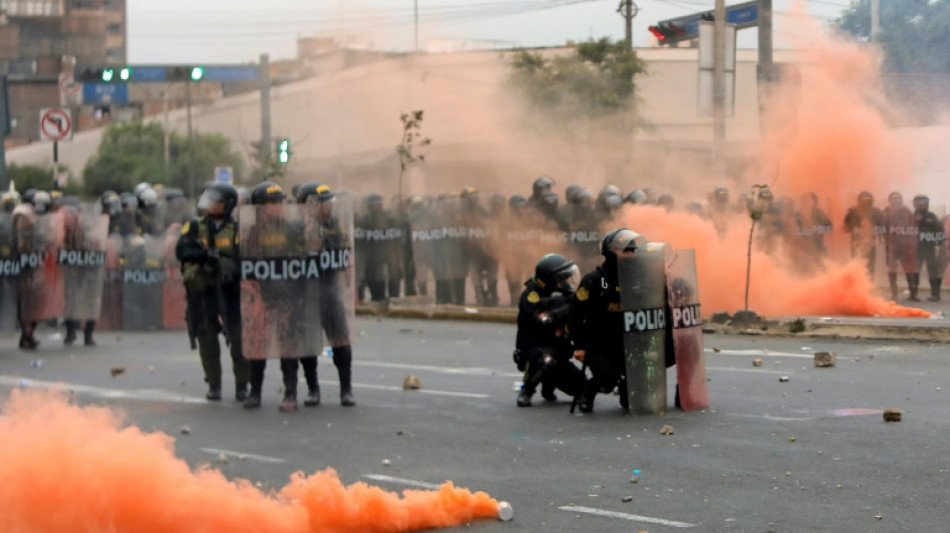
Castillo's supporters, many of them peasants and Indigenous peoples from the countryside, have blocked roads, causing fuel and food shortages in some areas; forced some airport closures, and clashed with security forces in Lima and other cities.
- Political calculation -
According to Santa Cruz, there is good reason for many legislators to reject snap elections, particularly rivals to Guerra Garcia's Popular Force party, led by Keiko Fujimori, who narrowly lost the 2021 election to Castillo.
"Popular Force has bases all over the country. It is better equipped to run a short campaign. Theirs is a political calculation," said Santa Cruz.
In the recent vote, Guerra Garcia's proposal was defeated by Popular Force's own right-wing allies in opposition, Popular Renewal and Advance Country.
Boluarte is from the same left-wing party as Castillo -- she was his vice president before his arrest -- but her support since then has come from the conservative opposition.
Now "the alliance that supports Boluarte is cracking," said Cardenas.
Experts say leftist politicians also deserve some blame for the current crisis by putting factional ambitions ahead of the country's needs.
The left has demanded a referendum on rewriting the constitution as a condition for supporting advanced elections, but that has little support elsewhere.
"The left knows that its proposal will never be supported by the right," said Cardenas, who believes the issue is being used as leverage to negotiate minor benefits.
"These are pretty mediocre reasons" to effectively hold the country hostage, he added.
Congress is fractured into at least 10 political forces, with no strong leaders or dominant personalities, the experts say.
Boluarte's resignation would not end the crisis, Cardenas and Santa Cruz said, as there is no experienced, unifying figure to replace her.
- Years of turmoil -
Peru is no stranger to political instability. Since 2018, it has been led by no fewer than six presidents who span the political spectrum.
Adding fuel to an unstable fire is a legislature that, experts say, seems more focused on squabbling than problem-solving.
Castillo, for his part, found himself in Congress's crosshairs almost from the day he took over.
Even if elections are now advanced to this year, political scientists say they have little faith that a stable future will follow.
"The political solution would have to come from political reform," said Cardenas, adding that change would have to come from the same politicians who are so widely mistrusted today.
F.Jackson--TNT