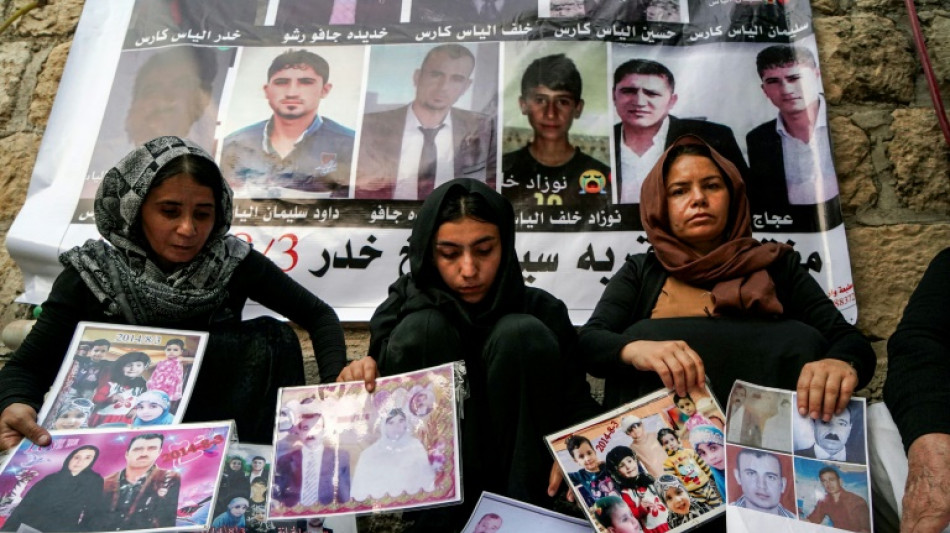
German parliament recognises Yazidi 'genocide' in Iraq / Photo: © AFP/File
Germany's lower house of parliament recognised on Thursday the 2014 massacre of Yazidis by Islamic State group jihadists in Iraq as a "genocide", and called for measures to assist the besieged minority.
In a move hailed by Yazidi community representatives, deputies in the Bundestag passed the motion by the three parliamentary groups in Germany's ruling centre-left-led coalition and conservative MPs.
The chamber "recognises the crimes against the Yazidi community as genocide, following the legal evaluations of investigators from the United Nations," the resolution said, after similar moves by countries including Australia, Belgium and the Netherlands.
The text condemns "indescribable atrocities" and "tyrannical injustice" carried out by IS fighters "with the intention of completely wiping out the Yazidi community".
The motion urges the German judicial system to pursue further criminal cases against suspects in Germany and the government to increase financial support to collect evidence of crimes in Iraq and boost funding to help rebuild shattered Yazidi communities.
It also calls for Germany to establish a documentation centre for crimes against Yazidis to ensure a historical record and to press Baghdad to protect the minority group's rights.
Islamic State jihadists in August 2014 massacred over 1,200 Yazidis, members of a Kurdish-speaking community in northwest Iraq that follows an ancient religion rooted in Zoroastrianism. IS sees them as "devil worshippers".
The Yazidi minority has been particularly persecuted by the jihadist group, which has also forced its women and girls into sexual slavery and enlisted boys as child soldiers.
A special UN investigation team said in May 2021 that it had collected "clear and convincing evidence" that IS had committed genocide against the Yazidis.
- 'Prevent future genocides' -
Foreign Minister Annalena Baerbock recalled speaking to Yazidi women in Iraq who had been raped and held captive by IS fighters and said the motion was being passed for them and "in the name of humanity".
"We must call out these crimes by their name," she told the chamber. "We must ask what we can do to prevent future genocides."
Around two dozen Yazidi community representatives attended the debate at the glass-domed Reichstag parliament building in central Berlin.
Mirza Dinnayi, head of Air Bridge Iraq, an NGO assisting victims of the massacre who live in Germany, told AFP the measure was "pioneering" for addressing "the consequences of the genocide".
He welcomed the inclusion of "practical steps the German government can take to support the Yazidi community in Iraq as well as the diaspora".
Another Yazidi aid group, HAWAR.help, called the motion "more than a symbolic act".
"The survivors want nothing more than justice, for the world to see their suffering and for the perpetrators to be punished," it said.
Derya Turk-Nachbaur, a deputy from the Social Democrats and one of the sponsors of the measure, noted there was "no statute of limitations on genocide".
"It was impossible for us to close our eyes any longer to their suffering," she said of the Yazidis.
"The indescribable atrocities of IS militias must not go unpunished -- not in Iraq and not in Germany."
- 'Silence cost lives' -
Green lawmaker Max Lucks said Germany was home to what is believed to be the world's largest Yazidi diaspora of about 150,000 people, meaning the country had a particular responsibility to the community.
"Their pain will never go away," he told the Bundestag.
"We owe this to the Yazidis because we did not take action (in 2014) when we were needed. Our silence cost lives."
While the Bundestag motion on genocide has no bearing on criminal trials, human rights advocates say it carries important symbolic and political weight.
Germany is one of the few countries to have taken legal action against IS.
In November 2021, a German court convicted an Iraqi jihadist of genocide against the Yazidi, a first in the world that Nobel Peace Prize laureate Nadia Murad hailed as a "victory" in the fight for recognition of the abuses committed by IS.
And last week, a German woman went on trial in the southwestern city of Koblenz accused of aiding and abetting war crimes and genocide with IS in Syria by "enslaving" a Yazidi woman.
T.Hancock--TNT