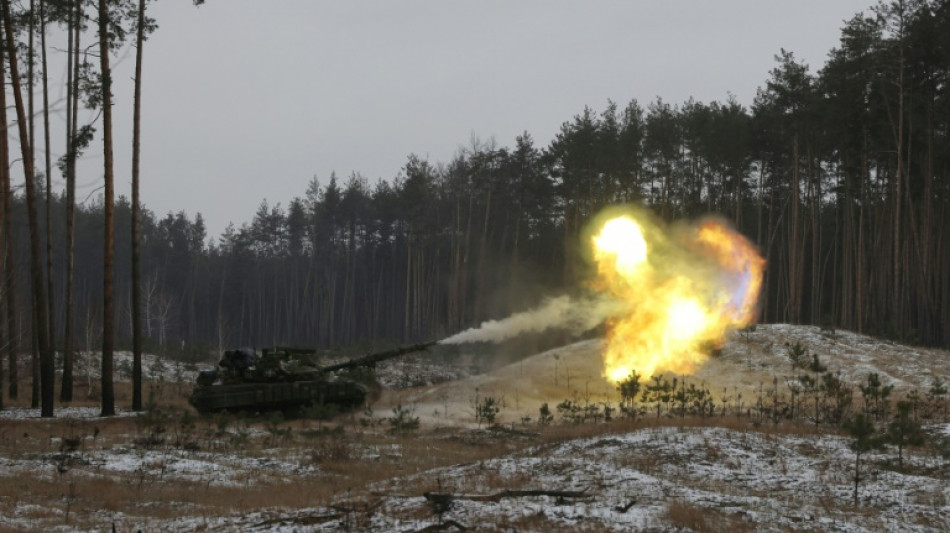
Russia says it controls battered Ukraine town of Soledar / Photo: © AFP
Russia said Friday its forces had wrested control of the war-scarred town of Soledar in east Ukraine, Moscow's first claim of victory in months of battlefield setbacks.
"On the evening of January 12, the liberation of the city of Soledar was completed," the defence ministry announced, claiming this would pave the way for more "successful offensive operations" in the Donetsk region.
Ukraine denied the Russian claim and said "severe fighting" was on in the nearly completely destroyed town that is now the epicentre of the war.
"Ukraine's armed forces have the situation under control in difficult conditions," said Sergiy Cherevaty, a spokesman for the eastern group of the Ukrainian armed forces.
Both sides have conceded heavy losses, with Moscow eager to sell any win back home after repeated battlefield humiliations and Ukraine desperate to hold and win back ground.
Moscow's announcement came as the UN Security Council was preparing to meet to discuss the war.
Ukraine's deputy defence minister said earlier that Russia had "relocated almost all of its main forces to the Donetsk front" to ensure Soledar's capture.
"This is a difficult phase of the war," Ganna Malyar conceded.
The Russian mercenary group Wagner has claimed that it spearheaded the offensive for Soledar and already announced this week that its forces were controlling it.
But both the Kremlin and the Russian defence ministry said fighting was ongoing at the time, an indication of the fractious Russian groupings involved in the fight.
President Volodymyr Zelensky vowed on Thursday that Ukrainian forces defending Soledar and neighbouring Bakhmut would be armed with everything they need in some of the bloodiest battles of the war.
- A 'small-scale victory' -
Observers are divided over the strategic significance of Soledar, a salt mining town with a pre-war population of around 10,000 people.
It could act as a bridgehead for Russia to develop its offensive for Bakhmut, a larger town nearby that Russian forces have been attacking for months.
The Russian defence ministry said Friday that Soledar's capture "makes it possible to cut off the supply routes of Ukrainian troops" there and surround them.
Moscow's last major gains were in June and July ear with the capture of Lysychansk and Severodonetsk in the eastern Lugansk region.
It has suffered several key defeats since, including its retreat from Kherson city in the south late last year.
The US-based Institute for the Study of War (ISW), a military observation group, said in an analytical note that Russian forces had likely already captured Soledar on Wednesday.
"But this small-scale victory is unlikely to presage an imminent encirclement of Bakhmut," it cautioned.
The think tank added that Russian information operations have "overexaggerated" the importance of Soledar.
ISW said its assessment of Russia's "likely" control over Soledar was based on geolocated footage earlier this week, adding that Moscow's troops "likely pushed Ukrainian forces out of the western outskirts of the settlement."
The battle for Soledar comes after a major military reshuffle in Moscow, with Chief of the General Staff Valery Gerasimov now in charge of its operations in Ukraine.
A Moscow-based defence analyst, who spoke on condition of anonymity, described the move to AFP as "unprecedented" and said it indicated "very serious problems" on the battlefield.
Ukraine has effectively become a NATO member, its defence minister said, despite the military alliance's reluctance to get embroiled in a wider conflict with Russia.
Oleksiy Reznikov said he was confident that Western allies would shed their inhibitions about supplying Ukraine with heavier weapons such as tanks and fighter jets.
"This concern about the next level of escalation, for me, is some kind of protocol," he told the BBC in an interview broadcast Friday, dismissing NATO fears about provoking Russia.
"Ukraine as a country, and the armed forces of Ukraine, became (a) member of NATO," he said. "De facto, not de jure (in law). Because we have weaponry, and the understanding of how to use it."
S.Clarke--TNT