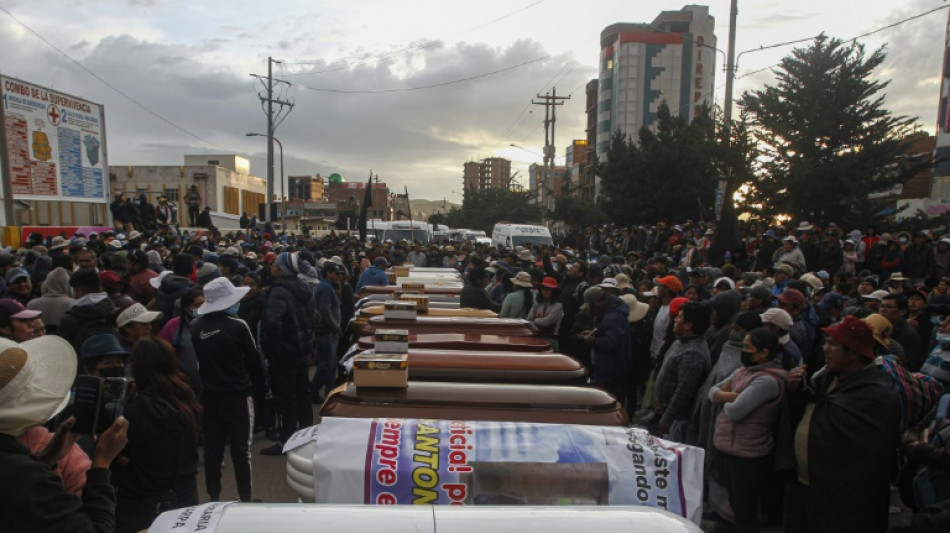
Peru president under investigation after dozens killed in protests / Photo: © AFP
Peru's prosecutor's office on Tuesday said it was opening an inquiry against President Dina Boluarte and others for their role in the repression of anti-government protests that have seen at least 40 killed since December.
The government announced a curfew on Tuesday in the southern Puno region in a bid to suppress the violent protests, a day after 18 people were killed there in clashes between demonstrators and security forces.
The inquiry is into whether the alleged crimes of "genocide, aggravated homicide and serious injuries" took place during anti-government demonstrations in the Apurimac, La Libertad, Puno, Junin, Arequipa and Ayacucho regions.
Puno, which borders Bolivia and is home to many Aymara Indigenous people, has become the epicenter of the protest movement against Boluarte by supporters of former president Pedro Castillo, who was ousted and arrested on December 7.
Prime Minister Alberto Otarola -- who is among those being investigated for alleged "genocide", alongside the interior minister and defense minister -- said the three-day nighttime curfew would run from 8:00 pm to 4:00 am.
Otarola's cabinet obtained a vote of confidence from Peru's parliament on Tuesday night, with 73 votes in favor, 43 against and six abstentions.
Overnight on Monday, protesters looted shops and attacked police vehicles in Puno.
Most of the bloodshed there took place when protesters tried to storm the airport in the city of Juliaca, which was being guarded by security forces.
Fourteen people were killed, many having suffered gunshot wounds, according to an official at a Juliaca hospital.
Three more people died during the ransacking of a shopping center in the city, while the last victim was a police officer who the United Nations said died after his vehicle was set on fire.
The government has defended the actions of security forces in Juliaca, claiming those guarding the airport faced down an organized attempted "coup" by thousands of demonstrators.
But UN Human Rights Office spokesperson Marta Hurtado called on authorities "to carry out prompt, impartial and effective investigations into the deaths and injuries, holding those responsible to account and ensuring victims receive access to justice and redress."
Protests erupted a month ago when leftist Castillo -- who was facing several graft investigations -- was forced from office and arrested on charges of rebellion after attempting to dissolve parliament and rule by decree.
Tension had since been mounting in the cities of Puno and Juliaca, where a week-long general strike has forced businesses to close.
Demonstrators have set up roadblocks in six of the country's 25 departments. Officials say there are 53 separate roadblocks.
In the southern Andean region of Ayacucho, thousands marched through the streets of the city of Huamanga demanding Boluarte's resignation and new elections, which have already been brought forward from 2026 to April 2024.
- 'War situation' -
The death toll brought a rebuke from the UN office in Peru, which expressed its "deep concern over the increasing violence."
"We urge the authorities and security forces to take urgent measures to ensure the respect of human rights, including the right to protest peacefully," it added.
Leaders of the Catholic Church, which is dominant in Peru, called the latest violence "a situation of war."
"We are in the hands of barbarism," Cardinal Pedro Barreto, the archbishop of the central city of Huancayo, told RPP radio station.
The Puno regional government declared three days of mourning over the recent deaths and called on Boluarte to resign.
On Wednesday, a delegation from the Inter-American Commission on Human Rights will visit Peru to investigate the protests and accusations of political repression.
On Tuesday, former Bolivia president Evo Morales, who is from the Aymara ethnicity and was his country's first indigenous leader, called on Peru to end "the massacre of our brothers."
On Monday, he was barred from entering Peru as the government accused him of trying to interfere in the country's affairs.
R.Hawkins--TNT