Charlie Hebdo: France's satirical magazine in new controversy / Photo: © AFP
French satirical magazine Charlie Hebdo is making headlines again by stirring outrage in Iran, demonstrating that it has lost none of its appetite for provocation or its ability to stir up diplomatic problems abroad.
The irreverent and militantly atheist publication operates today with round-the-clock police protection and from a secret location, seven years after it was attacked by Islamist gunmen.
Twelve people died in that assault, including some of its most famous cartoonists, but it continues to caricature and mock politicians and public figures in a style that is deliberately vulgar and disrespectful.
Most controversially of all, it has repeatedly published caricatures of the Prophet Mohammed -- acts seen as blasphemous by many Muslims and which were used as justification for the 2015 attack on its staff.
"There is nothing to regret," Charlie Hebdo's director Laurent Sourisseau, known as "Riss", told a French court in 2020 during a trial of accomplices to the 2015 gunmen.
"What I regret is to see how little people fight to defend freedom. If we don't fight for our freedom, we live like a slave and we promote a deadly ideology," added the cartoonist, who was himself injured in the attack.
The murders sparked a global outpouring of solidarity with France and freedom of speech under the "I am Charlie" slogan, but the publication also makes many people queasy, including in France.
Critics see it as being needlessly provocative towards Muslims and even Islamophobic, even though it has frequently offended other religious groups, including Catholics with its crude depictions of the pope.
"We will always defend freedom of expression," Canadian Prime Minister Justin Trudeau said of the magazine in 2020. "But freedom of expression is not without limits."
- Iranian women -
Riss was behind the latest publication that has incensed the Iranian government. It appeared on French newsstands on Wednesday.
Cartoonists were invited to depict Iran's supreme leader Ayatollah Ali Khamenei in the context of ongoing demonstrations against his theocratic regime, by women in particular.
The graphic front cover sought to highlight the fight for women's rights, while others were sexually explicit and insulting towards Khamenei and fellow clerics.
Many cartoons pointed to the authorities' use of capital punishment as a tactic to quell the protests.
"It was a way to show our support for Iranian men and women who risk their lives to defend their freedom against the theocracy that has oppressed them since 1979," Riss wrote in an editorial.
Iranian Foreign Minister Hossein Amir-Abdollahian pledged an "an effective and decisive response" and the authorities closed a Tehran-based French research institute on Thursday.
"We will not allow the French government to go beyond its bounds. They have definitely chosen the wrong path," Amir-Abdollahian wrote on Twitter.
The latest row echoes another in October 2020 in which Turkey accused Charlie Hebdo of "cultural racism" and serving French President Emmanuel Macron's supposedly "anti-Muslim agenda".
Turkish leader Recep Tayyip Erdogan had appeared on the front page depicted in a t-shirt and underpants, drinking a can of beer while lifting up the skirt of a woman wearing a hijab.
- Hate speech? -
Charlie Hebdo has repeatedly caused diplomatic problems abroad for the French government, which has no links with the publication but faces domestic pressure to defend its right to free speech in an officially secular country.
France has strict hate speech laws that criminalise discriminatory or inciteful comments about racial or religious groups, but it does not impose limits on what can be said -- or drawn -- about religions or religious figures.
This constitutionally protected freedom is rooted in the country's own centuries-long struggle against the power of the Catholic church.
Likewise, political leaders and public figures are offered protection from falsehoods by libel and defamation laws, but not from mockery or criticism.
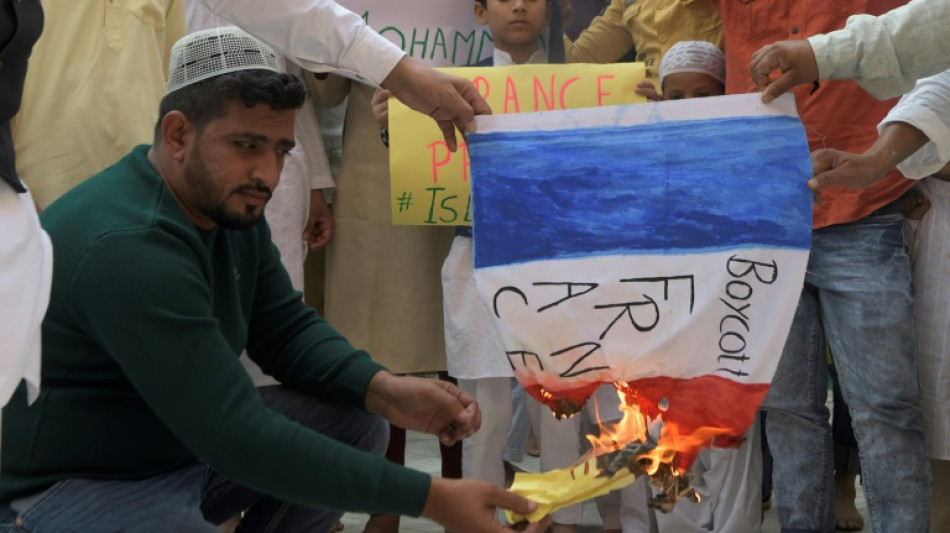
Anti-France demonstrations and calls to boycott French goods swept through many Muslim-majority countries in 2020 after Macron defended the right of cartoonists to be blasphemous.
In October of that year, a French school teacher was beheaded for showing cartoons of the Prophet in his class as part of a discussion about freedom of speech.
The daylight murder in a quiet northeastern suburb of Paris deeply shocked France.
Macron criticised "a confusion that has been fed by many media -- and sometimes political and religious leaders -- which is to say that these caricatures are in a way the project or the creation of the French government or the president".
G.Morris--TNT