The National Times - New recipes help Pakistani mothers ward off malnutrition

New recipes help Pakistani mothers ward off malnutrition


New recipes help Pakistani mothers ward off malnutrition
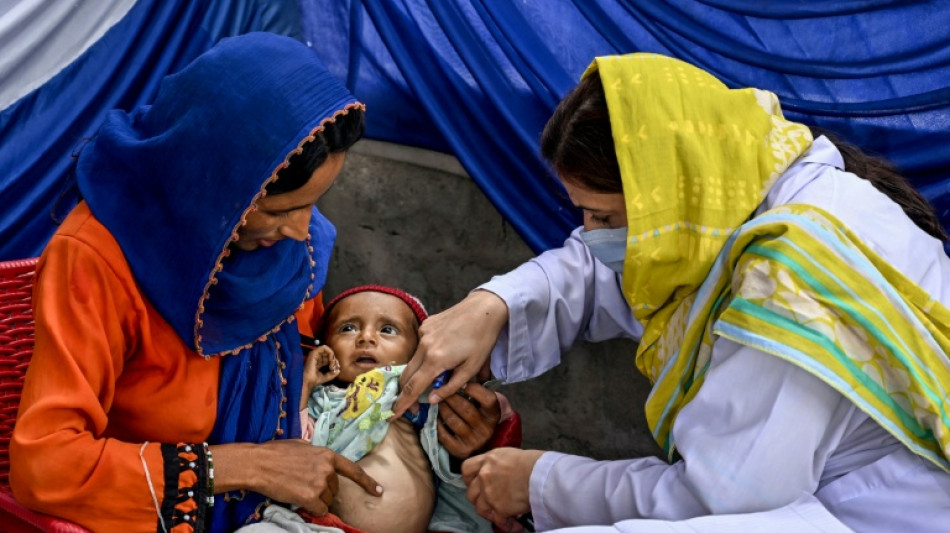
New recipes help Pakistani mothers ward off malnutrition / Photo: © AFP

Clutching their hungry babies, a group of mothers mix a semolina dish under the guidance of a teacher, an attempt to curb malnutrition which affects nearly one in two children in Pakistan's south.

Change text size:

Despite Sindh province being home to the mega port city of Karachi, the financial centre of the country that sprawls along the Arabian coastline, children in rural areas just a few hours away face stark levels of wasting and stunting.

In the arid village of Sujawal, lethargic children with prominent bones wilt in the searing heat as social workers educate mothers on nutrient-rich ingredients and dispel myths around food.

"Before, we only gave our children potatoes because they were always available at home," said Shahnaz, 25, who has radically changed the diet of her six children, weak and frequently sick, after a year of classes.

Now, convinced that children should eat a varied diet, she has introduced affordable ingredients such as lentils and semolina into her cooking, lifting her daughter out of malnutrition.

In impoverished rural Sindh province, 48 percent of children under five suffer from malnutrition and 20 percent from its most severe form, wasting, according to the latest national survey on the issue conducted in 2018.

In this class, Azma, a social worker, shows mothers how to cook with semolina -- easily available in the market.

"Semolina is cheap -- for 50 rupees it can last a week if you're feeding one to two spoonfuls daily to a six-month-old child," she explained to AFP.

In Sindh, a province of 55 million people where contraception remains taboo and large families are the norm, 3,500 mothers have benefited from cooking classes developed by UNICEF.

Like many mothers in the area, Kulsoom, 23 and pregnant with her sixth child, all born prematurely and underweight, once only fed her children pieces of fried flatbread.

"One of my children died, and my youngest is extremely weak, so I was advised to take these classes," said Kulsoom, who goes by only one name, like most women in her district.

- No spices -

Parents are recommended to feed babies solid foods from about six months old, but in rural Sindh this often means adult leftovers, too spicy for young stomachs.

"The main problem is the lack of dietary diversity," says Mazhar Iqbal, a nutritionist for UNICEF.

In Pakistan, 38 percent of children eat only two or fewer of the eight food categories recommended by UNICEF.

Meat is saved for special occasions, yet inexpensive protein alternatives exist such as chicken offal, boiled bones, lentils and beans.

As for fruit and vegetables, they are usually fried, losing their nutrients.

Bakhtawar Kareem joined the programme after her child died of anaemia.

"I have no money. Sometimes we eat, sometimes we don't," she lamented, scanning the swollen belly of her one-year-old daughter, who has only sparse clumps of hair.

Like 72 percent of children in the village, her daughter has stunting, well above the average rate in Pakistan of 42 percent -- one of the highest in the world.

Stunting is most closely associated with brain development and physical growth, and can have long-term physical and mental impacts.

Vulnerable to a lack of clean water and sanitation which contributes to malnutrition, children often also suffer from dengue fever or malaria, from vomiting, diarrhoea, or difficulty urinating, and have abnormally swollen bellies.

- Women eat leftovers -

But the vicious cycle of malnutrition begins with the mothers.

"With early marriages and repeated pregnancies, more than 45 percent of women in Sindh are anaemic," said the nutritionist.

"This increases the risk of having low birth weight babies, who are more likely to suffer from malnutrition."

In Sujawal, where only a quarter of the population can read and write, myths about food also deprive women of vital nutrients.

Farrah Naz, the head of the Global Alliance for Improved Nutrition in Pakistan, regularly has to repeat that eggs and dried fruits do not cause women to bleed more during their periods.

Cultural norms around women serving meals to men first and eating the leftovers -- despite the physical work they carry out in the fields -- also contributes to poor health.

"And when food runs out, it's their rations that are cut first."

N.Taylor--TNT

Featured

The "Everlasting Battery" Inside Your Joints:UConn Professor's Self-Powered Healing Material just Got Acquired

A material that turns your own movement into medicine has just landed a corporate home. PetVivo Holdings (OTCQX: PETV), a veterinary biotech and biomedical device company focused on treating osteoarthritis in dogs and horses, has acquired PiezoBioMembrane (PBM) — a startup built around a biodegradable implant that generates electricity from the everyday force of a joint in motion, and uses that charge to help regrow cartilage from the inside out. The material is the invention of Thanh Nguyen, a professor of mechanical engineering in UConn's College of Engineering, who founded PBM in 2021 to advance new implementation methods for his work with piezoelectric materials — substances that convert mechanical force into electrical energy. These materials are typically ceramics: hard, brittle, and poorly suited for medical use. But Nguyen's lab developed new forms that are so , flexible, and biodegradable, breaking down naturally within the body over time. wound healing, The materials have already shown strong potential across a range of medical applications, including tissue regeneration, implanted force sensors, and targeted drug delivery in tumor treatment. How It Works biodegradable ultrasound for In the case of arthritis, Nguyen explains, the piezoelectric materials function as an off-the-shelf product that can be implanted or injected directly into the ailing joint — with no drugs, chemicals, or cells required. The everyday force exerted on the joint generates a small electrical charge, which helps regrow healthy cartilage, mimicking the body's natural use of electricity to regenerate tissue. "The body can be electrically stimulated to regrow," Nguyen says. PBM's materials "act like a battery — an everlasting battery that works whenever there is a force applied, and vanishes safely inside the body over time." PetVivo's Vision for the Acquisition PetVivo Holdings CEO John Lai expressed enthusiasm for the merger's potential to improve the lives of companion animals globally. "PBM has developed a compelling functional biomaterials platform with the potential to support the development of multiple medical device and therapeutic product lines across both human and animal health markets," Lai said in a press release. "By combining PBM's scientific innovation with PetVivo's product development capabilities, commercialization experience, regulatory expertise, and public company infrastructure, we believe we can accelerate theadvancement of technologies that may serve as the foundation for numerous future products and strategic opportunities." For Nguyen, the deal is a chance to scale technology that could eventually benefit both animals and people. "PetVivo is an animal health company, but they do have a big passion: pushing the technology towards clinical trials for human use," Nguyen says. "That aligned perfectly with my passion for developing technology that has an impact on human life. That is why I am excited about this merger, which facilitates my passion." A Track Record of Innovation Nguyen's research sits at the intersection of medicine, micro/nanotechnology, and biomaterials. His inventions have earned him publications in prominent scientific journals and media coverage from outlets including NPR. Nguyen founded PBM during the COVID-19 pandemic, a er realizing the material he had developed could be used to create an especially effective, biodegradable face mask — one where the mechanical force of breathing generated an electrical charge that provided an extra layer of protection against viruses. PBM is not Nguyen's only venture in the acquisition pipeline. His other startup, Single-Time Microneedles (STM), is also currently undergoing an acquisition process. STM has pioneered stable, efficient vaccine delivery technology in the form of an adhesive patch. shelfNguyen's focus on biodegradable materials has translated into a remarkably diverse range of medical applications. He has received five R01 grants from the National Institutes of Health (NIH) supporting research in cartilage regeneration, bone regeneration, HIV antibody delivery systems, and biodegradable ultrasound technology to boost the effectiveness of chemotherapy for brain cancer. "Whatever we are working on, we want to show that it works very well in vitro and in vivo," Nguyen says. "Then, when we are at the point of commercialization, we set up a startup or license the technology — or maybe team up with an industry partner." Thanh Nguyen is a professor of mechanical engineering in UConn's College of Engineering. (Courtesy of Thanh Nguyen

Octrado introduces its proprietary trading offering: "Your Skill. Our Capital"

Infrastructure, transparent rules and clear legal boundaries positioned as the core of the funded-account model

Could gas prices return to 2022 highs on US-Iran war?

European gas prices have more than doubled owing to the US-Iran war, just as Europe needs to replenish its reserves ahead of winter.

CapTLX Expands Institutional-Oriented Platform for Access to U.S. Capital Markets

CapTLX, the securities trading and investment platform operated by CHAINLION TECH LTD, today announced the continued expansion of its technology infrastructure for qualified investors and institutional market participants seeking structured access to U.S. equity and private capital markets.

Change text size: