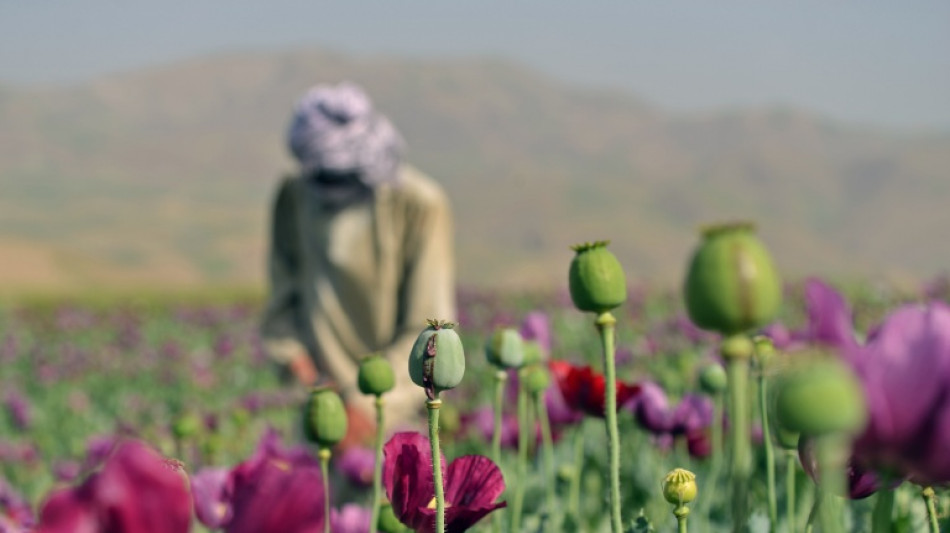
Afghanistan opium poppy cultivation surges despite Taliban govt ban: UN / Photo: © AFP
Opium poppy cultivation in Afghanistan more than quadrupled in 2026 despite a Taliban government ban, the United Nations said Thursday, urging that impoverished farmers needed alternatives to the lucrative crop.
Cultivated areas reached 43,000 hectares (around 106,200 acres), up from 10,000 hectares in 2025, while estimated opium production jumped fivefold from 300 tonnes to 1,500 tonnes, the United Nations Office on Drugs and Crime (UNODC) said in a report.
Long the world's leading producer of poppies, Afghanistan was overtaken by Myanmar after a 2022 Taliban government ban crushed the trade in the country. But rampant poverty has driven some farmers to return to the trade.
"Without opium, we cannot even afford basic food," Mohammad, a 22-year-old farmer in Afghanistan's northeast, told AFP.
Afghanistan's 2022 crackdown drove cultivated areas down from more than 200,000 hectares to 10,000 hectares in 2025.
Myanmar cultivated 53,000 hectares in 2025, with no 2026 figures available.
The Taliban authorities claim to have destroyed more than 22,000 hectares.
But UNODC said many poppy plots were concealed among cereal crops or behind walls, making them difficult to detect.
Mohammad lives with his parents in Badakhshan which has become Afghanistan's main opium poppy-growing province.
"The Taliban threaten us and do not allow us to grow opium. We cultivate it with a great deal of fear," he said, asking only to be identified by his first name.
"I want to buy a car, build a house and get married. Without opium, I cannot achieve these things," he further explained.
- 'The only way' -
In May, two people were killed in clashes that erupted as Afghan security forces moved to destroy opium poppy fields in Badakhshan.
Another 35-year-old farmer named Mohammad, who ploughs his poppy field with an ox, said: "If we grow wheat, it is not enough to sustain our lives. We are forced to grow poppies to earn a good income."
Mohammad said that he is threatened by the authorities and sometimes his crops are destroyed but he will continue.
"It is the only way to cover living expenses," he said.
One hectare of wheat generated just over $770 in 2023, compared with $10,000 for a hectare of poppy, according to UNODC.
"Opium prices slightly decreased from US$ 570 per kilogramme in 2025 to US$ 500 per kilogramme in 2026, remaining well above pre-ban levels of less than $100 per kilogramme," UNODC said in a press release.
"The fourfold increase in opium poppy cultivation shows the difficulty in sustaining decreases in illicit opium cultivation when poor farmers have no alternatives to feed their families," said UNODC Executive Director Monica Juma.
The Taliban government acknowledged that the ban was not a "sustainable and long-term solution" without alternative livelihoods and economic support for farmers.
The challenge comes as Afghanistan faces the return of 6.6 million Afghans since 2023, climate disasters, dwindling aid and banking isolation since the Taliban movement returned to power in 2021.
With support from Japan and the European Union, UNODC has funded programmes to help farmers find alternatives.
- 'International problem' -
Through the NGO Afghan Aid, Zikrullah, 35, who supports an extended family of 12 in Badakhshan, received improved wheat seeds and fertiliser.
"We're satisfied, it takes less effort than opium and we're more at ease," he told AFP, also asking to be identified only by his first name.
A third farmer named Mohammad, 30, who has converted 80 percent of his land to wheat, told AFP, that the lack of water in recent years has affected crops other than poppy.
To curb opium production sustainably, alternative crops alone are insufficient, UNODC Country Representative for Afghanistan Polleak Ok Serei told AFP in an interview in Kabul.
"Sustainable alternative livelihood requires more than thinking in terms of alternative crops," he said.
Farmers "need access to markets, including international markets through trades. They need infrastructure, roads, irrigation, storage".
UNODC estimated in 2025 that approach would require approximately $500 million, but "only 10 percent" had been funded by donors and the Taliban authorities, according to Ok Serei.
The strategy also takes time, he said.
"Thailand spent 15 years investing in alternative livelihood before starting eradicating," Ok Serei said.
The problem extends far beyond Afghanistan, he said.
"It truly is an international problem," Ok Serei added, explaining that Afghan drugs were consumed across other continents.
Afghan opium is the main source of heroin in the European Union, where approximately 850,000 people used opioids in 2024, according to the European Union Drugs Agency.
Addressing the problem requires international cooperation, the UN representative said.
Ok Serei called for a "drug demand reduction strategy, not only in Afghanistan but also outside of Afghanistan".
D.Cook--TNT