British Museum exhibition traces rise and fall of Stonehenge
A new exhibition on the Stonehenge stone circle in southern England sheds new light on its 4,500-year history, linking its declining influence to the Bronze Age population's discovery of metal working.
Opening Thursday at the British Museum in London, the exhibition called "The World of Stonehenge" traces the development of the UNESCO-protected site -- two concentric circles of huge stone blocks and lintels.
According to Celtic legends of the Middle Ages, the circle was magically created by the mythical magician Merlin.
Construction at the site was started during the Neolithic era by hunter-gatherers without metal tools and continued into the Bronze Age as metal working became widely established.
European metal workers arrived during the early Bronze Age, gradually superseding the local Neolithic population.
"Within a couple of hundred years, those people from Europe replaced the previous population by almost 95 percent," Neil Wilkin, the exhibition's curator, said.
As their culture and beliefs became dominant, Stonehenge lost its original purpose and became used as a cemetery, he added.
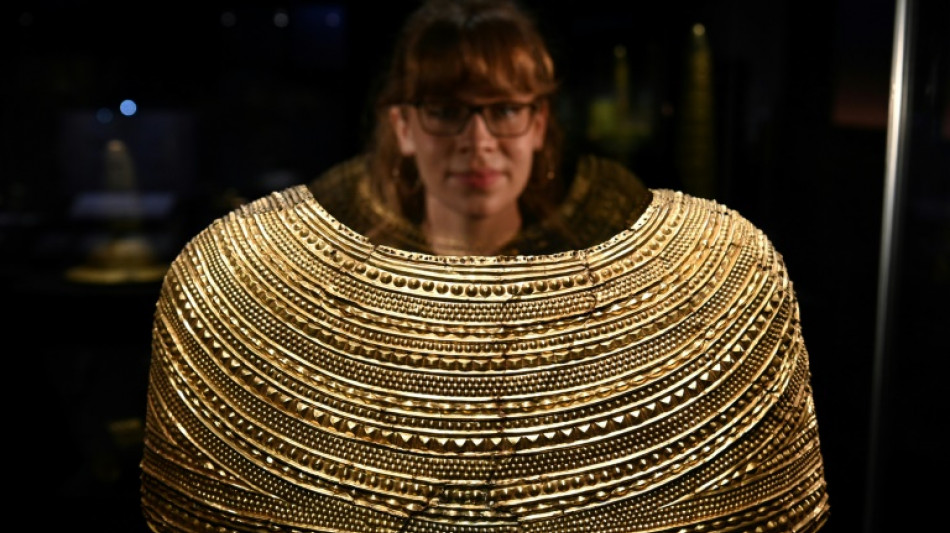
The exhibition shows numerous tombs from the time, as well as objects such as large gold necklaces made in France around 2300 BC.
The Nebra Sky Disc, the world's oldest surviving map of the stars, smelted in gold and bronze in 1600 BC in present-day Germany, is also featured.
Altogether there are more than 430 objects from the United Kingdom, Ireland, France, Germany, Denmark and Switzerland at the exhibition, which runs to July 17.
The British Museum also displays 14 wooden poles that were preserved for millennia under the sand of a beach in Norfolk, eastern England, until their discovery in 1998.
These are the remains of a wooden circle called Seahenge, on loan to the museum for the first time.
The 4,000-year-old circle once featured 54 oak piles arranged in a circle 6.6 metres in diameter, with a huge upturned tree in the centre, its roots facing skywards.
This circle would have been used for rituals in a similar way to Stonehenge, but was built five centuries later (2049 BC), using metal axes typical of the Bronze Age, said Wilkin, as the tradition of building such circles dwindled away.
"Seahenge is one of the last monuments of its type built in Britain. It's the very end of a long tradition that spans 1,000 years," he noted.
O.Nicholson--TNT