'My Name Was Poison': Donny Osmond on Fame, Failure, and Michael Jackson
Former teen idol Donny Osmond opens up about the devastating fall from grace that followed his early success, revealing how Michael Jackson once told him his name was 'poison.' Now a veteran performer, Osmond discusses his survival through career exile, his enduring friendship with Jackson, and the personal foundation that allowed him to rebuild his life and legacy decades later.
For a brief period in the early 1970s, Donny Osmond was not merely popular; he was a global phenomenon. At just 14 years old, the youngest member of the Osmonds had become the world’s teenage heartthrob, surpassing even Michael Jackson in initial solo fame. His song "Puppy Love" spent five weeks at number one in the UK, and between 1972 and 1973, he secured six Top 5 hits there, three of which reached the summit, including "The Twelfth of Never" and "Young Love." He was equally dominant in the United States. Osmond’s clean-cut image, religious upbringing, and respectful demeanor made him a marketing dream for an industry just recovering from Beatlemania. With his purple velvet cap, doleful eyes, and dazzling all-American smile, he embodied a new kind of pop star.
Osmond recalls that era with a sense of disbelief at its intensity. "You better believe it," he says when asked if he realized how big he was at the time. "Incredible. Incredible." The scale of his fame was such that in October 1973, a viewing balcony collapsed at Heathrow Airport after fans went wild upon his arrival in the UK. Shortly thereafter, BBC host David Dimbleby organized a debate on teenage "hysteria," questioning whether the Osmonds were bad for the nation’s girls and if they should be deported. Osmond’s brother Alan reminded him to cherish the moment, noting that nobody ever gets such attention. At the time, Osmond was simply enjoying it, thinking, "This is so cool."
However, his career trajectory shifted dramatically in 1974. His solo career lurched to a sudden end, and although he continued to have hits with his brothers for another year, that too collapsed. By age 18, Osmond was considered a pop has-been on two fronts. He and his sister Marie attempted a reinvention through their own television show, but ratings dropped after Osmond married. The show was cancelled in 1979. By the age of 21, his career had gone kaput for a third time, with no apparent path to recovery. It was not merely that he was no longer popular; he had become an embarrassment, even to himself.
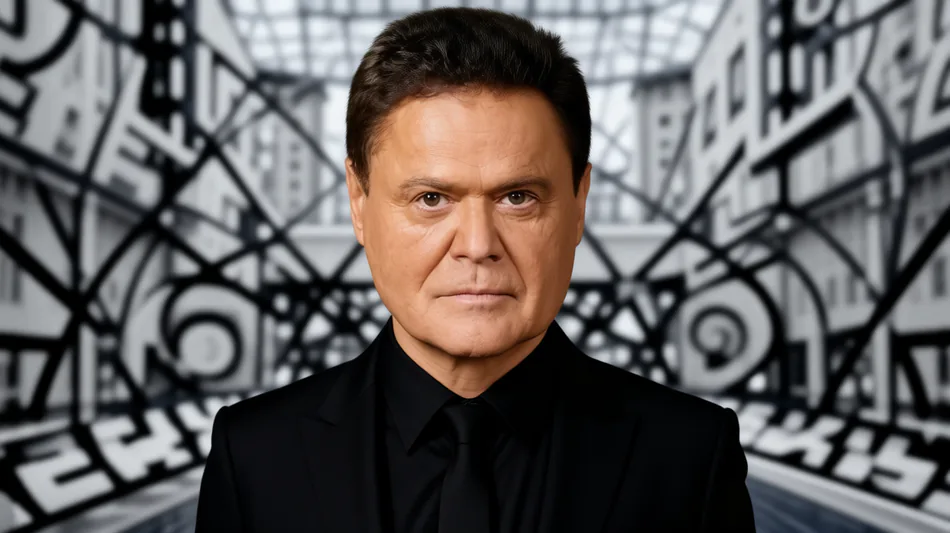
Almost half a century later, Osmond has rebuilt his life and career. He maintains a Vegas residency for six months of the year, released his 65th album a few years ago, and is preparing for a UK tour. At 68, he is a father of five boys and a grandfather 16 times over. Meeting in a London studio where he was having his photo taken, Osmond appears distinctively himself yet undeniably changed. He retains the slight build of a teenager but possesses the monumental face of a Mount Rushmore president, giving him the air of a marionette. His hair remains bluey-black and his teeth pearly white. When asked about his maintenance routine, he jokes about his hairdresser’s name being Clairol before clarifying it is a joke. He attributes his appearance to careful eating and lucky genetics, noting his mother had perfect skin. He denies having plastic surgery but admits to trying Botox 15 to 20 years ago, which he hates because it freezes his face into a "rictus grin," taking away the crow’s feet he worked hard for.
Osmond, from Ogden, Utah, entered showbiz at age five, with footage of him on the Andy Williams Show singing "You Are My Sunshine." He was the standout in the band, much like Michael Jackson was in the Jackson 5. This created a perfect symmetry between the two groups: both were five-brother bands of similar ages, with Donny and Michael as solo stars. The Jackson 5 were black, soulful, and funky; the Osmonds were white, soulful, and dabbling in hard rock. While Donny was initially the bigger solo star, the Jackson 5 eventually gained the edge, with their first four Motown singles going to number one on the US Billboard 100 in 1969 and 1970.
More than 50 years later, Osmond still feels compelled to set the record straight regarding his rivalry with the Jacksons. He insists the Osmonds were the first boyband, arguing that the Beatles do not fit the definition because they were not a boyband, and while people cite the Jackson 5, the Osmonds preceded them. He recounts the first time he met the Jackson 5 in Toronto. The Jacksons had flown in a day early to watch the Osmonds perform. Afterward, in their hotel room, the parents sat on the sofa with Osmond’s parents. The boys instinctively sought out their contemporaries: Jackie and Alan talked, Wayne and Tito talked, Jermaine and Merrill talked, Marlon and Jay talked. Donny and Michael were nowhere to be found because they were in another room playing with toys, trying to be kids at ages 13 and 14.
Osmond shares a story about Joe Jackson that has stayed with him. Joe told Osmond’s father that he used to sit his kids in front of the Andy Williams Show, pointing to the TV, and say, "You’re going to do that." When the Osmonds’ first hit, "One Bad Apple," came out, many claimed the Osmonds were copying the Jacksons. Osmond asserts it was actually the opposite.
Both groups were managed by tough, disciplinarian fathers. Joe Jackson was notorious for his violence; Michael later said he used to sit in a chair with a belt in hand while watching them practice. Osmond distinguishes his father from Joe, describing his own dad as strict but not mean. "Dad was not Joe," Osmond says. "Joe was mean. He was not a nice man." Osmond recalls visiting Michael’s house and having fun talks, but Joe did not like him there, communicating this through glares rather than words.
Standing up to his own father was difficult for Osmond. At age eight, during a tour in Sweden, he became homesick and wrote a letter to his mother asking to come home. His brother Jay snitched on him. His father told him he had to stay and do his job. Osmond now understands that going home would have ruined the tour for everyone.
Life on the road became his norm. He did not know any different because he never had a normal life to compare it to. At age 12, when "One Bad Apple" became their first number one, he decided he was going to do this for the rest of his life. It was a reluctant acceptance that turned into enthusiasm. He remembers walking on stage with his brothers and Alan introducing him, causing the place to go berserk. "It was a blast," he says.
But when the young girls fell out of love with Osmond, he was left with nothing. His religion, his songs, and his lack of cool were ridiculed by the music press. He recalls a particularly cruel quote from Rolling Stone magazine: "The worst day in rock’n’roll history was the day Donny Osmond was born." He laughs bitterly at the memory, noting he was 16 when it was written. "Devastating," he says. "I’d like to meet the guy who wrote that. Probably nothing because I’m over it. But at the time? You have no idea what you’re saying."
Osmond was never accurately described as just a bubblegum star. He moved from singing soppy ballads to joining his brothers in developing a heavy prog rock sound, most famously on "Crazy Horses." When asked if his brothers resented him for hogging the limelight and stymying their rock career, Osmond cites a conversation with brother Merrill. Merrill said there was no jealousy, but they were rock’n’rollers, and Donny’s career kept them away from the scene. Osmond notes that "Crazy Horses" is now respected, citing Ozzy Osbourne calling it his favorite rock song and Tommy Lee of Mötley Crüe praising his newer music.
By 21, Osmond had been dumped by record labels and TV stations. His name became a laughingstock. "The name Donny Osmond became a laughing stock," he says. "It is. It was. I lived with it. That was me." He coped by knowing the talent was there.
He remained friends with Michael Jackson, who was also experiencing waning early success. At that time, Osmond was still doing the Donny and Marie show, so he was probably more famous than Mike, who then "left me in the dust" as he finished "Off the Wall." Seeing Osmond’s struggles, Jackson offered radical advice. When Osmond asked how to get back on the charts, Jackson said, "You’ve got to change your name because your name is poison." Osmond admits it hurt but realized Jackson was right. "I’m living in this body so I know my name is poison," he says.
Osmond’s 20s were a terrible decade. He became persona non grata, and the Osmond brothers lost their fortune to poor investments. He credits his wife, Debbie Glenn, with saving him. They married when he was 20 and she was 19. They first met properly in Provo, Utah, when he was 16 and she was a 15-year-old cheerleader. By 21, Osmond was a father. "I found the perfect girl for me, who dated my brother first!" he jokes, referring to Jay. "They only dated twice." He says his kids and wife literally saved him from depression.
In 1984, a publicist shared by Jackson and Osmond suggested a radical way to gain street cred: plant drug paraphernalia in Osmond’s suitcase during immigration in Japan so he would be on every newspaper cover. The publicist was Norman Winter, known for an "anything goes" approach. Osmond considered it but rejected the idea of going to jail, realizing it would make him a "real person" only for 15 minutes. He asked himself what his kids and grandkids would say if he sold out for fleeting fame. He chose to do it the hard way: with music.
Jackson was proved right. Osmond, mentored by Peter Gabriel, eventually had a hit in 1989, 15 years after his last one. In Christmas 1988, he decided to quit show business to support his family. He had recorded a single called "Soldier of Love." A fan took it to radio station WPLJ in New York. Music director Jessica Ettinger loved it but refused to play it because it was Donny Osmond. She later changed her mind and played it as a "mystery artist." Osmond’s manager called with good news: he had the number one requested record on US radio, but bad news: nobody knew it was him. People thought it was George Michael. On Friday afternoon drive time, Osmond revealed his identity live on air, causing phone lines to blink.
A new, cooler Osmond emerged, wearing leather jackets instead of velvet caps. "Mike was right, my name was poison. But I figured out a way, accidentally, to detoxify it." "Soldier of Love" reached number two in the US charts, followed by "Sacred Emotion." He proved he could make a comeback.
He signed on for Andrew Lloyd Webber’s "Joseph and the Amazing Technicolor Dreamcoat" in Toronto for six months, staying for five years. He reunited with Marie for a daytime TV show, wrote his memoir, starred in the 1999 film version of "Joseph," hosted "Pyramid," and had his first UK Top 10 hit in over 30 years in 2004 with "Breeze on By." He returned to Broadway with "Beauty and the Beast," won "Dancing With the Stars" in 2009, enjoyed an 11-year Vegas residency with Marie, and has maintained a solo residency for five years. In the process, he remade his fortune.
Osmond remained friends with Jackson, who died of a drug overdose in 2009 at age 50. They had planned to record a cover of Stevie Wonder’s "I Wish." Osmond played the instrumental track for Stevie, who said it would be massive. Osmond told Jackson they had to do it. Jackson set a session for three weeks later but called a week later to postpone due to being busy. The right time never materialized.
Osmond heard from Jackson one last time, a year or so before he died. While on tour, his phone rang with a little voice saying, "Donny?" It was Michael. He said he couldn’t tell Osmond where he was but revealed he was in Phoenix, having rented a tour bus for his kids because he had to get out of LA due to allegations. Osmond offered him a weekend in Provo for normalcy, but Jackson didn’t take him up on it.
While Osmond’s personal life remained stable, Jackson’s became increasingly erratic. He had numerous surgeries, fathered three children through surrogacy and artificial insemination, was inseparable from his chimpanzee Bubbles, and admitted to sharing his bed with many children. In 2003, he was charged with child sexual abuse, maintaining the practice was non-sexual. In 2005, after a 14-week trial, he was acquitted on all counts, including child molestation and conspiracy. Before the trial, it emerged he had paid $25 million in a civil settlement to Jordan Chandler’s family.
Osmond believes pressure and expectations destroyed Jackson, not just the allegations. "Every time I’d go over, he’d be like: ‘How’s your family, tell me this, tell me that,’ because he realised I had something he didn’t have: normalcy," Osmond says. "It’s sad. We lost a genius." When asked if there was truth in the allegations, Osmond declines to comment, citing their friendship. "I’m not going to go there. I don’t want to go there. Because he was such a dear friend." He prefers to remember nicer times, like when they were 15 and ate tacos at Jack in the Box from a black limo on Sunset Boulevard.
Osmond attributes his survival to his parents, who never yelled or swore, providing a model for treating women and kindness. His faith provided spiritual stability. He also believes falling out of favor helped him reinvent himself. Over time, he has made peace with his past. When asked if he hated himself when singing old hits deliberately ruining them, he nods. "Uh-huh." But now, he is at ease. Debbie says he is more comfortable in his skin than ever.
Two of his older brothers, Wayne and Alan, have died. Eight years ago, Jimmy had a stroke while playing Captain Hook. Osmond describes it as tough but notes Jimmy is an amazing painter now and constantly says "I love you." Osmond feels it is less important to champion his personal legacy than his siblings’. He wants to highlight their role in pop history, which is why he includes "Crazy Horses" in his tour. The show also features a lottery draw where a winner sits on stage while Osmond serenades them with "Puppy Love." This time, there is no self-sabotage. It will be sung with love for the song and his old self.
If the young Donny could meet today’s Donny, he thinks the boy would say: "Can you please hold my hand through this whole thing because it’s going to be tough? You figured it out – please tell me the secret."
F.Morgan--TNT