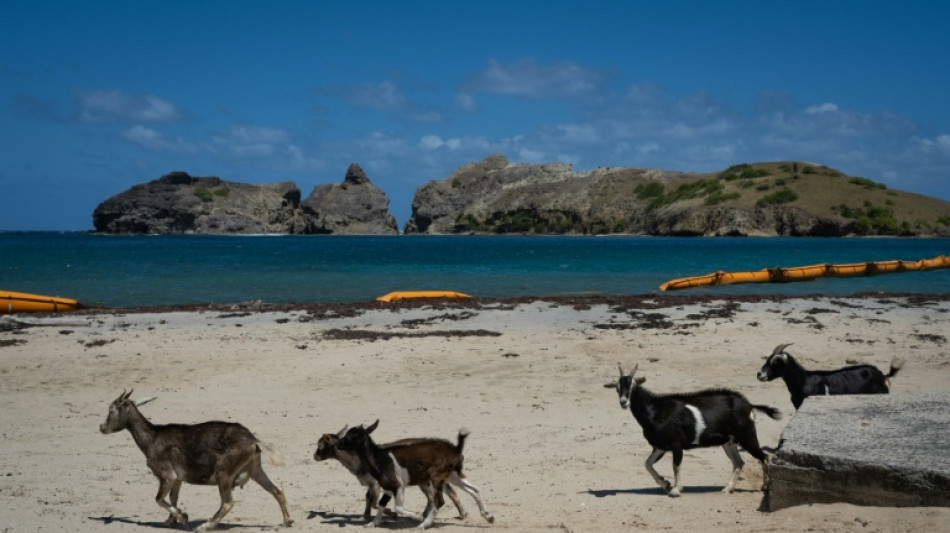
Goat vs gecko: A tiny Caribbean island faces wildlife showdown / Photo: © AFP
The tiny Caribbean island of Terre-de-Haut boasts pristine turquoise waters and deserted coves. It also has goats, hundreds of them.
There are as many goats as humans on the island and, while they charm the tourists as they roam on the beaches and graze in the gardens, there is a darker side to this uncontrolled feral herd.
They ravage protected areas, munch through vegetation and destroy the habitats of other animals -- some of which are endangered and endemic to Terre-de-Haut and other islands in Les Saintes archipelago.
Officials on the island chain, which is part of the French overseas territory of Guadeloupe, are now considering drastic action.
The animals could be shunted into designated grazing areas then, after health checks are carried out, they could be used for meat.
Marie Robert of the French Office for Biodiversity (OFB), a government body, told AFP the situation was alarming.
"On Terre-de-Haut alone, the herd is estimated at least one goat per inhabitant, or about 1,500," she said.
"They overconsume native plants, leaving all the space to more resilient invasive exotic species."
- Species at risk -
At Le Chameau, the highest point on Terre-de-Haut, the vegetation is devastated -- trees stripped bare and branches gnawed away.
Robert said the destruction wrought by the goats raised the risk of landslides and threatened animal biodiversity.
Several endemic species are particularly at risk, including the Terre-de-Haut racer snake, the Guadeloupe skink and a tiny brightly coloured gecko called Les Saintes Sphaerodactylus.
It's feared that these species, already weakened by rats and stray dogs and cats, could disappear entirely.
The OFB is tapping the EU's fund for environmental projects, the LIFE programme, to help.
It has an estimated budget of 10 million euros to protect reptiles in Guadeloupe and the nearby islands of Saint-Martin and Saint-Barthelemy, which face similar pressures.
"It involves eradicating species like rats, but also bringing goats under control," said Philippe De Proft, a coastal warden in Les Saintes for nearly 20 years.
- A new scourge? -
The goats were brought over by humans and were used for many years as the only local source of meat.
But tourism has long since displaced livestock farming as a way of life.
The goats, however, have not stopped reproducing -- a female can give birth to two or three kids several times a year.
The authorities are looking to Saint-Barthelemy for inspiration.
Goats are already being captured there and confined to grazing areas.
Officials have given an exemption from the usual rules to allow the animals to be used for meat.
"Even wild adults can be put to good use," explained Rudi Laplace, whose Island Nature Experience group organised the capture on Saint-Barthelemy.
Officials on Les Saintes are keen to follow the example, and they cannot act quickly enough as a new scourge could be on the way.
Sheep abandoned by a farmer are beginning to proliferate -- from a single pair, the flock has now grown to 25 animals.
R.Evans--TNT