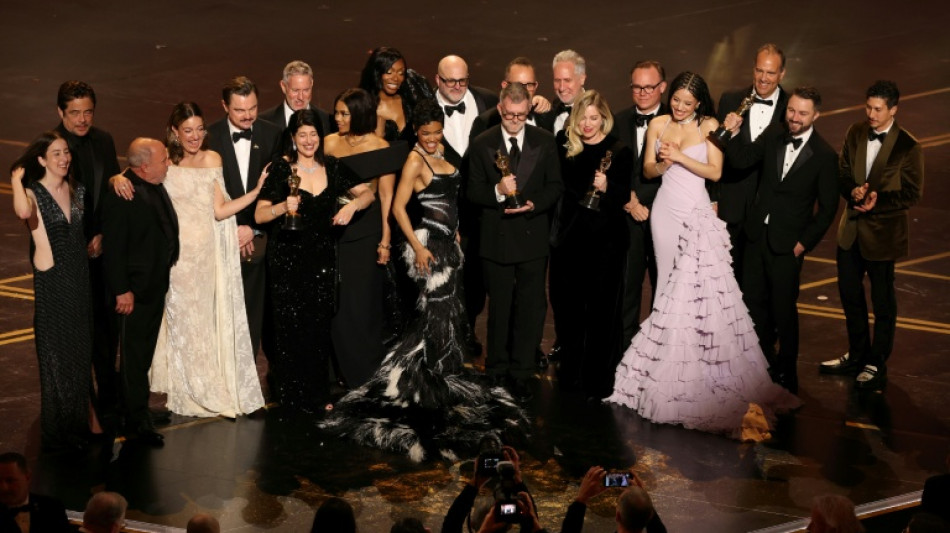
'One Battle After Another' wins best picture Oscar / Photo: © AFP
Paul Thomas Anderson's "One Battle After Another" -- a wild tale of leftist revolutionaries, white supremacists and immigrant detention centers -- felt to many filmgoers like it offered a window on modern America.
But the zany political satire -- chock full of heart-pounding car chases, gunfights and harrowing escapes -- also features romance, offbeat humor, and a touching story of a father's unconditional love for his daughter.
That potent mix earned the movie a best picture Oscar on Sunday -- and overall top honors with a total of six golden statuettes.
"The thing that gets me really excited about making films is collaborating with people," Anderson told reporters backstage.
The director rallied a cast of megawatt A-listers including past Oscar winners Leonardo DiCaprio, Sean Penn (who won again on Sunday) and Benicio Del Toro. He also got a searing breakthrough turn from Oscar nominee Teyana Taylor.
The film's Oscar success seemed preordained.
Despite Ryan Coogler's "Sinners" leading the nomination tally with a record-setting 16, "One Battle" racked up the precursor awards, from the Critics Choice Awards to the Golden Globes to the BAFTAs.
Loosely based on Thomas Pynchon's novel "Vineland," the movie follows the story of the fictional French 75, a radical leftist revolutionary group staging a series of bombings in support of liberal causes.
Their work starts to go off the rails when they rescue a group of immigrants from a facility on the US-Mexico border, and group firebrand Perfidia Beverly Hills (Taylor) makes an enemy of the fantastically named Colonel Steve Lockjaw (Penn).
Perfidia vanishes, and her explosives expert lover Pat (DiCaprio) goes into hiding with their daughter Willa (newcomer Chase Infiniti).
Lockjaw meanwhile slowly picks off each member of the French 75, and gets involved with a group of white supremacists called the Christmas Adventurers.
Cut to 16 years later, and Pat, known now as Bob Ferguson, is off the grid and in a constant state of paranoia. Lockjaw however locates him -- and isn't afraid to stage bogus immigration crackdowns to catch him.
Willa, now a teen, vanishes, but Bob, his brain addled by years of alcohol and drug use, struggles to reconnect with his revolutionary pals to find her. DiCaprio goes on a journey -- in his bathrobe and an unfortunate man bun -- to salvage his family.
"I love the idea that you expect this character's going to use massive espionage skills, but he cannot remember the password," DiCaprio told reporters in September when the film opened.
- 'It's not going away' -
Car chases in the desert haze, a teen hidden by an order of nuns called the Sisters of the Brave Beaver, Del Toro chewing the scenery as karate dojo owner (and part-time savior of immigrants) Sensei Sergio: the film is relentless, leaving the viewer on edge.
The movie dissects "how we have stopped listening to one another, and how these characters thinking or acting in these extremes can bring a lot of hurt," DiCaprio told The New York Times.
It is the first movie in two decades directed by Anderson that is set in the present day, after "There Will Be Blood," "The Master," "Inherent Vice," "Phantom Thread" and "Licorice Pizza."
But Anderson insists his statement is not particular for this moment in time.
"The biggest mistake I could make in a story like this is to put politics up in the front," the filmmaker told the Los Angeles Times last year.
"You have to care about the characters and take those big swings in terms of the emotional arcs of people... That's not a thing that ever goes out of fashion. But neither does fascism."
"I'm not trying to diminish what's happening right now," he told the paper. "But I'm also trying to say that what’s worse is that it's not going away."
A.M.Murray--TNT