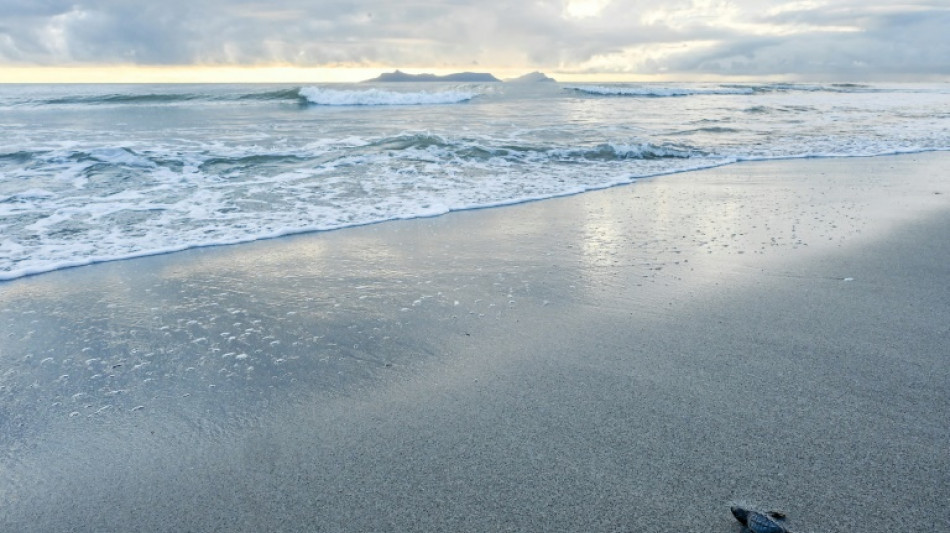
Battle to save Panama turtle at center of aphrodisiac superstition / Photo: © AFP
The sea turtles of Punta Chame, a peninsula of Panama that juts into the Pacific Ocean, face an existential threat similar to the rhino and pangolin: human superstition.
The eggs of the protected olive ridley turtle, illegally harvested from the beach, are sold door to door in town for 75 cents to $1 each for their purported aphrodisiac qualities.
"Especially men think that by eating turtle eggs they will have more sexual pleasure," said Jorge Padilla, a conservationist with the NGO Fundacion Tortuguias which collects and hatches the precious eggs.
"The eggs won't help you. They are not an aphrodisiac," he insisted.
The olive ridley (Lepidochelys olivacea) is listed as "vulnerable" on the Red List of the International Union for Conservation of Nature, with its numbers declining.
Its survival relies heavily on people like Padilla, who with village volunteers collect freshly laid eggs and bury them in sand at the nursery.
Hundreds hatch here each year between July and February. Within hours they are brought to the beach and released near the water's edge by volunteers who look on with parent-like pride as the tiny critters make a frantic dash for the ocean.
"We cannot just put them (in the water) because they have to go through a process called 'imprinting' (along the beach) that will bring them back in 18-20 years to the same beach where they were born" to lay their own eggs.
- Used for combs, clothes -
Day and night, Padilla patrols the beach to scare off poachers.
Other threats include stray dogs roaming the beaches for food, and eagles.
Padilla repels the dogs but leaves the eagles as they are natural turtle predators and part of the circle of life.
The turtles also end up as by-catch from fishing, and face threats to their nesting beaches from human encroachment and climate change.
"There are many threats to sea turtles, both in the Pacific and in the Caribbean: illegal egg harvesting, overconsumption of their meat, their shells... They are used for combs... clothing," said Padilla.
Marine turtles and their uncertain fate are on the agenda of a global wildlife summit taking place in Panama City, not far from Punta Chame with its 500 human inhabitants.
The gathering of countries under the Convention on International Trade in Endangered Species of Wild Fauna and Flora (CITES) will consider ways to combat egg theft and trafficking.
A working document on the CITES website states "the illegal harvest and trade continues to threaten marine turtles."
R.T.Gilbert--TNT