The National Times - Japan space rocket ordered to self-destruct after failed launch

Japan space rocket ordered to self-destruct after failed launch


Japan space rocket ordered to self-destruct after failed launch
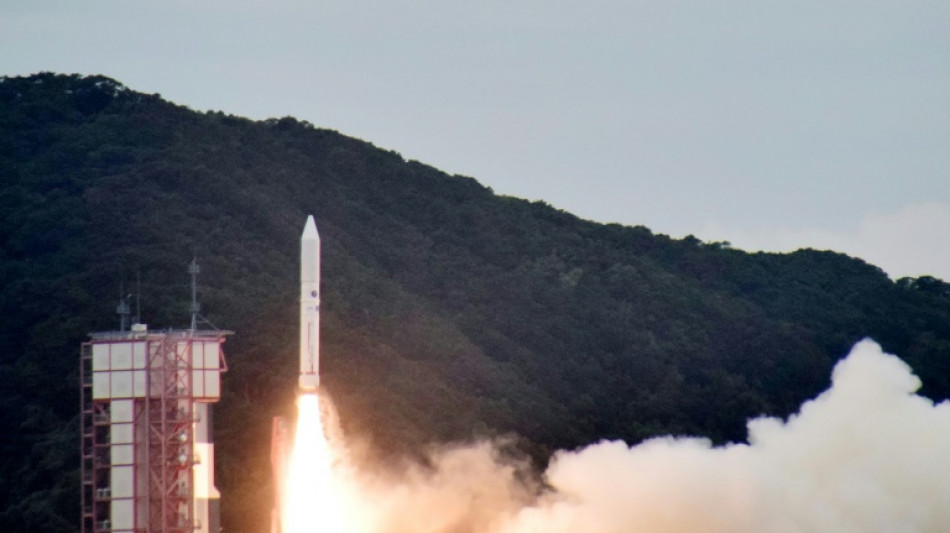
Japan space rocket ordered to self-destruct after failed launch / Photo: © JIJI Press/AFP

Japan's space agency said it sent a self-destruct order to its Epsilon rocket after a failed launch on Wednesday because of a problem that meant the craft could not safely fly.

Change text size:

The unmanned rocket, designed to launch in three stages, was taking several satellites into orbit on its sixth space mission.

"The rocket can't continue a safe flight, because of the danger it would create if it falls on the ground," a JAXA official said in comments broadcast by TBS television network.

"So we took measures to avoid such an incident, and we sent the signal (to destroy the rocket)," he said, adding that information on the problem's cause was not immediately available.

Public broadcaster NHK and other media outlets said it was Japan's first failed rocket launch since 2003.

A JAXA livestream of the launch from Uchinoura Space Center in the southern Kagoshima region was interrupted and presenters said there had been a problem, without giving details.

The solid-fuel Epsilon rocket has been in service since 2013.

It is smaller than the country's previous liquid-fuelled model, and a successor to the solid-fuel "M-5" rocket that was retired in 2006 due to its high cost.

One of the satellites being carried by the rocket, called RAISE-3, had been due to orbit the Earth for at least a year, according to a NASA article about the launch.

C.Bell--TNT

Featured

Mysterious world beyond Pluto may have an atmosphere: astronomers

A tiny, little-known world beyond Pluto appears to have an atmosphere, Japanese astronomers said Monday, defying what had been thought possible for icy objects in our cosmic backyard.

Datavault AI and CyberCatch Announce Signing of Binding Letter of Intent for Datavault AI to Acquire CyberCatch to Accelerate AI-Driven, Quantum-Resistant Cyber Risk Mitigation Solutions

Strategic acquisition is anticipated to position Datavault AI to bring CyberCatch's AI-enabled cyber risk mitigation solution into Datavault AI's SanQtum-secured edge Graphics Processing Unit ecosystem, addressing a global information security market projected to reach $240 billion in 2026 (Gartner)CyberCatch's post-quantum cryptography conversion plan is also expected to position the combined company ahead of the AI-enabled "Q-Day" quantum-attack horizon, now compressed to as early as 2029 (Google)AI-enabled adversary attacks in 2025 rose 89% year-over-year while average eCrime breakout time fell to 29 minutes, a 65% increase in adversary speed compared to 2024, per CrowdStrike's 2026 Global Threat Report, and Google Quantum AI research has now compressed the timeline for cryptographically relevant quantum computing to as early as 2029.

Apple earnings beat forecasts on iPhone 17 demand

Apple on Thursday said it had its best start to the year ever when it came to earnings, with iPhone demand and digital service sales helping it beat expectations.

Musk grilled on AI profits at OpenAI trial

Elon Musk sparred with lawyers for a third day Thursday at his California trial against OpenAI, struggling to explain why his own for-profit AI empire differs from the one he is trying to take down.

Change text size: