The National Times - Webb telescope captures its first image of exoplanet

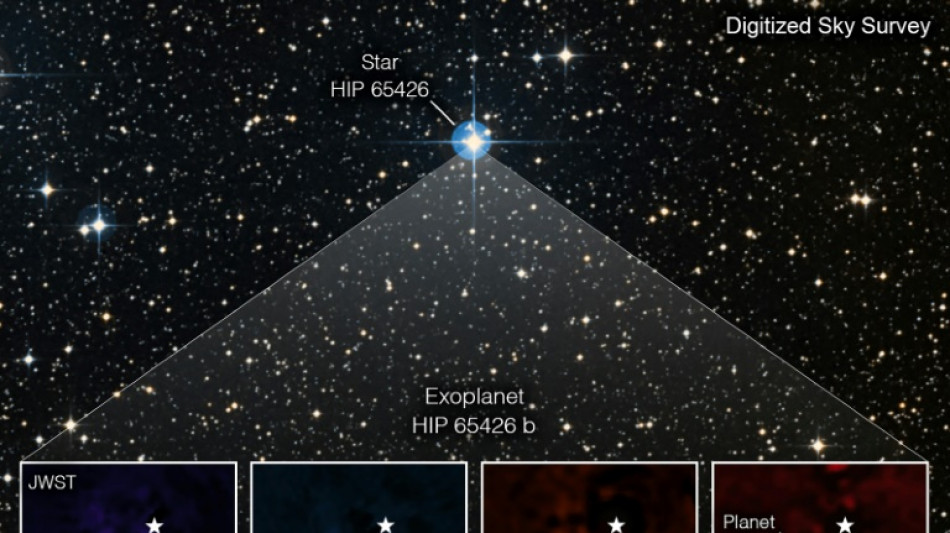
Webb telescope captures its first image of exoplanet


Webb telescope captures its first image of exoplanet
Webb telescope captures its first image of exoplanet / Photo: © NASA/ESA/AFP

The James Webb space telescope has taken its first image of an exoplanet -- a planet outside our solar system -- as astronomers hail the device's performance since its launch last year.

Change text size:

Images from the most powerful space telescope ever built have thrilled observers in recent months as it orbits the Sun a million miles (1.6 million kilometers) from Earth.

Its latest pioneering pictures show the exoplanet, called HIP 65426 b, is a gas giant with no rocky surface and could not be habitable.

"This is a transformative moment, not only for Webb but also for astronomy generally," said Sasha Hinkley, astronomy professor at the University of Exeter, who led the observation team.

Webb's infrared gaze and coronagraphs -- telescopic attachments that block out starlight -- enable it to take direct images of exoplanets.

"It was really impressive how well the Webb coronagraphs worked to suppress the light of the host star," Hinkley said in a NASA statement on Thursday.

The HIP 65426 b exoplanet is six to 12 times the mass of Jupiter and young -- about 15 to 20 million years old, compared to the 4.5-billion-year-old Earth.

The telescope, which only released its first images in July, has already revealed dazzling new detail of the Phantom Galaxy and of the planet Jupiter.

The Hubble space telescope previously captured direct exoplanet images, but in far less detail.

"I think what's most exciting is that we've only just begun," said Aarynn Carter, of the University of California. "We may even discover previously unknown planets."

The $10-billion Webb telescope is a collaboration between NASA, the European Space Agency and the Canadian Space Agency. It is expected to operate for approximately 20 years.

S.M.Riley--TNT

Featured

Mysterious world beyond Pluto may have an atmosphere: astronomers

A tiny, little-known world beyond Pluto appears to have an atmosphere, Japanese astronomers said Monday, defying what had been thought possible for icy objects in our cosmic backyard.

Datavault AI and CyberCatch Announce Signing of Binding Letter of Intent for Datavault AI to Acquire CyberCatch to Accelerate AI-Driven, Quantum-Resistant Cyber Risk Mitigation Solutions

Strategic acquisition is anticipated to position Datavault AI to bring CyberCatch's AI-enabled cyber risk mitigation solution into Datavault AI's SanQtum-secured edge Graphics Processing Unit ecosystem, addressing a global information security market projected to reach $240 billion in 2026 (Gartner)CyberCatch's post-quantum cryptography conversion plan is also expected to position the combined company ahead of the AI-enabled "Q-Day" quantum-attack horizon, now compressed to as early as 2029 (Google)AI-enabled adversary attacks in 2025 rose 89% year-over-year while average eCrime breakout time fell to 29 minutes, a 65% increase in adversary speed compared to 2024, per CrowdStrike's 2026 Global Threat Report, and Google Quantum AI research has now compressed the timeline for cryptographically relevant quantum computing to as early as 2029.

Apple earnings beat forecasts on iPhone 17 demand

Apple on Thursday said it had its best start to the year ever when it came to earnings, with iPhone demand and digital service sales helping it beat expectations.

Musk grilled on AI profits at OpenAI trial

Elon Musk sparred with lawyers for a third day Thursday at his California trial against OpenAI, struggling to explain why his own for-profit AI empire differs from the one he is trying to take down.

Change text size: