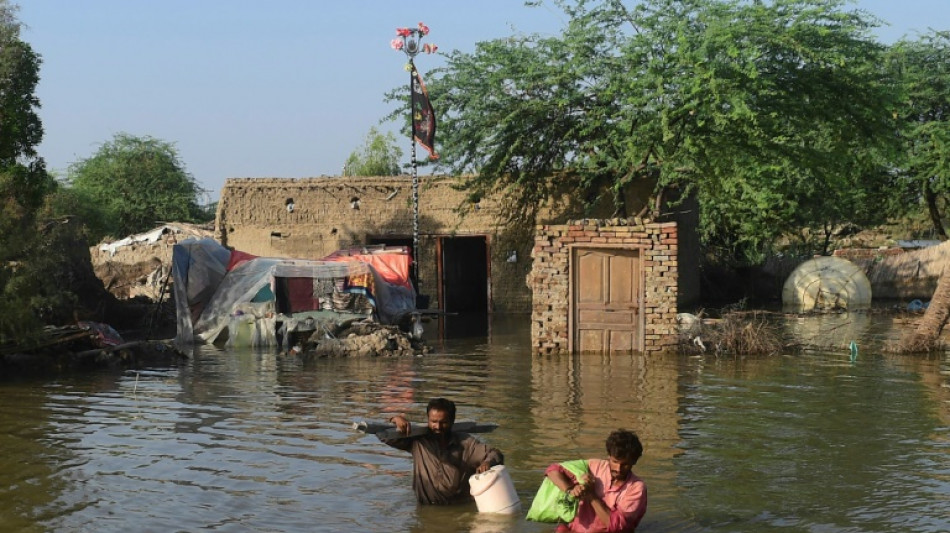
Misery mounts for millions in Pakistan's 'monsoon on steroids' / Photo: © AFP
Army helicopters flew sorties over cut-off areas in Pakistan's mountainous north Wednesday and rescue parties fanned out across waterlogged plains in the south as misery mounted for millions trapped by the worst floods in the country's history.
Monsoon rains have submerged a third of Pakistan, claiming at least 1,160 lives since June and unleashing powerful floods that have washed away swathes of vital crops and damaged or destroyed more than a million homes.
United Nations chief Antonio Guterres called it "a monsoon on steroids" as he launched an international appeal late Tuesday for $160 million in emergency funding.
Officials say more than 33 million people are affected -- one in every seven Pakistanis -- and it will cost more than $10 billion to rebuild.
The focus for now, however, is reaching tens of thousands still stranded on hills and in valleys in the north, as well as remote villages in the south and west.
"We appeal to the government to help end our miseries at the soonest," said Mohammad Safar, 38, outside his submerged home Wednesday in Shikarpur in the southeastern province of Sindh.
"The water must be drained out from here immediately so we can go back to our homes."
There is so much water however that there is nowhere for it to drain.
Climate Change Minister Sherry Rehman described the country as "like a fully soaked sponge", incapable of absorbing any more rain.
- 'Burning with pain' -
Pakistan has received twice its usual monsoon rainfall, weather authorities say, but Balochistan and Sindh provinces have seen more than four times the average of the last three decades.
Padidan, a small town in Sindh, has been drenched with an astonishing 1.75 metres (70 inches) since June.
Pakistan receives heavy -- often destructive -- rains during its annual monsoon season, which are crucial for agriculture and water supplies, but such intense downpours have not been seen for three decades.
Officials have blamed climate change, which is increasing the frequency and intensity of extreme weather around the world.
Earlier this year much of the nation was in the grip of a drought and heatwave, with temperatures hitting 51 degrees Celsius (124 Fahrenheit) in Sindh province.
The latest disaster could not have come at a worse time for Pakistan, where the economy is in free fall.
Pakistan Prime Minister Shehbaz Sharif promised aid donors that any funding would be responsibly spent.
"I want to give my solemn pledge and solemn commitment... every penny will be spent in a very transparent fashion. Every penny will reach the needy," he said.
Pakistan was already desperate for international support and the floods have compounded the challenge.
Prices of basic goods -- particularly onions, tomatoes and chickpeas -- are soaring as vendors bemoan a lack of supplies from the flooded breadbasket provinces of Sindh and Punjab.
Makeshift relief camps have sprung up all over Pakistan -- in schools, on motorways and in military bases.
Displaced people are sweltering in the summer heat with sporadic food aid and little access to water.
In Sindh, doctors treated patients who made their way to a makeshift clinic after walking barefoot through dirty floodwater, mud and streets full of debris and manure.
"My child's foot is burning with pain. My feet too," said Azra Bhambro, a 23-year-old woman who had come to the clinic for help.
In the northwestern town of Nowshera, a technical college was turned into a shelter for up to 2,500 flood victims.
Aid flights have arrived in recent days from China, Turkey and the United Arab Emirates, while other countries including Canada, Australia and Japan have also pledged assistance.
S.Collins--TNT