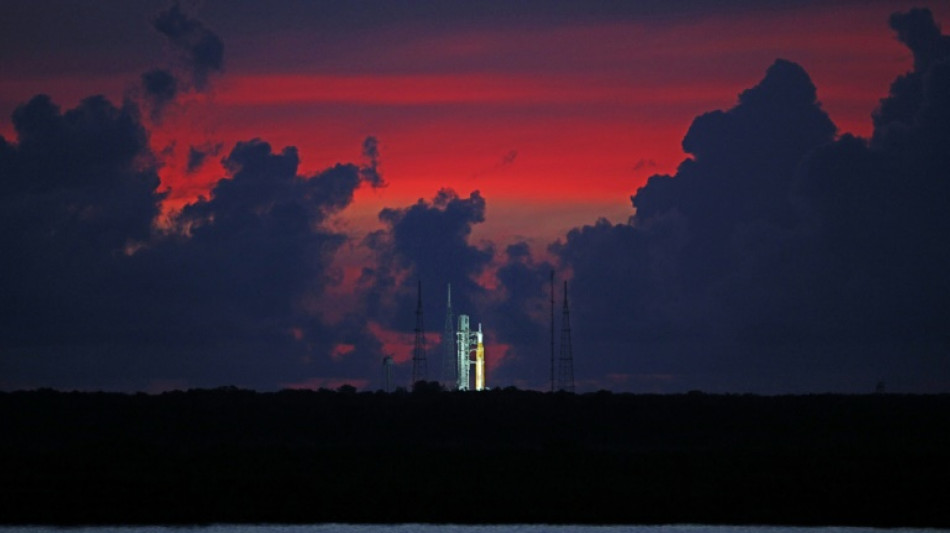
All systems go for Artemis 1 mission to Moon / Photo: © AFP/File
Fifty years after the last Apollo mission, the Artemis program is poised to take up the baton of lunar exploration with a test launch on Monday of NASA's most powerful rocket ever.
The goal is to return humans to the Moon for the first time since the last Apollo mission in 1972 -- and eventually to Mars.
The 322-foot (98-meter) Space Launch System (SLS) rocket is scheduled to blast off at 8:33 am (1233 GMT) from the Kennedy Space Center (KSC) in Florida.
The mission, more than a decade in the planning, may be uncrewed, but is highly symbolic for NASA, which has been under pressure from China and private rivals such as SpaceX.
Hotels around Cape Canaveral are booked solid with between 100,000 and 200,000 spectators expected to attend the launch.
The massive orange-and-white rocket has been sitting on KSC's Launch Complex 39B for a week.
"Ever since we rolled out to the pad last week, you can feel the excitement, the energy," said Janet Petro, director of KSC. "It's really, really palpable."
The objective of the flight, baptized Artemis 1, is to test the SLS and the Orion crew capsule that sits atop the rocket.
Mannequins equipped with sensors will take the place of crew members, recording acceleration, vibration and radiation levels.
Cameras will capture every moment of the 42-day trip and include a selfie of the spacecraft with the Moon and Earth in the background.
- Splashdown in Pacific -
The Orion capsule will orbit around the Moon, coming within 60 miles (100 kilometers) at its closest approach and then firing its engines to get to a distance 40,000 miles beyond, a record for a spacecraft rated to carry humans.
One of the primary objectives of the mission is to test the capsule's heat shield, which at 16 feet in diameter is the largest ever built.
On its return to the Earth's atmosphere, the heat shield will have to withstand a speed of 25,000 miles per hour and a temperature of 5,000 degrees Fahrenheit (2,760 degrees Celsius).
Orion, its descent slowed by parachutes, will end its voyage with a splashdown off the coast of San Diego in the Pacific.
Monday's liftoff will be at the mercy of the weather, which can be unpredictable in Florida at this time of year, and NASA has built in a two-hour launch window.
If the rocket is unable to take off on Monday, September 2 and 5 have been penciled in as alternative flight dates.
Otherwise, it's all systems go.
NASA gave the green light for the mission on Tuesday after a detailed inspection known as a flight readiness review.
That doesn't mean things can't go wrong with a rocket and a capsule flying for the first time.
- 'Inherent risk' -
"We're doing something that is incredibly difficult to do and does carry inherent risk in it," said Mike Sarafin, the Artemis 1 mission manager.
Because it is an uncrewed flight, Sarafin said the mission will continue in conditions that would not be acceptable for a flight with astronauts.
"If we had a failed solar array deployment we would proceed, and that is something that we wouldn't necessarily do on a crewed flight," he said.
A complete failure would be devastating for a program that is costing $4.1 billion per launch and is already running years behind schedule.
The next mission, Artemis 2, will take astronauts into orbit around the Moon without landing on its surface. The crew of Artemis 3 is to land on the Moon in 2025 at the earliest.
While the Apollo astronauts who walked on the Moon were exclusively white men, the Artemis program plans to include the first woman and person of color.
And since humans have already visited the Moon, Artemis has its sights set on another lofty goal -- an eventual crewed mission to Mars.
Gateway would serve as a staging and refueling station for a voyage to Mars that would take a minimum of several months.
"I think it's going to inspire even more than Apollo did," Bob Cabana, associate NASA administrator and a former astronaut, said of Artemis. "It's going to be absolutely outstanding."
K.M.Thompson--TNT