The National Times - James Webb telescope captures stunning images of Jupiter

James Webb telescope captures stunning images of Jupiter


James Webb telescope captures stunning images of Jupiter
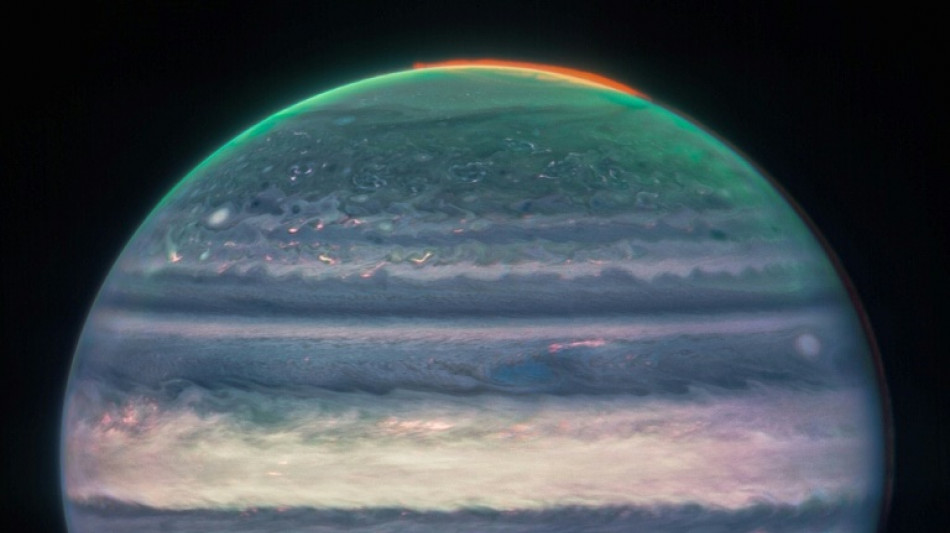
James Webb telescope captures stunning images of Jupiter / Photo: © NASA/AFP

NASA's James Webb Space Telescope has captured stunning images of the planet Jupiter showing two tiny moons, faint rings and auroras at the northern and southern poles.

Change text size:

"We hadn't really expected it to be this good, to be honest," said planetary astronomer Imke de Pater of the University of California, Berkeley.

"It's really remarkable that we can see details on Jupiter together with its rings, tiny satellites, and even galaxies in one image," she said.

De Pater headed the observations of Jupiter, the largest planet in our solar system, with Thierry Fouchet of the Paris Observatory.

The composite images were taken with the observatory's Near-Infrared Camera (NIRCam) and were artificially colored because infrared light is not visible to the human eye.

The auroras above the northern and southern poles of Jupiter have been mapped in redder colors while the Great Red Spot, a storm bigger than Earth, appears white.

One image shows Jupiter's faint rings and its moons Amalthea and Adrastea.

Launched in December 2021 from French Guiana on an Ariane 5 rocket, Webb is orbiting the Sun at a distance of a million miles (1.6 million kilometers) from Earth, in a region of space called the second Lagrange point.

It took the spacecraft almost a month to reach the region, where it remains in a fixed position behind the Earth and Sun to give it a clear view of the cosmos.

The Webb telescope is an international collaboration between the US space agency NASA, the European Space Agency, and the Canadian Space Agency, involving more than 10,000 people.

N.Johns--TNT

Featured

Mysterious world beyond Pluto may have an atmosphere: astronomers

A tiny, little-known world beyond Pluto appears to have an atmosphere, Japanese astronomers said Monday, defying what had been thought possible for icy objects in our cosmic backyard.

Datavault AI and CyberCatch Announce Signing of Binding Letter of Intent for Datavault AI to Acquire CyberCatch to Accelerate AI-Driven, Quantum-Resistant Cyber Risk Mitigation Solutions

Strategic acquisition is anticipated to position Datavault AI to bring CyberCatch's AI-enabled cyber risk mitigation solution into Datavault AI's SanQtum-secured edge Graphics Processing Unit ecosystem, addressing a global information security market projected to reach $240 billion in 2026 (Gartner)CyberCatch's post-quantum cryptography conversion plan is also expected to position the combined company ahead of the AI-enabled "Q-Day" quantum-attack horizon, now compressed to as early as 2029 (Google)AI-enabled adversary attacks in 2025 rose 89% year-over-year while average eCrime breakout time fell to 29 minutes, a 65% increase in adversary speed compared to 2024, per CrowdStrike's 2026 Global Threat Report, and Google Quantum AI research has now compressed the timeline for cryptographically relevant quantum computing to as early as 2029.

Apple earnings beat forecasts on iPhone 17 demand

Apple on Thursday said it had its best start to the year ever when it came to earnings, with iPhone demand and digital service sales helping it beat expectations.

Musk grilled on AI profits at OpenAI trial

Elon Musk sparred with lawyers for a third day Thursday at his California trial against OpenAI, struggling to explain why his own for-profit AI empire differs from the one he is trying to take down.

Change text size: