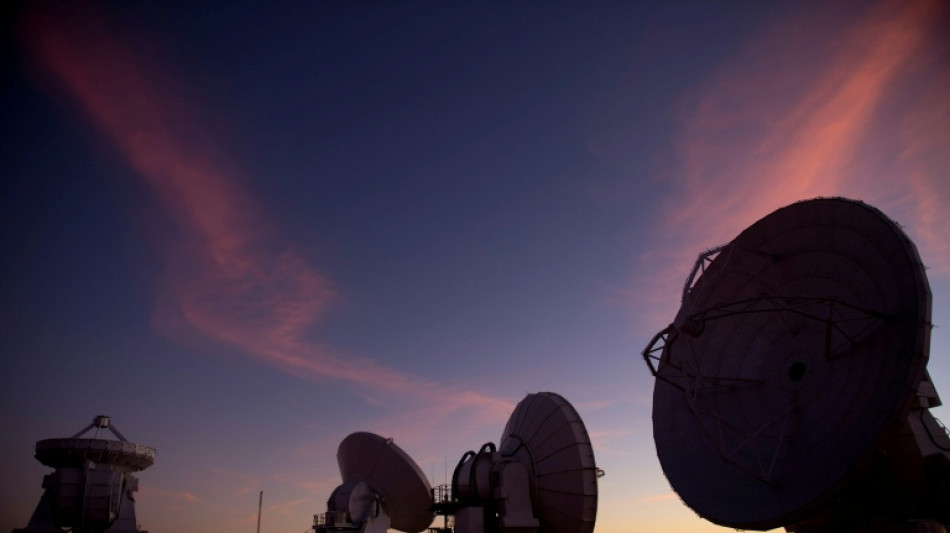
Planned 1.7 million satellites 'devastating' for astronomy: study / Photo: © AFP/File
The 1.7 million satellites that companies are aiming to launch into Earth's orbit in the coming years will have "devastating consequences for astronomy", new research warned Wednesday.
The plans to swarm Earth with huge, extremely bright satellites represent an "existential threat" to telescopes viewing the universe, according to the European Southern Observatory (ESO) which conducted the research.
To retain humanity's ability to properly explore the night sky, the team of researchers called for a maximum limit of 100,000 satellites orbiting Earth.
The study is the first to calculate how much the constellations of big and particularly bright satellites being planned would impact astronomical observations by making the night sky brighter.
The number of satellites orbiting Earth has now reached 14,000 after surging in recent years, many of them part of trillionaire Elon Musk's Starlink internet constellation.
But that is just the start.
Musk's SpaceX company has announced plans to launch more than one million satellites by 2028 to serve as data centres powering the artificial intelligence boom.
Other projects such as the "Cinnamon" plans of start-up E-Space and Chinese constellations CTC-1 and CTC-2 would add hundreds of thousands more satellites spinning around our planet.
And US startup Reflect Orbital hopes to launch 50,000 huge satellites that use giant mirrors to point sunlight back down to Earth, with the aim of providing light during the night.
In total, more than 1.7 million satellites could soon be lighting up the night sky, obscuring or blotting out the view of ground-based telescopes.
- Night sky four times brighter -
"When a satellite crosses what we observe, it makes a bright streak on our image, zapping whatever is behind it," said ESO astronomer Olivier Hainaut, who led the study published in Astronomy & Astrophysics.
"For the past few years, this has been happening -- but it is still manageable," Hainaut told AFP.
"But if we go from 14,000 to 1.7 million, we are really going to have problems."
The Reflect Orbital satellites pose a particularly significant threat to dark skies.
Even when their mirrors are not pointed at the observer, the light they scatter will make each one as bright as Venus -- which is known as the "morning star", Hainaut said.
The researchers determined that almost all images captured by the largest camera ever built -- part of the new Vera C. Rubin Observatory in Chile -- would be rendered unusable.
Whether you were in France, the Sahara Desert or Chile, the sky "would no longer be clear, resembling instead the sky seen in the suburbs of a city," he warned.
And in light-polluted cities, the satellites "would be the only 'stars' visible in the night sky," according to the ESO.
All 50,000 Reflect Orbital satellites would also make the whole night sky up to four times brighter, it added.
- 'Ball in FCC's court' -
Hainaut called for the number of orbiting satellites to be limited to 100,000 -- and that they be made dim enough to be invisible to the naked eye.
Reflect Orbital and SpaceX are awaiting a decision from the US Federal Communications Commission (FCC) about whether they can launch their constellations.
The new study served as the basis for the ESO's response to their applications, in collaboration with the UK's Royal Astronomical Society and the International Astronomical Union.
"The ball is now in the FCC's court," the ESO's institutional affairs officer Betty Kioko said in a statement.
"For optical astronomy, this is an existential threat, and we hope that the regulators will share that view."
The light pollution created by constellations of very bright satellites is not just a problem for astronomers.
The loss of dark sky has been found to disrupt the biological clocks of humans and animals -- and interfere with ecosystems.
There is also the energy and environmental impact of launching nearly two million satellites into space.
And there are concerns that huge amounts of space debris from satellites could increasingly crash into each other in a dangerous chain reaction known as "Kessler syndrome".
P.Sinclair--TNT