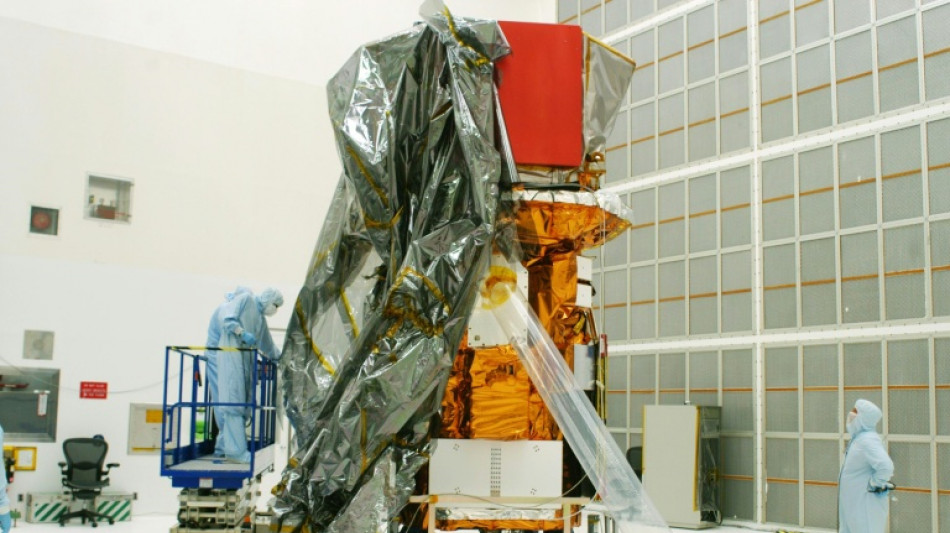
NASA robot mission aiming to rescue space telescope / Photo: © NASA/AFP
NASA on Tuesday is set to launch a daring robotic rescue mission, a long shot bid to prevent one of its aging telescopes from vanishing into dust.
If successful, the effort could pave the way for giving other satellites a second life.
The operation is set to last several months, kicking off with the launch of a robot designed to rescue the Swift space telescope that's currently falling towards Earth.
Without intervention, Swift is expected to soon burn up in the atmosphere.
The rescue spacecraft developed by the US startup Katalyst is slated to lift off Tuesday at 1023 GMT from a Pacific Ocean atoll aboard a small rocket named Pegasus.
The rocket-propelled launch vehicle will not take off from a launch pad. Instead, it will be released from a jet.
"Everything about this mission is so crazy," said NASA astrophysicist Regina Caputo with a laugh during an interview with AFP.
After it reaches an orbit near that of the telescope, the robot must locate Swift across the vastness of space.
The aim is then for the robot to maneuver around the telescope and latch on with three movable arms.
It will then vie to tow Swift into a stable orbit over the course of at least a month, rescuing it from destruction by moving it about 300 kilometers higher.
"This is a lot of firsts stacked on top of each other," said Shawn Domagal-Goldman, the director of NASA's astrophysics division, during a recent call with reporters.
"I'm just deeply thankful that we're even giving this a go."
- 'Special' telescope -
The idea of such a rescue might seem odd at first glance.
The Neil Gehrels Swift Observatory telescope was launched in 2004, and was originally designed for a two-year mission.
The device was intended to study gamma-ray bursts, what Caputo called "the most energetic things that happen in the universe."
She likened it to a supercharged version of a supernova, which is a dramatic, explosive death of a star.
Gamma-ray bursts are extremely brief, she explained, so the telescope was placed at an altitude of approximately 600 kilometers in low Earth orbit, so it could remain in constant communication with researchers.
But with that pro came a con -- at such an altitude, the device without its own propulsion would eventually drift closer to Earth and burn up in the atmosphere.
Caputo said that phenomenon was expected and normal, because when the Sun is in its more active cyclical stages, it emits more particles and causes an expansion of Earth's atmosphere.
That creates drag, meaning satellites in low Earth orbit lose altitude.
Yet when forecasts in early 2025 indicated the telescope was nearing the end of its life, NASA began considering a possible rescue.
"We decided, yeah, we want to go save this one this time, because of how special it is," said Domagal-Goldman.
- '50-50' -
Despite its age, the Swift telescope remains in high demand within the scientific community, not least for its rapid response capabilities.
Should it burn up, it could not be immediately replaced.
The mission attempting unprecedented maneuvers has a projected cost of $30 million to save the device, which originally cost $250 million.
The rescue robot named LINK will have to overcome numerous challenges and unknowns.
For example, engineers do not have a clear picture of what the back of the telescope actually looks like -- even though that's where the robot must latch on.
With a laugh, Caputo projected the chances of success at "maybe 50-50."
Still, both NASA and the company Katalyst believe the mission -- which could run into the fall -- might pave the way for new possibilities in spacecraft management, and is worth a shot.
Robert Lamontagne, a vice president at Katalyst, said during a call with journalists that it could represent the "start of a new model" to "refuel, reposition, repurpose, repair, and even upgrade satellites, even if they were never prepared for it."
T.Ward--TNT