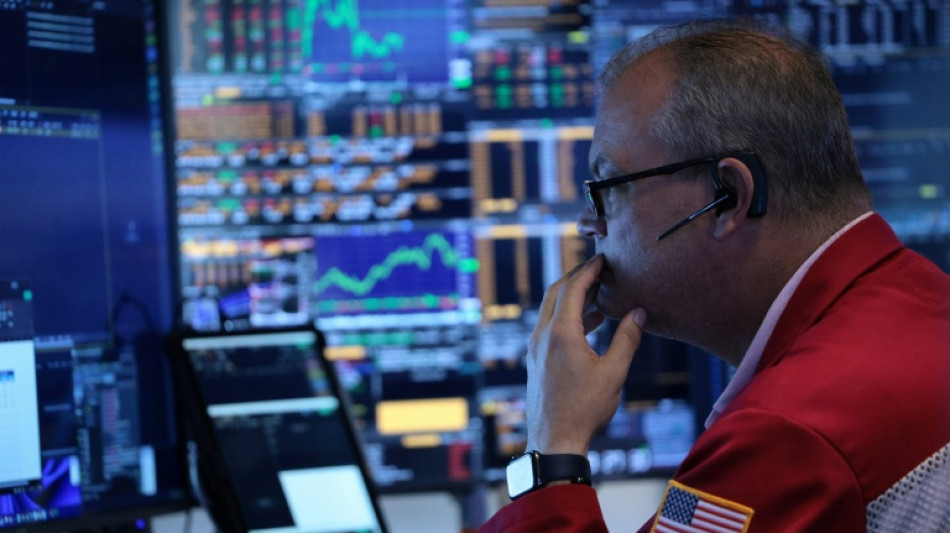
Should we fear an AI bubble bust? / Photo: © GETTY IMAGES NORTH AMERICA/AFP
Recent swings in tech stocks are reviving fears of an AI bubble -- and some experts warn that if it pops, the fallout could be bigger than anything Wall Street has ever seen.
- Bubble or no bubble? -
"There are many indications that we are in a bubble," said Itay Goldstein, a finance professor at the University of Pennsylvania's Wharton School.
"It seems likely that there is overpricing," he added.
The numbers back him up. The five biggest companies on Wall Street -- all tech giants -- are worth a combined $18 trillion, almost the size of China's entire economy.
Big tech has been pouring money into AI and now investors are getting nervous: will any of it actually pay off?
Six months ago, these same companies were buying back their own shares -- a move that signals excess cash and drives up the stock price.
Now they're taking on debt to fund their AI buildout in a significant reversal.
"The amount of debt that's being taken on is still relatively modest," said Brent Fredberg, director of investments at Brandes Investment Partners.
But a rise in interest rates -- recently floated by the US Federal Reserve -- could make that borrowing a lot more painful.
Fresh off its blockbuster IPO, space and AI giant SpaceX announced this week it plans to issue $25 billion in bonds, raising new doubts about its financial health.
The news sent its share price lower.
Analysts also warn of "circular financing" -- where big tech companies invest in AI startups, which then use that money to buy big tech's own products and services.
"This can lead to problems down the road," Fredberg said, calling out a potential house of cards.
- Early signs of a pop? -
Tech stocks took a beating this week, reigniting old fears about an AI meltdown.
But not everyone is sounding the alarm. Some say the recent selloff is just a breather after a long run-up and not the start of a real crash.
"The recent volatility reflects a valuation test, profit-taking and flow-driven positioning amid higher rates -- not a fundamental break," wrote Christian Stocker, a director at UniCredit, in a recent note.
Still, some warning signs are hard to ignore.
Oracle -- one of the biggest names in software and cloud computing -- just had its worst week since the dot-com bust of the early 2000s, with shares down 19 percent in five days.
For comparison: during the dot-com crash in August 2001, Oracle fell 20 percent, according to CNBC.
"The market is very skittish," Fredberg said.
- An unprecedented crisis -
If the AI bubble does burst, the consequences could be historic.
"We're talking about the biggest firms that are traded in the financial markets," Goldstein said. "If they are taking a hit, that will certainly be felt across the board."
The dot-com bust more than 25 years ago was bad -- but it mostly wiped out smaller companies. A crash today would directly hit some of the largest corporations on earth.
Still, there is less wild speculation right now than in the late 1990s tech frenzy, Fredberg said.
But a severe tech crash would still send shockwaves through the whole economy -- including for everyday Americans.
A huge portion of the US population holds stocks, either directly or through retirement accounts like 401(k)s. If Wall Street tanks, so would the financial security of millions of people.
E.Reid--TNT