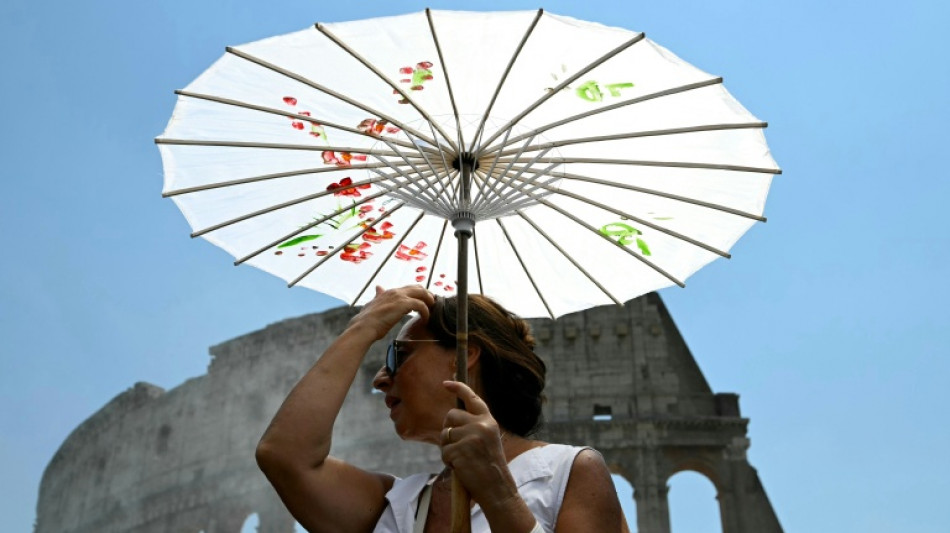
Europe heatwave shattering temperature records: UN / Photo: © AFP
Europe's heatwave has smashed several temperature records, the UN's weather and climate agency said Friday, adding that it would determine the full impact once the phenomenon has ended.
The World Meteorological Organization said the heat levels currently being experienced across the continent would be more typical of late July and August.
"A widespread intense late June heatwave in Europe... has shattered numerous temperature records," WMO spokeswoman Clare Nullis told a press conference in Geneva.
"It's having major impacts on human health, on ecosystems, on agriculture, on labour productivity, and it's accompanied in some areas, in particular France, by worsening drought and the risk of wildfires, as well as localised storms.
"We're supporting coordinated heat health action plans to try to save lives -- as always, that's the top priority -- and to inform decisions to minimise economic damage and the very real disruption that we're seeing."
The deadly European heatwave was forecast to shift east on Friday, choking 150 million people with temperatures of 35C.
Nullis said the heat was expected to increasingly shift from western Europe towards central Europe and the Balkans by the end of the month.
"We need to get used to it, unfortunately," she said.
- Hot air funnel -
John Kennedy, the WMO's climate information chief, said that as there was no specific definition of a heatwave, it was therefore hard to describe one as record-breaking across the board.
"We can say locally that records have been broken," he said.
"This is a record-breaking heatwave in many ways -- but not in every single way."
Nullis added: "It's possible that at the end of summer, we can look back and say, yes, it was a record-breaking heatwave; but it's still very much in progress."
Kennedy said several factors have to come together for temperatures to reach record extremes.
He said high pressure over Europe was funnelling hot air north from northern Africa, with the weather system hindering cloud formation.
"These kinds of blocks can stay in place for days or even weeks, and the persistence of the block means that the heat can build, day upon day -- and, crucially, the impact night upon night," he said, when the body should be cooling down.
Kennedy added that Europe had warmed by around 2C in the 50 years since the 1976 major heatwave, with "high confidence there is a human contribution to that observed warming".
"Heat waves like this are what we expect to see in a changing climate," he said.
"Extreme heat will occur more frequently, for longer duration and with greater intensity as global warming continues."
H.Davies--TNT