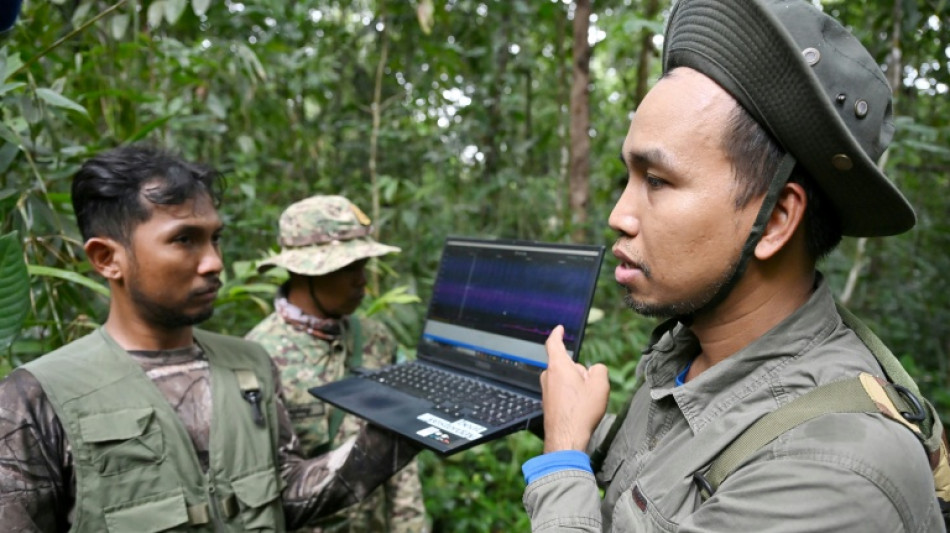
Secret cameras, mics and AI reveal rare Cambodia wildlife / Photo: © AFP
Above the patter of rain cascading through the jungle canopy comes the haunting call of a pileated gibbon singing to fend off intruders in Cambodia's Cardamom Mountains.
It is being recorded as part of work harnessing hidden microphones, cameras and artificial intelligence to reveal the secrets of species living deep in the rainforest and help protect them.
To conservationist Ratha Sor, the whoops and whistles are the sound of hope -- a sign that the country's largest remaining stretch of intact rainforest is healthy enough to support the endangered species.
Gibbons are "indicators that our forest is still alive", he said.
By showing that everything from pangolins to elephants call the Cardamom Mountains home, conservationists hope to secure its future, in a country that has lost over a third of its forest cover in the last 25 years.
"This is the real evidence... we are conserving very unique species in our landscape," said Ratha Sor, biodiversity and science manager at Conservation International (CI), a US-headquartered non-profit.
The Cardamoms range, spread across more than a million hectares (2.47 million acres) in southwest Cambodia, is regarded as one of the most important remaining rainforests in the region.
For decades, it was eaten away by rampant deforestation and emptied by poaching.
Bolstered protections have helped slow both, though infrastructure projects, including dams, remain a serious threat.
In 2024, CI published the results of the first-ever systematic camera trap survey of the Central Cardamom region, revealing more than 100 resident species, nearly two dozen of them either vulnerable or endangered.
That effort, involving nearly 150 devices placed at regular intervals, will be repeated later this year.
It is supplemented by ongoing targeted camera trapping, focused on areas where animals are likely to be and offering deeper understanding of how populations are changing and behaving.
- Macaques, dholes, elephants -
AFP joined conservationists, rangers and locals this month as they retrieved and replaced cameras and microphones in the forest.
Under a chaotic canopy woven with vines and studded with fearsome spiked stems, the group crossed streams, waded through mud and picked off dozens of leeches.
Local community members like Pan Sok, a member of the Chong Indigenous minority, guide CI on where to place devices.
The 50-year-old lives outside the forest but calls himself a "jungle man" after years tapping resin from its trees.
He sat to review black-and-white footage from a camera he helped locate, describing "pride" at the sight of pig-tailed macaques, endangered wild dogs called dholes and his favourite, elephants.
"My efforts paid off," said Pan Sok.
Some of these species are seen fairly regularly elsewhere in Southeast Asia, but encounters can be vanishingly rare in the Cardamoms.
A ranger told AFP he had not seen an elephant once in 12 years patrolling.
While camera traps can capture many of the forest's inhabitants, gibbons are rarely seen because they live in treetops and move too quickly, so CI is turning to bioacoustic monitors and AI.
Its staff spent three months training a machine-learning programme to identify calls recorded by dozens of monitors placed at 10 sites.
They are set at least three kilometres (1.9 miles) apart, as close as gibbon groups come to each other without fighting, meaning each device is picking up a different troop.
- 'This is gibbon, this is not' -
In just six weeks, the monitors recorded nearly 800 calls.
The team labelled up to half the data for the AI, teaching it "this is gibbon, this is not", said Ratha Sor.
AI then processed the rest, and in the future will be trained to distinguish male from female, and eventually individual calls.
Experts say poaching in the region has waned, though a ranger found part of an old snare during AFP's visit.
Patrolling has also reduced small-scale encroachments, but infrastructure projects including multiple dams are still driving deforestation.
In the last five years, the Central Cardamom protected region has lost nearly 7,000 hectares of tree cover, Global Forest Watch data shows.
Ratha Sor trod carefully when asked about government-backed infrastructure projects responsible for some of that deforestation.
"It's out of our control," he said.
But he hopes evidence of the region's rich wildlife will show the benefits of leaving the forest standing.
"It is an encouragement to protect... one of the very pristine evergreen forests in this Cardamom Mountains."
F.Harris--TNT