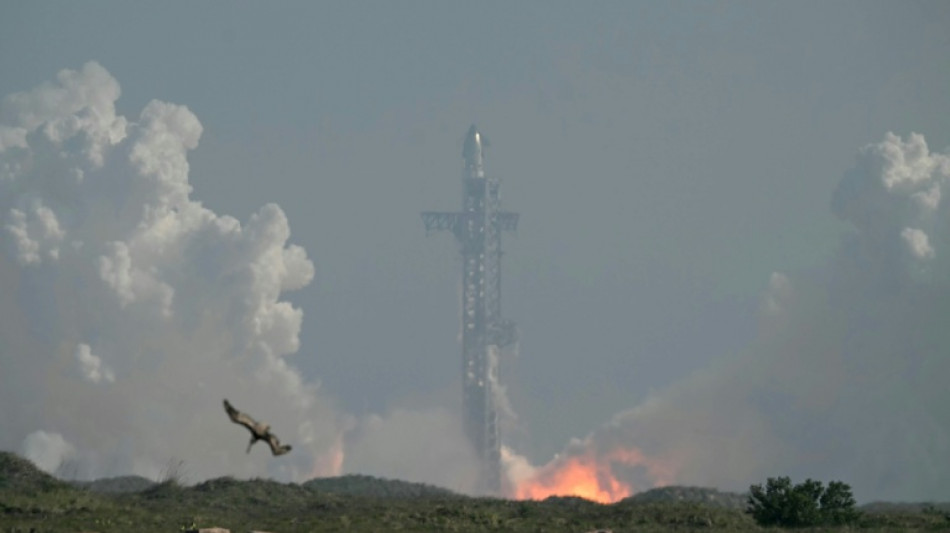
SpaceX's enormous Starship splashes down after test flight / Photo: © AFP
SpaceX's Starship spacecraft splashed down into the Indian ocean Friday after the company performed a test flight of the latest version of the enormous rocket.
The voyage was not without a few glitches, but SpaceX employees shown on a livestream roared in delight following the trial flight that comes as the firm prepares a potentially record initial public offering.
The mammoth rocket blasted off into space at just after 5:30 pm local time (2230 GMT).
The company did not intend to recover either the booster or the upper stage, and the final splashdown was fiery but controlled, as planned.
"Splashdown confirmed! Congratulations to the entire SpaceX team on the twelfth flight test of Starship!" the company wrote on X.
The third-generation Starship spacecraft carried out a maneuver that saw it flip upright and reignite its engines for control, despite one being out of commission.
It also deployed its 22 mock satellites, including two that attempted to photograph the spacecraft's heat shield for analysis.
The vehicle had coasted through space but was not in exactly the correct orbit after one of its engines malfunctioned during an initial burn.
"I wouldn't call it nominal orbital insertion," company spokesperson Dan Huot said, adding however that it was "within bounds" of a previously analyzed trajectory.
After the Super Heavy booster separated from the upper stage as expected, Huot said on the livestream that the booster failed to complete its so-called boost-back burn.
The booster fell swiftly back to Earth, uncontrolled, into the Gulf of Mexico. SpaceX wasn't planning to recapture the booster anyway, but was still hoping for a precision return.
- NASA administrator onsite -
Friday's flight followed an aborted trial one day prior.
The countdown clock stopped and started until it was determined that the last-minute red flags could not be addressed in time.
Musk quickly posted on X that "the hydraulic pin holding the tower arm in place did not retract." SpaceX said that issue was corrected overnight.
The company is facing extra scrutiny after SpaceX filed earlier this week with US financial regulators to go public, likely in June, in what is expected to become a record IPO.
Friday marks Starship's 12th flight overall, but the first in seven months.
The latest design is bigger than its predecessor, standing at just over 407 feet (124 meters) when fully stacked.
There's a lot riding on SpaceX's progress: the company is under contract with NASA to produce a modified version of Starship to serve as a lunar landing system.
The US space agency's Artemis program aims to return humans to the Moon, as China forges ahead with a rival effort that's targeting 2030 for its first crewed mission.
Ahead of launch, NASA Administrator Jared Isaacman appeared during the pre-launch SpaceX program and said "we're looking forward to seeing this fly, because hopefully at some point in the not-too-distant future we're going to join up in Earth orbit."
Both SpaceX and rival Blue Origin, the Jeff Bezos-owned firm also vying to develop a lunar lander, have realigned their strategies to prioritize projects related to Moon missions.
NASA is aiming to test an in-orbit rendezvous between its spacecraft and one or two lunar landers in 2027 and carry out a crewed lunar landing before the end of 2028.
But a lot needs to happen before then -- and industry experts have voiced repeated skepticism that SpaceX and Blue Origin can achieve benchmarks in time.
T.Bennett--TNT