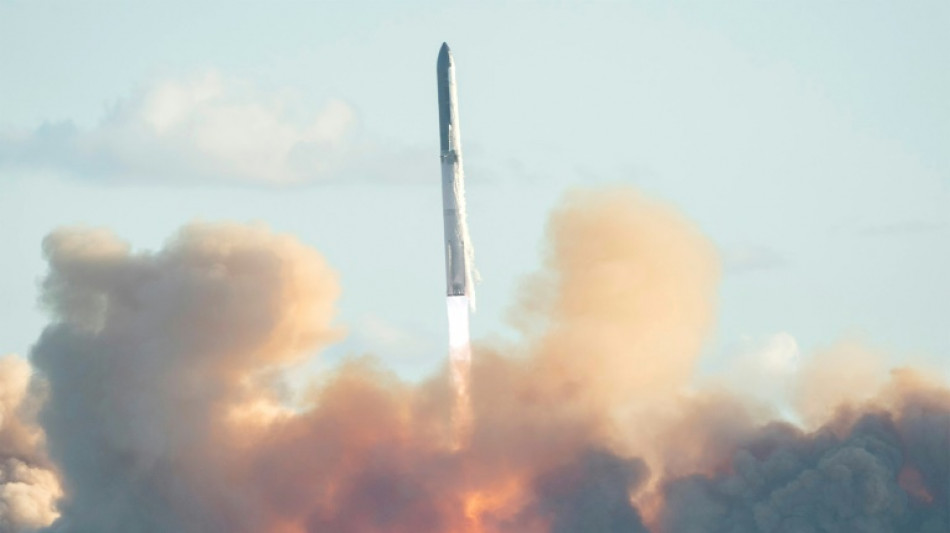
Upgraded SpaceX Starship set for test launch ahead of IPO / Photo: © AFP
Elon Musk's SpaceX is set for the debut launch of its latest Starship iteration on Thursday, testing the most powerful version yet of the megarocket as the company targets a blockbuster initial public offering.
The massive rocket is set to take off from its launchpad in southern Texas as early as 6:30 pm eastern (2230 GMT) amid high stakes for the space company.
The planned launch comes a day after SpaceX filed with US financial regulators to go public, likely in June, in what is expected to become a record IPO.
The filing provides potential investors with detailed financial information, risk factors and business strategy.
Thursday's launch will also provide a live-streamed look at SpaceX's progress in developing its enormous Starship rocket, a key component of its own ambitious plans as well as US space agency NASA's program to return to the Moon.
It will be the 12th Starship flight, but the first in seven months.
The latest design is bigger than its predecessor, standing at about 407 feet (124 meters) tall when fully stacked.
The company, which aims to make Starship a fully reusable system, says the primary goal of Thursday's mission is to demonstrate its redesigns in flight -- and will not attempt to return its booster to the launch site for a catch.
Instead, the so-called "Super Heavy" booster will splash into the water off the coast.
The upper stage is to deploy a payload of 20 mock satellites and two "specially modified Starlink satellites" outfitted with cameras, which will analyze the spacecraft's heat shield.
The test mission is meant to last approximately 65 minutes after liftoff, as the upper stage cruises on a suborbital trajectory and eventually splashes down in the Indian Ocean, if all goes to plan.
The most recent Starship missions have gone down as successful.
But previous tests have ended in spectacular explosions, including twice over the Caribbean and once after reaching space. Last June, the upper stage blew up in a ground test.
The new test is proceeding despite the recent death of a worker who reportedly fell from scaffolding at the Texas site.
- 'Huge' stakes -
The test flight comes at a clutch moment for SpaceX, both as Musk plans the buzzy IPO and NASA eagerly awaits development of a viable lunar lander.
SpaceX is under contract with NASA to produce a modified version of Starship to serve as a landing system.
The US space agency's Artemis program aims to return humans to the Moon as China forges ahead with a rival effort that's targeting 2030 for its first crewed mission.
And given private sector delays, anxiety is rising within President Donald Trump's administration that the US might not get there first.
The stakes of Thursday's launch are "huge," said physicist G. Scott Hubbard, a former director of NASA's Ames Research Center.
"There's a lot riding on this," the astronautics expert, who is now at Stanford University, told AFP.
"The government made the decision to go with these arms-length contracts for the human landing system, and now these people have to perform."
For Antoine Grenier, a partner and global head of space at the strategy consulting firm Analysys Mason, "if the launch goes without any issues, then it really paves the way for more space infrastructure and lunar contracts."
Both SpaceX -- and rival Blue Origin, the Jeff Bezos-owned firm also vying to develop a lunar lander -- have realigned their strategies to prioritize projects related to Moon missions.
NASA is aiming to test an in-orbit rendezvous between the spacecraft and one or two lunar landers in 2027, and carry out a crewed lunar landing before the end of 2028.
But a lot needs to happen before then -- and industry experts have voiced repeated skepticism that SpaceX and Blue Origin can achieve benchmarks in time.
A major hurdle is proving in-orbit refueling capabilities with super-cooled propellant -- an essential but untested step for carrying out deep-space missions.
"Let's hope they succeed," Hubbard said, "but it's a major engineering challenge."
NASA is scheduled to give an update on their lunar exploration plans Tuesday.
T.Bailey--TNT