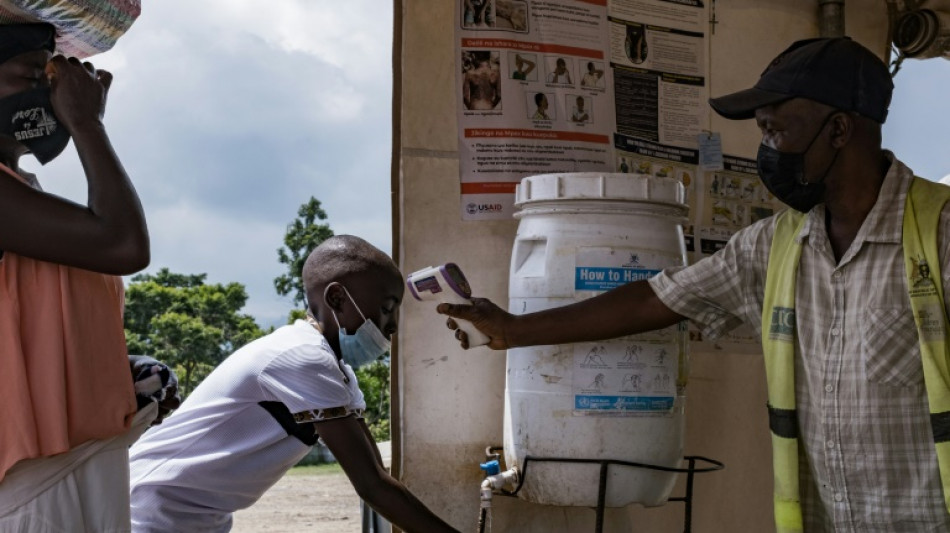
Race to find vaccines, treatments for Ebola strain behind outbreak / Photo: © AFP/File
An escalating outbreak of a rare Ebola strain in the Democratic Republic of Congo has kicked off a race to find vaccines and treatments that can be quickly tested and rolled out to save lives and stem the crisis.
More than l30 people have died so far during the outbreak, the World Health Organization said on Tuesday, as the United States warned its citizens not to travel to the affected region.
It is the 17th Ebola outbreak in DR Congo, but just the third caused by the Bundibugyo strain, for which there are no approved vaccines or treatments.
However scientists have developed numerous candidates for vaccines and treatments that have not yet been tested in humans.
The WHO has said it will examine the options, including a vaccine called Ervebo that targets the more common Zaire strain and has already been deployed in numerous countries.
Virologist Thomas Geisbert, who helped develop the Ervebo vaccine, has designed a similar, single-injection jab targeting the Bundibugyo strain that research on monkeys has found offers protection against the virus.
However trialling vaccines in humans and mass manufacturing doses is a lengthy and expensive process, Geisbert told AFP, comparing the market for a Bundibugyo jab to that of the Andes hantavirus strain that recently sparked global alarm.
"There hasn't been an incentive for big pharma to jump in, because it's not a money-maker," said the researcher at the University of Texas Medical Branch at Galveston.
Geisbert first published a study about his Bundibugyo vaccine candidate back in 2013, but it has since "just sat there", he said.
It was a similar story when he first published research in 2005 about what would eventually become the Ervebo vaccine.
It was only in 2014, during the biggest Ebola outbreak on record which killed 11,300 people in West Africa, when attention turned towards his vaccine.
It took US pharmaceutical company MSD around nine months to roll out the first doses of Ervebo, which research has found to be 84-percent protective against Zaire.
"I really hope that somebody jumps in now and does something like that" for Bundibugyo, Geisbert said, estimating that it could be done in as little as six or seven months.
A spokesperson for MSD -- known as Merck in North America -- told AFP that independent data on non-Zaire strains such as Bundibugyo is "limited, not from humans and not from evaluation of Ervebo".
- A new mRNA vaccine -
Just as the scale of the DRC outbreak was becoming clear on Monday, research about a newly developed vaccine candidate was published in the journal PNAS.
Chinese researchers used the mRNA technology made famous during the Covid pandemic for their vaccine targeting the three main Ebola strains, including Bundibugyo.
Virologist Connor Bamford of Queen's University Belfast welcomed the effort, but warned that such mRNA vaccines are expensive to make and need to be kept cold.
"This could limit its use in Africa," he told AFP.
Geisbert pointed out that the vaccine was only tested on mice -- and these results often do not translate to monkeys, let alone humans.
Scientists at Oxford University told AFP they were working with the world's largest vaccine maker, the Serum Institute of India, to get a viral vector vaccine called ChAdOx1 BDBV ready as soon as possible.
"We are working through the logistics at pace," but cannot give a precise timeline yet, Teresa Lambe, head of vaccine immunology at the Oxford Vaccine Group, told AFP.
- Treatments? -
A WHO-sponsored trial of two experimental Bundibugyo treatments could soon reportedly be launched in Ebola-hit areas.
"We're in a really strong position to quickly launch trials," University of Oxford researcher Amanda Rojek told Nature on Monday. "We're working day and night."
One of the treatments, an antiviral called remdesivir made by US pharma firm Gilead, has been tested on humans for the Zaire Ebola strain, but not for Bundibugyo.
However Geisbert said that during tests in his lab, remdesivir had "stronger in vitro data against Bundibugyo than it does for Zaire".
The other drug being considered for a trial is a monoclonal antibody called MBP134, developed by Mapp Biopharmaceutical, which targets Ebola viruses including Bundibugyo.
Geisbert, who has also tested this option, said the "fantastic" drug effectively protected monkeys even if they were already sick.
Any clinical trials would need to be approved by the governments of DR Congo and Uganda.
D.Cook--TNT