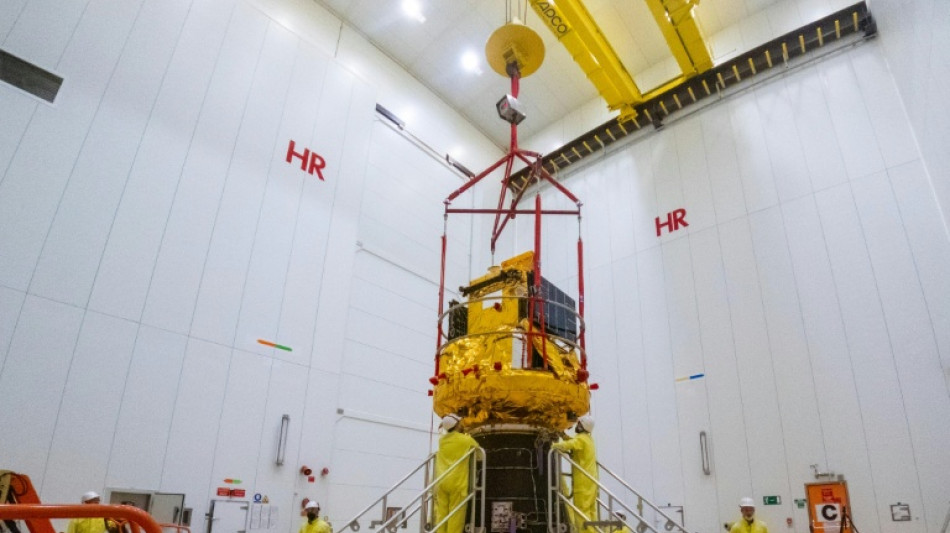
EU-China spacecraft takes off on mission to probe solar winds / Photo: © ESA/AFP
A joint European-Chinese spacecraft blasted off into orbit Tuesday to investigate what happens when extreme winds and giant explosions of plasma shot out from the Sun slam into Earth's magnetic shield.
Particularly fierce solar storms can knock out satellites, threaten astronauts -- and create dazzling auroras in the skies known as the northern or southern lights.
To find out more about this little-understood space weather, the van-sized SMILE spacecraft is tasked with making the first-ever X-ray observations of the Earth's magnetic field.
The spacecraft achieved lift-off on a Vega-C rocket at 0352 GMT on Tuesday from Europe's spaceport in Kourou, French Guiana, on the northeastern coast of South America.
Fifty-five minutes later, SMILE detached at 700 kilometres (435 miles) of altitude to make its own way onwards to an extremely elliptical orbit thousands of kilometres above the surface of our planet.
SMILE will be at an altitude of 5,000 kilometres when it flies over the South Pole, allowing it to transmit data to the Bernardo O'Higgins research station in Antarctica.
But the spacecraft will be 121,000 kilometres above the Earth when it swings over the North Pole -- an orbit which the European Space Agency (ESA) says will allow the mission to "observe the northern lights non-stop for 45 hours at a time for the first time ever".
SMILE -- or the Solar Wind Magnetosphere Ionosphere Link Explorer -- is a joint mission between the ESA and the Chinese Academy of Sciences.
- Dazzling auroras -
Solar wind is a stream of charged particles shot out from the Sun.
Sometimes this wind is kicked up into a huge storm by massive eruptions of plasma called coronal mass ejections. Hurtling at around two million kilometres an hour, these powerful blasts take a day or two to reach the Earth.
When they arrive, the Earth's magnetic field acts as a shield, deflecting most of the charged particles.
However, during particularly intense events, some particles can penetrate our atmosphere, where they have the potential to take out power grids or communication networks.
During the worst geomagnetic storm on record, in 1859, bright auroras were seen as far south as Panama -- and telegraph operators around the world were given electric shocks.
Solar winds can now also pose a danger to satellites orbiting the Earth, as well as astronauts sheltering inside space stations.
Given these threats, scientists want to learn more about space weather, so the world can better forecast and prepare for big blasts in the future.
To help with this endeavour, the SMILE mission plans to detect the X-rays emitted when charged particles from the Sun interact with the neutral particles of the Earth's upper atmosphere.
SMILE is expected to start collecting data just an hour after it is put into orbit.
The mission is designed to run for three years, but could be extended if all goes well.
Lift-off was originally planned for April 9, but was postponed due to a technical issue.
T.Bennett--TNT