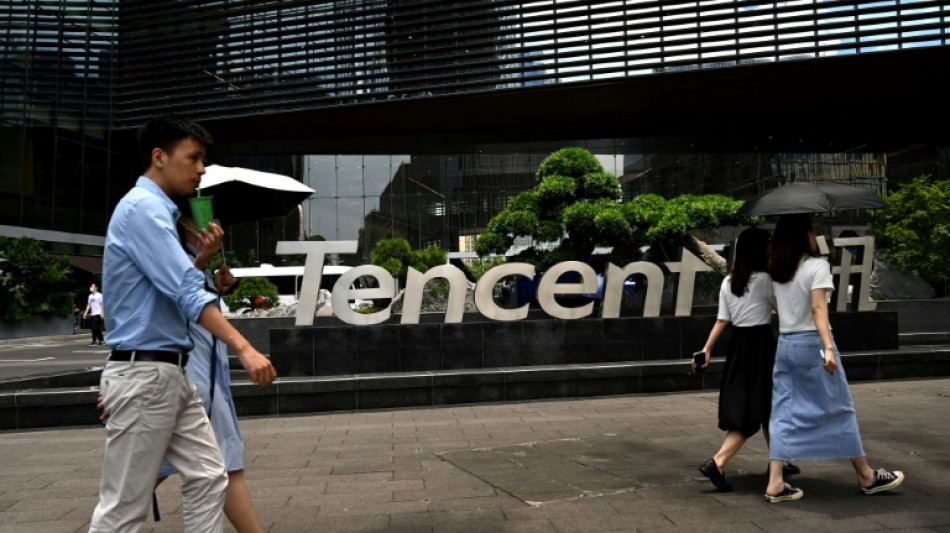
China tech giant Tencent sees Q1 profit jump after AI bets / Photo: © AFP/File
Chinese tech firm Tencent reported a 21 percent jump in quarterly net profit Wednesday as the video game giant bets big on the booming artificial intelligence sector.
The company, one of China's top AI players, hired a top former OpenAI researcher last year to head its AI venture, and in April unveiled a preview of a major upgrade to its flagship model.
It is competing with big rivals such as Alibaba and ByteDance, and startups including DeepSeek, in a field where Tencent has previously been seen as a cautious actor.
Tencent logged on Wednesday a net profit of 58.1 billion yuan ($8.6 billion) in the first quarter, up from 47.8 billion yuan in the same period last year.
The figure was slightly better than estimates of 57.8 billion yuan in a Bloomberg survey of economists.
"We started 2026 by making significant initial progress on our new AI products, as well as continuing to utilise AI to grow our existing core businesses," the company said in a filing with the Hong Kong stock exchange.
Shenzhen-based Tencent is the operator of China's multifunctional app WeChat and a major player in the global gaming industry.
The firm, which owns the developer of popular eSports titles including "League of Legends", has sizeable operations in other areas from cloud computing to entertainment.
It is reportedly also in discussions to invest in DeepSeek -- whose first external financing round could value it at up to $50 billion.
Chinese regulators gave conditional approval this week, following an antitrust review, for Tencent to acquire the huge online audio platform Ximalaya.
"Though Tencent remains well placed in AI, rising costs -- including agentic AI token expenses -- pose a margin headwind, despite price increases in its cloud computing division," Bloomberg Intelligence analysts said ahead of Wednesday's results.
Despite the double-digit growth, Tencent's quarterly earnings would be "impacted by rising AI investment costs and slower video-game sales, which were affected by the relatively late Lunar New Year holiday".
"We don't expect Tencent to generate significant external revenue from AI this year, though AI targeting should continue to benefit the advertising business," they wrote.
Revenue in the first three months of 2026 was 196 billion yuan, up 9.0 percent compared to the same period last year, Tencent said.
By contrast, the company saw double-digit year-on-year revenue growth in each quarter in 2025.
G.Waters--TNT