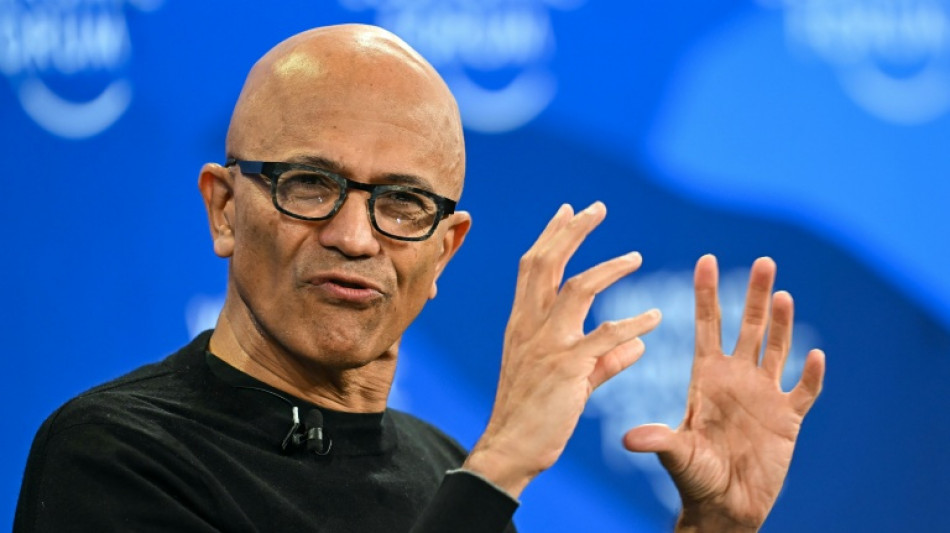
Microsoft boss to testify on his role in OpenAI's founding / Photo: © AFP/File
Microsoft CEO Satya Nadella is expected to take the stand Monday in Elon Musk's lawsuit against OpenAI, to explain emails that revealed how his company funded the ChatGPT creator's shift from philanthropic organization to for-profit AI giant.
Nadella's testimony will precede that of OpenAI boss Sam Altman, whose questioning -- likely on Tuesday or Wednesday -- will be one of the final stages in a closely watched trial before a federal jury in Oakland, California.
The trial has laid bare the internal strife within a circle of elite Silicon Valley engineers, investors and executives in the years leading up to the high-profile launch of the ChatGPT chatbot in 2022.
In his lawsuit, Musk accuses OpenAI of betraying its original nonprofit mission and misappropriating his founding donations totalling $38 million to build an empire valued at over $850 billion.
The Tesla and SpaceX founder is calling for OpenAI to revert to its original status as a nonprofit -- a move that would impact its position in the global artificial intelligence race against Anthropic, Google and China's Deepseek.
OpenAI counters that Musk left voluntarily after failing to seize majority control and has since become the company's direct competitor through his own AI venture, xAI.
An "advisory" jury is expected to reach a verdict on any actual wrongdoing by the week of May 18.
Judge Yvonne Gonzalez Rogers will then make the final ruling on both liability and remedies after hearing the jury's opinion. She has indicated she will likely follow their advice.
If Gonzalez Rogers ultimately sides with Musk, OpenAI's initial public offering could be jeopardized.
- Attracting investment -
On Monday, Musk's lawyers are expected to try to convince the jury that Microsoft, by investing in OpenAI in 2019, knew it was helping divert a nonprofit foundation from its original purpose.
He will rely on recently disclosed Microsoft emails from January 2018 to demonstrate that the tech giant only opened its checkbook once a profit appeared possible.
In the emails, Nadella consulted his executives about a discount granted to OpenAI to use the computing power of Azure, Microsoft's cloud-computing platform.
"Overall I can't tell what research they are doing and how if shared with us it could help us get ahead," Nadella wrote. "From what Elon is telling everyone... he feels Open AI is at verge of some big AGI (artificial general intelligence) breakthroughs."
Skepticism predominated at the time, with Microsoft Chief Technology Officer Kevin Scott fearing OpenAI might "storm off to Amazon in a huff."
In the months that followed, cash-strapped OpenAI established a for-profit subsidiary to attract investments, rather than relying solely on donations.
In 2019, a year and a half after turning its back on the startup, Microsoft finally invested $1 billion. It would ultimately inject $13 billion in total, a stake now valued at $228 billion -- 17 times the initial investment.
The trial has already heard gripping testimony.
Last week, co-founder Greg Brockman -- whose stake in OpenAI is valued at $30 billion -- came under fire about his 2017 diary entries including one in which he appeared keen on "making money for us."
Musk's lawyers seized on the entries to portray Brockman as a calculating opportunist.
Brockman also told lawyers that Musk physically threatened him in 2017 after Musk was refused absolute control of OpenAI.
Musk on Wednesday announced a major partnership with Anthropic, OpenAI's top rival, to allow it to use the compute capacity at SpaceX's largest data center.
R.Evans--TNT