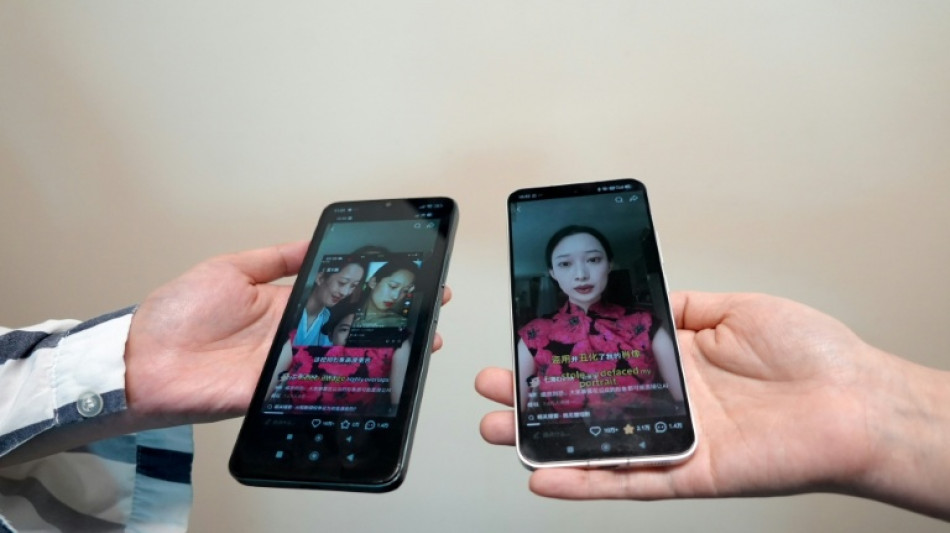
'Clearly me': AI drama accused of stealing faces / Photo: © AFP
Christine Li is a model and influencer, but not an actor, so when she saw herself playing a cruel character in a Chinese microdrama she felt bewildered, then angry and afraid.
The 26-year-old is one of two people who told AFP their likenesses were cast without consent in the AI-generated show "The Peach Blossom Hairpin", which ran on Hongguo, a major microdrama app owned by Tiktok parent company ByteDance.
Li plans to sue the drama makers and the platform, highlighting new legal and regulatory grey areas created by artificial intelligence.
"I was genuinely shocked. It was clearly me," said Li, who lives in Hangzhou in eastern China.
"It was so obvious that they used a specific set of photos I took two years ago" and had posted on social media, she said.
Microdramas are ultra-short, online soap operas hugely popular in China and elsewhere.
When Li's fans alerted her to the series, she was horrified to find her digital twin shown slapping women and mistreating animals.
"I also felt a deep fear. I kept wondering what kind of person would do something like this," Li said.
Hongguo hosts thousands of free, bite-sized shows -- both live-action and AI-generated -- whose episodes are two or three minutes long.
As of October, the platform had around 245 million monthly active users, according to data cited by Wenwen Han, president of the Short Drama Alliance.
A Hongguo statement in early April said it had taken the series down because the producers had violated platform rules and contractual obligations.
- 'Sleazy' antagonist -
AI's ability to mimic real people has sparked global concern for actors' jobs, and over such deepfakes being used for scams and propaganda.
Li and a man who says he was portrayed as her AI husband in the series, which became a hit last month on Hongguo, spoke out online about their separate unwelcome discoveries.
But even as their stories sparked a public outcry about AI ethics, AFP saw that "The Peach Blossom Hairpin" kept running for days before its removal, with the disputed characters quietly replaced.
The man, a stylist specialised in traditional Chinese clothing and make-up, had posted photos of himself in costume on the Instagram-like Xiaohongshu app.
Like Li, he was upset by the "ugly" portrayal of his likeness as a "sleazy" antagonist in the show.
"Will it have an impact on me, on my job, on my future work opportunities?" said the man, who asked to use the pseudonym Baicai.
To keep audiences hooked, microdramas are often full of shocking, larger-than-life moments.
Li and Baicai both showed AFP their original photos and the characters in "The Peach Blossom Hairpin", which bore a strong resemblance.
- Legal risk -
For low-budget AI microdramas, Chinese regulations say platforms must be the primary checkpoint for potentially dodgy content.
If they do not carry out mandatory content reviews, the videos will be forcibly taken down, according to the National Radio and Television Administration.
If the platforms were aware of any infringement but failed to act on it, parties affected can alert China's cyberspace authorities which can impose administrative penalties, according to Zhao Zhanling, a partner at Beijing Javy Law Firm.
Hongguo said in a second statement this month it would continue to strengthen how it reviews content and how it authorises creators, among other steps.
It said it had dealt with 670 AI microdramas that violated regulations, with most taken down, and warned it would crack down on repeated breaches.
When approached for comment, parent company Bytedance referred AFP to the two Hongguo statements.
Li and Baicai say they need more information from Hongguo to confirm the identity of the drama's creator -- with two companies potential candidates.
One is linked to a verified account on the Chinese version of TikTok that also published the series. Another is listed as the drama's producer on an official Chinese filing system.
AFP contacted both firms but received no response.
Using AI to slash costs may be tempting in the fast-growing, multi-billion-dollar microdrama market.
But featuring someone in a demeaning way without permission "may constitute an infringement of both portrait rights and reputation rights", said Li's lawyer Yijie Zhao, from Henan Huailv Law Firm.
- 'Associated with controversy' -
National regulations require microdrama makers to register to obtain a licence -- a step made mandatory for AI-generated animations from this month.
But producers could remain in the shadows by registering temporary outfits, Zhao said, while some allegedly use overseas servers to hide.
In 2024, a Beijing court ordered a company to apologise and pay compensation to a celebrity after its AI software enabled users to produce a virtual persona using his photos and name that could exchange intimate messages.
But lawyers told AFP that compensation for plaintiffs like Li likely won't amount to much due to the limited commercial value of an ordinary likeness.
Li worries that the saga may cost her opportunities in the modelling industry, as she is now "associated with controversy".
Baicai has not launched legal action, but hopes to see more measures from regulators and platforms to protect people like him.
"There are probably plenty of cases with unknown victims," he said.
A.Davey--TNT