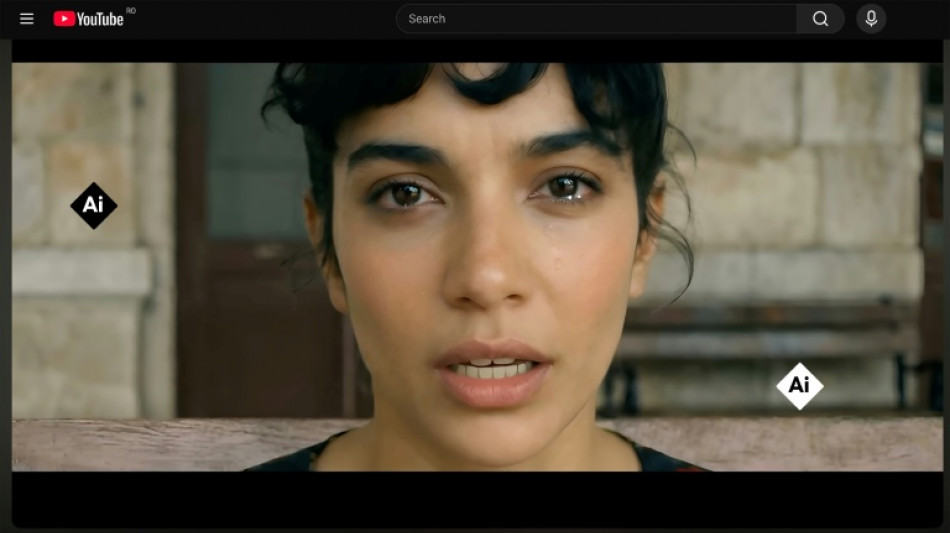
Romanian AI music sensation Lolita sparks racism debate / Photo: © AFP
The sultry songs of Lolita Cercel, an AI-generated singer, are a sensation in Romania, racking up millions of views online -- but angering real-life musicians and drawing criticism from the Roma minority as a racist cliche.
Since debuting late last year, "Lolita" has given TV interviews, landed representation by a top booking agency and had a cabinet member use the digitally generated singer's telegenic image to promote his ministry's projects.
But the videos' popularity has stirred debate in Romania about artificial intelligence replacing humans, and has raised questions about ethnic stereotypes in a country with a history of discriminating against the Roma.
Lolita is "a very sexualised" character, "a non-Roma man's fantasy of what a Roma woman might look like", Bogdan Burdusel, a 35-year-old Roma activist, told AFP, criticising "latent and unaddressed racism" in Romanian society.
Real-life Roma singer Bianca Mihai, a contestant on the Romanian version of reality TV show "The Voice" last year, called Lolita's overnight success "unfair".
"I'm trying to build a career right now, and I feel like there's no room for me," said Mihai, 25, who juggles a full-time job as an IT consultant with studio rehearsals and an acting gig.
In reality, Lolita is the work of a man who calls himself Tom, a 32-year-old visual designer who said he did not necessarily mean for his creation to have a Roma identity.
Tom, who spoke on condition of anonymity, said Lolita "doesn't necessarily belong to a specific culture".
"She reflects the reality of millions of people living in the Balkans. She embodies a Balkan identity more than a Romani one," he told AFP.
Tom, who has described his project as "a fusion of Balkan nostalgia and the synthetic future", said he chose folk music traditionally played by Roma for Lolita's songs because it "speaks the truth most bluntly" and represents "a kind of blues of our own".
- 'Didn't mean to offend' -
"I didn't mean to offend anyone," he said, seeming shy and uncomfortable with the media attention the project has generated.
Tom said he wrote the lyrics for Lolita's songs -- about love and everyday struggles" -- and used prompts to produce the music and videos with AI, not expecting it "to go so viral".
In public comments, he has praised AI for "democratising" musical creation.
AI-generated tracks regularly go viral, and global music industry body IFPI has called on the sector to ensure AI-generated content compensates musicians.
AI is "really good" at focusing in on people's music consumption, mimicking what the industry usually offers, said Grigore Burloiu, a lecturer in interactive technologies at the National University of Theatre and Film in Bucharest.
"No one woke up overnight and said: 'That's it, I like AI'... AI is all about finding the lowest common denominator," he told AFP.
- 'That hurts' -
In one of Tom's most-viewed songs, a teary-eyed Lolita, wearing a red flower dress and hoop earrings, stares into the camera on a train platform.
The avatar calls herself "a cast-out gypsy", asking her married lover if she's not worth a dime compared to his "proper fine lady" who has "furs and money".
"She's exactly the kind of girl we find very easy to accept and exoticise," said real-life singer Mihai.
In general, Lolita's lyrics are "the most cliched things", added Mihai, saying people tell her "all the time" she looks like the AI-generated singer.
"It's nice to borrow elements from Romani culture, but we don't necessarily like the Romani people. And that hurts," Mihai told AFP.
Enslaved from the 14th to the 19th century, Roma were legally treated as property in a swath of Europe spanning what is now Romania and Moldova.
Mihai herself only began to publicly identify as Roma when she was around 18 years old, after her parents -- fearing she would face discrimination -- encouraged her not to reveal it.
While participating in "The Voice", Mihai was the target of anti-Roma hate speech, even receiving death threats on social networks.
Meanwhile, praise abounds on Lolita's channels, with one user calling her Romania's Amy Winehouse.
"Now I understand why people fall in love with AI," wrote another.
Mihai is watching uneasily.
"Lolita released five songs in a month and got a ton of views," she said, calculating that it would take her months to do that.
"We can't really compare. It's very hard."
S.Arnold--TNT