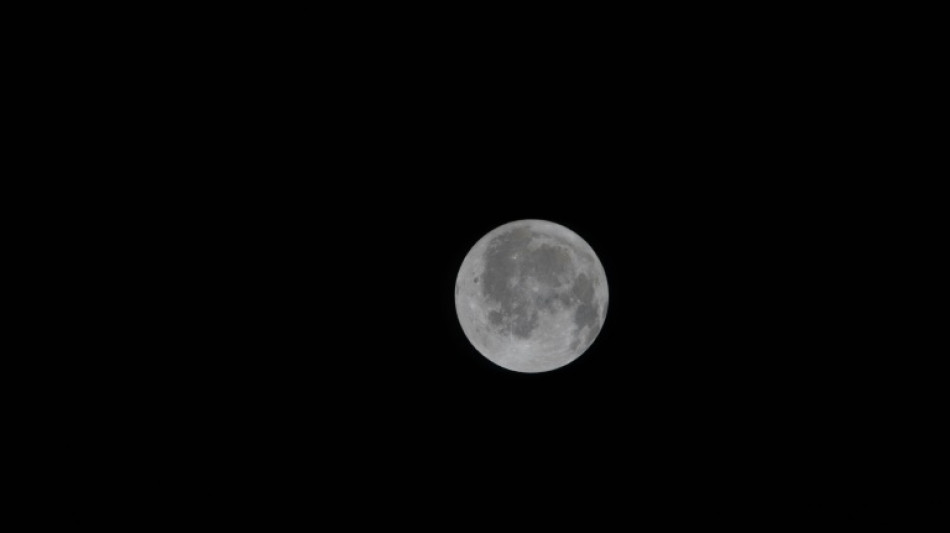
Artemis astronauts to study the Moon's surface using mainly their eyes / Photo: © NASA/AFP
More than 50 years after humans first flew around the Moon, Artemis astronauts will repeat the feat on Monday and use the most basic instrument to study it: their eyes.
Despite the technological advancements since the Apollo missions, NASA still relies on the eyesight of its astronauts to learn more about the Moon.
"The human eye is basically the best camera that could ever or will ever exist," Kelsey Young, the lead scientist for the Artemis 2 mission, told AFP.
"The number of receptors in the human eye far outweighs what a camera is able to do."
Although modern cameras may be superior to human eyesight in some respects, "the human eye is really good at color, and it's really good at context, and it's also really good at photometric observations," Young said.
Humans can understand how lighting changes surface details, like how angled lighting reveals texture but reduces visible color.
In just the blink of an eye, humans can detect a subtle color shift and understand how lighting changes the contours of a landscape like the Moon's surface, details which are scientifically useful but difficult to ascertain from photos or videos.
Artemis 2 astronaut Victor Glover, who pilots the Orion spacecraft, said before liftoff this week that eyes were a "magical instrument."
- Field scientists -
To ensure they made the most of their proximity to the Moon, the four Artemis 2 crew members underwent more than two years of training.
Young said the goal was to turn the astronauts into "field scientists" via a combination of classroom lessons, geological expeditions to Iceland and Canada, and multiple simulated flybys of the Moon, just like the mission they are on.
The three American astronauts -- commander Reid Wiseman, pilot Glover and mission specialist Christina Koch -- along with Canadian astronaut Jeremy Hansen, all had to memorize the Moon's "Big 15," or the 15 features of the Moon that will allow them to orient themselves.
Using an inflatable Moon globe, they practiced seeing how the angle of the sun changed the colors and textures of the lunar surface, honing their observation and note-taking skills for the big moment.
"I can tell you, they are excited and they are ready," Young said with a smile.
- 'About the size of a basketball' -
The Artemis astronauts' mission is to study certain lunar sites and phenomena as part of 10 objectives chosen by NASA and ranked in priority order based on scientific interest.
During the Moon flyby, which will last for several hours, the crew will have to observe the celestial body with their naked eyes, along with cameras they have on board.
Noah Petro, head of NASA's planetary geology lab, told AFP that the Moon will look to the astronauts "about the size of a basketball held at arm's length."
"The question I'm most interested in is, are they going to be able to see color on the lunar surface," Petro said.
"I don't mean rainbow colors, but you know, dark browns or tan colors because that tells us something about the composition, and that tells us something about the history of the Moon."
David Kring of the Lunar and Planetary Institute told AFP he is not expecting any earth-shattering discoveries because of the multiple lunar probes and high-resolution images of the Moon taken since the Apollo missions.
Nevertheless, "having astronauts describing what they're seeing... That is an occurrence that at least two generations of people on Earth have never heard before," he said.
The Artemis 2 flyby will be broadcast live by NASA, save for a period for when the spacecraft is behind the moon.
"Just listening to their practice descriptions in the mission simulations... It brings chills up my arms," Young said.
"I am absolutely confident that these four people are going to deliver some incredible descriptions."
O.Nicholson--TNT