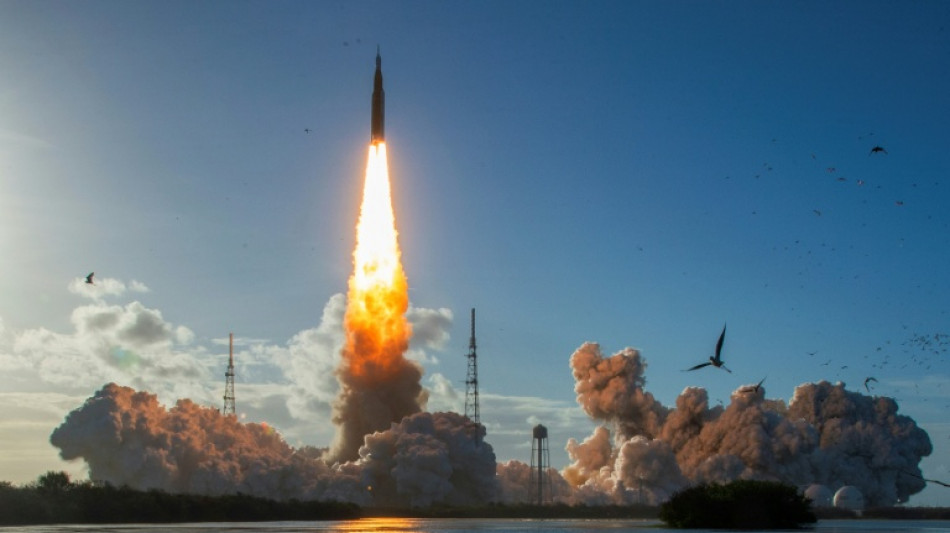
With mighty thrust, Artemis astronauts blast towards Moon / Photo: © AFP
The four Artemis astronauts fired up their spacecraft's engine to break away from Earth's orbit and zoomed towards the Moon Thursday, a milestone that commits NASA to the first crewed lunar flyby in more than half-a-century.
With enough thrust to accelerate a stationary car to highway driving speed in less than three seconds, the Orion capsule engine blasted the astronauts on their trajectory towards the Moon, which they now will loop as part of the 10-day Artemis 2 mission.
The burn lasting just under six minutes propelled the astronauts on their three-day voyage towards Earth's natural satellite, the first since 1972.
"Looks like a good burn, we're confirming," mission control in Houston said.
"The crew is feeling pretty good up here on our way to the Moon," said astronaut Jeremy Hansen.
"Humanity has once again shown what we are capable of."
The burn came one day after the enormous orange-and-white Space Launch System (SLS) rocket carrying the Orion capsule blasted off flawlessly from Kennedy Space Center in Florida for the long-anticipated journey around the Moon.
Now that they're moonbound, there's no turning back: the astronauts are on a "free-return" trajectory, which uses the Moon's gravity to slingshot around it before heading back towards Earth without propulsion.
In the event that something goes wrong, the astronauts are wearing suits that also serve as "survival systems" -- in the unlikely case of a cabin depressurization or leak, they'll maintain oxygen, temperature controls and the correct pressure for up to six days.
The astronauts -- Americans Reid Wiseman, Victor Glover and Christina Koch and Canadian Hansen -- spent their first hours in space performing checks and troubleshooting minor problems on the spacecraft that has never carried humans before, including a communications issue and a malfunctioning toilet.
They began the second day of their mission by playing "Green Light" by John Legend and Andre 3000, NASA said -- a reference to the go signal they would soon get to fire up the engine and get moving towards the Moon.
They also had their first workouts of the mission on the spacecraft's "flywheel exercise device" -- each astronaut will carve out 30 minutes a day for fitness, a bid to minimize the muscle and bone loss that happens without gravity.
- Historic journey -
The 10-day Artemis 2 mission is aimed at paving the way for a Moon landing in 2028.
The mission marks a series of historic accomplishments: sending the first person of color, the first woman and the first non-American on a lunar mission.
If all proceeds smoothly, the astronauts will set a record by venturing farther from Earth than any human before -- more than 250,000 miles.
It is also the inaugural crewed flight of SLS, NASA's new lunar rocket.
SLS is designed to allow the United States to repeatedly return to the Moon with the goal of establishing a permanent base that will offer a platform for further exploration.
It was meant to take off as early as February after years of delays and massive cost overruns.
But repeated setbacks stalled it and even necessitated rolling the rocket back to its hangar for repairs.
- Compete with China -
During a post-launch briefing, Isaacman said competition was "a great way to mobilize the resources of a nation."
"Competition can be a good thing," he said. "And we certainly have competition now."
The Artemis program has come under pressure from Trump, who has pushed its pace with the hope that boots will hit the lunar surface before his second term ends in early 2029.
But the projected date of 2028 for a landing has raised eyebrows among some experts, in part because Washington is relying heavily on the private sector's technological headway.
F.Hughes--TNT