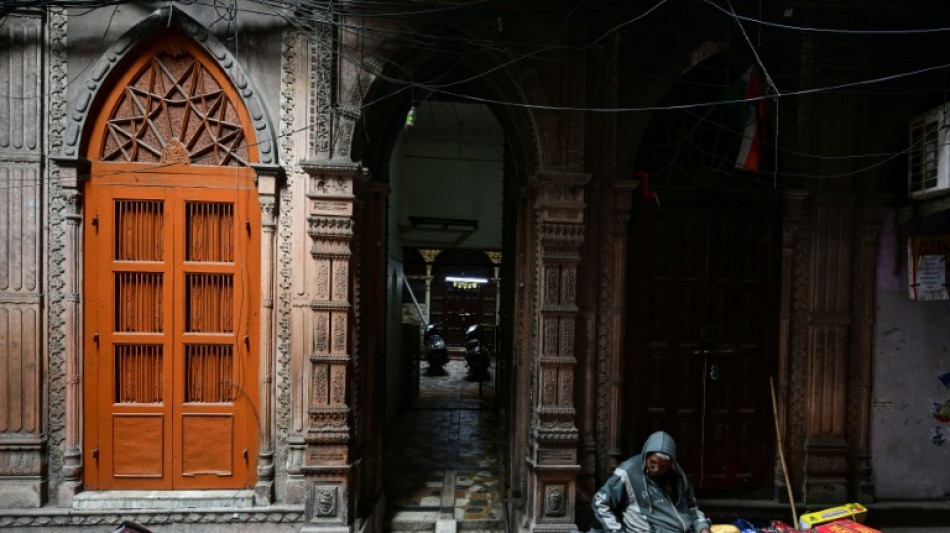
India's historic haveli homes caught between revival and ruin / Photo: © AFP
Once the grand residences of Mughal-era nobility, the Indian capital's haveli homes now stand at a fragile crossroads -- a handful lovingly restored but many more sliding quietly into ruin.
Across Old Delhi -- the 17th‑century walled city founded as the Mughal capital Shahjahanabad -- cracked facades, shuttered gateways and sagging balconies tell the story of a heritage under siege from neglect, inheritance battles and relentless urban pressure.
Only a few restored pockets provide a glimpse of what once was -- airy courtyards, carved sandstone pillars and homes built around a deeply social way of life.
Inside one restored mansion that now houses a cultural centre, sunlight filters through stained glass onto carved sandstone arches, the air infused with freshly polished wood and rosewater.
Musicians tune their instruments in a frescoed courtyard, where nobles may once have entertained guests, offering a rare peek into Old Delhi's rich architectural past.
But outside in the narrow lanes of Old Delhi's Chandni Chowk district, the contrast is stark.
Many havelis are abandoned or on the verge of collapsing, their carved facades fading beneath peeling paint.
The contrast reflects two futures -- one of careful restoration and the other of gradual decay.
- 'Who will pay?' -
The Kathika Cultural Centre's founder Atul Khanna said his initiative hoped to create an immersive cultural space inside a restored structure.
But he admitted that conservation in Old Delhi remains a huge challenge.
Many havelis are split among multiple heirs, with no single stakeholder willing or able to invest in costly upkeep.
"When there are multiple ownerships, that becomes a challenge," he said.
"If the haveli is decaying, who is going to spend the money?"
Khanna also blamed bureaucratic hurdles for discouraging restoration.
"There should be some kind of a single window for anyone who is working with heritage," he said, arguing that easing red tape would be more effective than offering subsidies for restoration.
Another prominent restoration is the 18th century Haveli Dharampura, now converted into a heritage hotel.
"Restoration in Old Delhi is still isolated unless there is sustained support and awareness," said Vidyun Goel, whose family owns the property.
Residents say family disputes and the push to convert properties into shops or apartments have led to rapid decline.
In nearby Roshanpura, only a scattering of old homes still stand. Among them, the century-old Mathur ki Haveli is a rare example of a lived-in heritage home.
- Showpiece projects -
"We are in love with this house," said Ashok Mathur, a fourth‑generation resident who continues to live in the ancestral property despite mounting challenges.
Wooden ceilings are deteriorating, floors are wearing thin and doors require constant repair, he said, walking through rooms that bear only traces of intricate craftsmanship.
Still, he said he has never considered leaving -- although he can only imagine the social world that once defined haveli life.
"There is no community left," Mathur, 56, said. "We are living in a cocoon."
Conservationist K. T. Ravindran said that while Old Delhi is economically vibrant, its havelis suffer from unclear titles and multiple claimants.
"Often buildings that look intact from outside conceal deeper damage," he said, noting that the condition was worse in the inner lanes hidden from public view.
Ravindran said revival was still possible, but only through neighbourhood‑level regeneration rather than isolated showpiece projects.
Oral historian Sohail Hashmi said each haveli once formed part of "a larger social ecosystem of neighbourhoods, crafts and traditions", with architecture and community deeply intertwined.
As Khanna put it, the loss goes beyond architecture.
"When you lose a haveli, you are not only losing the structure," he said.
"Every element in it is a piece of art."
B.Scott--TNT