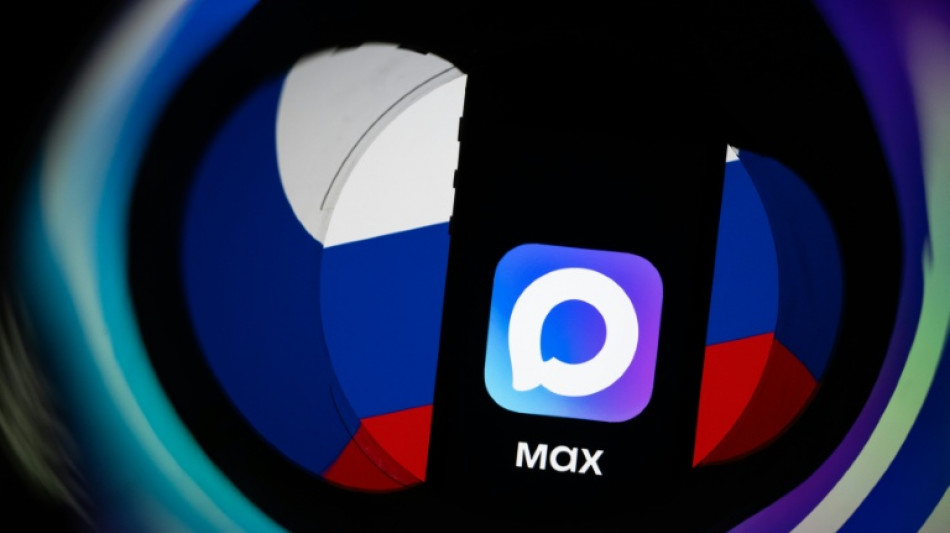
Russia's Max: The unencrypted super-app being forced on citizens / Photo: © AFP
Russia is pushing its Max messenger -- a social media platform without encryption -- onto its citizens with a massive promotion campaign and the simultaneous blocking of Whatsapp and Telegram, the country's two most popular messenger apps.
The rollout has raised concerns among critics and digital rights groups that Moscow will use Max to surveil its citizens and further cut digital links to the West.
"Any data that passes through this application can be considered to be in the hands of its owner, and in this case, the hands of the Russian state," cybersecurity researcher Baptiste Robert, CEO of the French company Predicta Lab, told AFP.
Launched in 2025 by Russian social media giant VK, the app has been compared to China's WeChat, combining social media and messaging functions with access to government services, a digital ID card system, banking and payments.
It is not officially mandatory, but the authorities are making it clear that life without Max will become increasingly hard.
President Vladimir Putin has touted it as a more "secure" platform that meets Russia's demand for "technological sovereignty."
Moscow has been pushing that agenda for years.
"This is the culmination of policies aimed at creating a sovereign internet," Marielle Wijermars, an associate professor of internet governance at Maastricht University told AFP.
"Russia wants to restructure the internet to better control what is published" including "by migrating all Russians to platforms that are more state-controlled," she added.
- 'Forced' to download -
Max has been pre-installed on phones and tablets sold in Russia since September.
The design is familiar and resembles Telegram, offering private messages, public channels and cute stickers.
Unlike Telegram and Whatsapp, it is also on Russia's "white list" of approved digital services that stay online during the increasingly common forced internet blackouts that Moscow says are necessary to thwart Ukrainian retaliatory drone attacks.
Initially only available to users with a Russian or Belarusian SIM card, the app is now available in English and to those with phone numbers from 40 other countries -- only those Russia deems "friendly," like Cuba, Pakistan and ex-Soviet republics in Central Asia.
It is not available in the European Union -- or Ukraine.
That has not stopped Ukrainian President Volodymyr Zelensky vowing to infiltrate the messenger.
One of the reasons Russia wants to ditch Telegram is because it has become a platform used by Ukraine to recruit Russians for sabotage attacks, including assassinations.
Inside Russia, opinions are split.
"You can send messages, photos and videos. What more do you need?" said Yekaterina, a 35-year-old dance teacher.
Irina, a 45-year-old doctor, however, complained she has been "forced" to use Max for school activities for her children and to access the government's official online portal, Gosuslugi, where her patients make appointments.
She plans to "buy another SIM card to download Max on another phone."
Large businesses have been accused of forcing employees to download the app and schools have migrated all communication with parents to the platform.
At the same time, celebrities and popular bloggers are moving their content to Max.
Dmitry Zakharchenko, founder of the Russian analytics agency GRFN, has compared the "aggressive" campaign with Soviet propaganda billboards.
The carrot-and-stick approach has driven downloads -- more than 100 million users in March, according to the service.
- 'Being watched' -
The launch of Max comes years into Russia's political and technological campaign to develop a "sovereign internet", less reliant on -- and vulnerable to -- foreign services.
Russian telecoms regulator Roskomnadzor and the security services have enjoyed growing powers to monitor and block sites they deem dangerous.
Unlike Telegram and Whatsapp, Max does not use end-to-end encryption and its terms of use state that user data is stored exclusively on services in Russia.
Varvara, a 35-year-old interpreter said she was not worried about that as she was not a "foreign agent" and had nothing to hide -- referring to a label used by the Kremlin to target critics.
Even so, she has ditched Max in favour of IMO, a less popular US-made app that has encryption.
Scientist Alexandra, 32, refuses to download Max "out of contrariness" to its heavy-handed promotion.
"We're already being watched everywhere," she added, dismissing the privacy concerns.
But another resistant user -- Natasha, 48 -- shows the general feeling of resignation when it comes to the future of the app in Russia.
"Sooner or later, there will be no alternative."
T.Ward--TNT