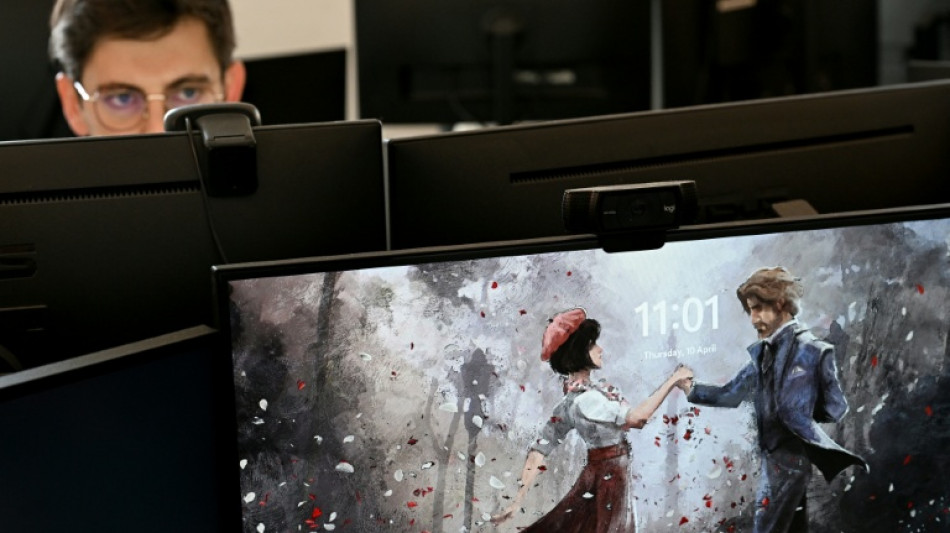
3D tool Unreal Engine makes real impact in creative industries / Photo: © AFP/File
Massively popular video game "Fortnite", TV news graphics and acclaimed animated series and films have something in common: use of the powerful Unreal Engine that is quickly becoming the go-to tool for 3D projects beyond the video games industry.
Created for the 1998 game "Unreal" by Tim Sweeney -- who is now the head of "Fortnite" developer Epic Games -- the engine was soon made available for other companies.
It was a rare move in an industry where most studios develop their own engines, an expansive term for the software controlling the main characteristics of a game world such as sound, graphics and physics simulation.
In recent years, the ease of use and power of the latest version of Unreal Engine has seen it integrated into hit games titles such as China's "Black Myth: Wukong" or France's "Clair Obscur: Expedition 33".
"Tomb Raider" star Lara Croft will be crafted in Unreal Engine in her upcoming fresh adventures too, said Scot Amos, director of the Crystal Dynamics studio.
Using Unreal "gives us access to a broad swath" of developers, he said, calling it "an ubiquitous tool that so many people will use and get".
The off-the-shelf solution saves on time and costs as "we don't have to keep teaching people how to use a proprietary tech" developed in-house, Amos added.
More than one quarter (28 percent) of games released for PCs in 2024 were built using Unreal Engine, according to specialist data firm Sensor Tower.
"It's become truly indispensable in the industry," said Brice Roy, director of France's Institute for Digital Creation and Animation (ICAN), a training school with sites in several cities.
"The engine is preconfigured, which is what makes it so attractive: as soon as you create a rough build, it looks really beautiful, it works right away".
- 'Planned to diversify' -
Epic Games' ambition for Unreal Engine is not limited to underpinning large swaths of the game industry.
A first technical demonstration of its real-time modelling power for high-end carmaker McLaren drew attention from other sectors too.
Unreal has since been applied to modelling architectural projects, onboard navigation for cars and reconstructions in television news reports.
Film and TV have not hesitated either, with Epic Games' tech deployed in Star Wars series "The Mandalorian" and Oscar-winning short film "War is Over".
"We planned to diversify this way," said Sebastien Miglio, Epic's vice-president for Unreal Engine product development.
The developer has been gradually adding "the missing functionality to integrate (Unreal Engine) into production pipelines" across different industries.
Around 600 people work full-time at Epic on the game engine, which boasts a monthly user count of more than one million.
That makes Unreal Engine a "significant" part of Epic's business, Miglio said.
Some of the software's success can be traced to its unique business model, under which Epic offers game developers the software for free and takes a five-percent cut only if their work tops $1.0 million in revenue.
In other sectors, access costs around $1,800 per user for companies making more than a million in annual revenue.
- 'Standardisation' -
Generous access policies have made Unreal Engine a boon to online content creators.
"We see it kind of as a free tool" that "meets the need to illustrate our videos," said Sylvain Szewczyk, who uses Unreal to create interview backgrounds and illustrations for tech-focused stories broadcast to his 540,000 YouTube subscribers.
But the tool's dominance as the first choice for creators could lead to excessive "standardisation" of 3D content, ICAN's Roy warned.
"Games developed with Unreal often have a graphical footprint that's easy to spot," he said.
Epic still has big plans for Unreal Engine, aiming to adapt it for mobile games and add to its capabilities.
"Today we can make multiplayer games on maps of around eight square kilometres (three square miles) with 100 players," Epic's Miglio said.
"What we're looking at today is how to put up to 100,000 players on maps of 100, 200 or 300 square kilometres."
The tool has not escaped the 2020s AI fever, with the developer also planning to integrate a generative tool for 3D objects or for automatically carrying out certain tasks.
E.Cox--TNT